


 Shkruar nga Fadil Lepaja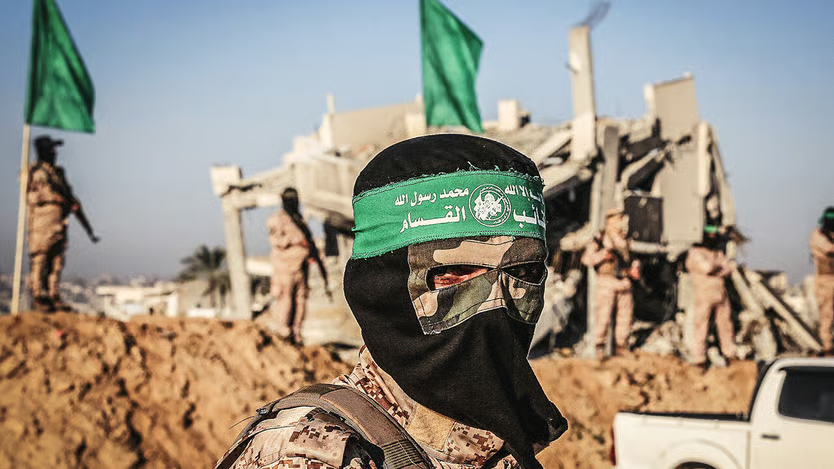
Gaza as the second test of civilization and Arab silence as a strategic choice
If there is an analytical approach that is not simply wrong, but dangerous for the very concept of freedom, it is the comparison that some Islamic circles among Albanians have made between Gaza and Kosovo, equating Hamas with its Liberation Army, even though the former fights in the name of God while the KLA fought in the name of the citizens.
This comparison is neither historically, politically, nor morally valid. It is not an innocent misunderstanding, it is a distortion that obscures the distinction between a liberation movement that sought democratic order and an ideological organization that imposes authoritarian order.
The KLA was not Hamas. Kosovo was not Gaza. And this difference is not semantic; it is substantial.
The KLA: a movement for democratic order, not ideological power
The Kosovo Liberation Army was not an ideological army. It did not seek to build a theocratic order, nor to export a religious or nationalist ideology. It was a reaction to a brutal occupation, with a clear goal: the liberation of territory and the construction of democratic institutions. In this sense, the KLA was part of a political project aimed at integration into the Western order, not its overthrow.
Hamas, by contrast, is an ideological project rooted in a theocratic order that challenges the very foundations of the secular state. It seeks not only territorial liberation, but the transformation of the social and political order in accordance with a narrow religious vision. Therefore, the comparison with the KLA is not only inaccurate, but also insulting to the very history of Kosovo.
Hamas and Serbian clerical nationalism: two sides of the same coin
If we want to make precise comparisons, Hamas' policy of liberating the "holy places" coincides more with the policy of Serbian clerical nationalism, which aimed to restore Serbian dominance over territories it considered part of its historical and religious heritage. Hamas seeks the destruction of Israel at all costs, while the KLA did not seek the destruction of Serbia, but only its removal from a territory it had occupied in the Middle Ages and again in the 20th century.
In this light, the policy of the state of Kosovo for building democratic institutions and for integration into the international order coincides more with that of Israel, which had liberated Jerusalem from Islamic occupation and had built a secular state, with functional institutions and political pluralism.
The Liberation of Gaza: From Tanks to Institutions
Only now, with the agreement brokered by President Trump, is Gaza entering a phase that can be compared to Kosovo after 1999. This agreement is not simply a ceasefire, but a project for the double liberation of Gaza: from Israeli military occupation and from Hamas’ ideological capture. The massive return of citizens to their ruined homes is more than a humanitarian act, it is a restoration of civic sovereignty.
International forces, the disarmament of local forces, and US guarantees are the elements that make this process similar to that of Kosovo. But the similarity is not in the past; it is in the future that is being built: an order where citizens, through free voting, build secular institutions and implement a political autonomy liberated from both occupiers.
The economy as the foundation of the new order
In this context, foreign investments - American, Western, Arab and Turkish - are not just economic aid. They are instruments of modernization. They create jobs, build infrastructure, and most importantly: they offer alternatives to dependence on the state budget or ideological structures. This is the most sustainable way to liberate the citizen: by giving him a real opportunity to live with dignity.
Turkey and the United States, with their different but complementary experiences, can play a key role in this transformation. They can help build an order in which the Palestinian citizen sees its own interest in supporting secular institutions because they offer them security, jobs, and prospects.
Gaza as the second test of civilization and Arab silence as a strategic choice
Only in this way can the Arab silence in the face of the Israeli occupation be understood: not as approval, but as rejection of the most dangerous alternative, the export of the Islamic revolution to the region, the appropriation of “holy places” and the construction of all social life around a theocratic model. Silence is not surrender, but calculation: a choice to preserve the secular order, to protect the regional balance and to prevent Gaza from becoming a springboard for an order that threatens the very foundations of the modern state.
In this light, cooperation between the US, Turkey and Egypt is not just diplomacy — it is political architecture. It can bring economic and political freedom, and mobilize the civic will to build secular, effective institutions and a model democracy. Gaza is not like Kosovo, but it can be, if liberation does not stop with tanks, but continues with ideas, with the economy and with the vote. And only then, the history of Gaza will be written not as a repetition of pain, but as a new beginning of freedom. / Pamphlet








Lini një Përgjigje