


 Shkruar nga Gjergj Zefi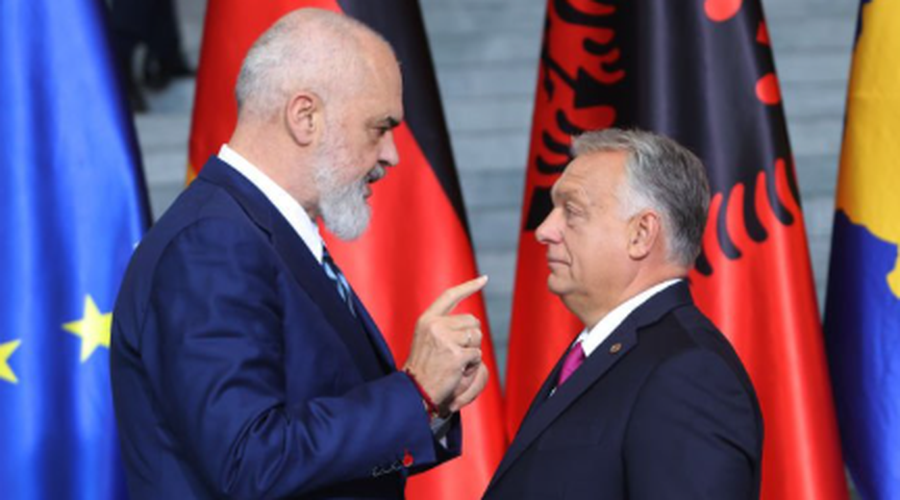
From Victor Orban to Edi Rama: Is the 'distorted democracy' model spreading in Southeast Europe?
Europe is facing a phenomenon that is no longer an ideological periphery, but a center of debate: the political model built by Viktor Orban in Hungary. A model that he himself has called "illiberal democracy"; a formula that, in essence, preserves elections as a mechanism of legitimacy, but weakens institutional balances, media independence and control over power.
Recent editorials in prestigious European media speak of a deformation of democracy, a gradual distortion of the European liberal model that is replacing institutional balance with concentrated power. The term is not an exaggeration. When the executive branch consolidates control over the judiciary, when public media becomes the voice of the government, and when national rhetoric becomes an instrument to delegitimize the opponent, we are dealing with a gradual deformation of the European liberal model.
Orban is no longer a folkloric exception on the EU scene. He has become a reference for a section of the continental right that sees sovereignism, immigration restrictions, and centralization of decision-making as an alternative to traditional liberalism.
His ambivalent stance towards Russia and skepticism about sanctions against Moscow following its aggression in Ukraine have often put Budapest at odds with Brussels. But they have also raised his profile as a figure "against the grain."
The essential question is not whether Orbán is right or wrong on some specific policies.
The question is: what happens to democracy when the “strong leader” model becomes a regional aspiration?
When is institutional control seen as an obstacle rather than a guarantee?
If the model built by Viktor Orban in Hungary represents a deformation of liberal democracy within the European Union, the question that arises for our region is more sensitive: are similar elements emerging in aspiring countries? Repeated criticisms by the media and international organizations have pointed out that Edi Rama’s government is characterized by a strong concentration of decision-making in the executive, dominance of the public narrative and ongoing tensions with independent institutions. Although Albania remains formally committed to the Euro-Atlantic course, the perception of expanded political control over the administration and the media fuels the debate about whether Tirana is borrowing elements of the “leader-centered” model that Orban has institutionalized in Budapest. The essential difference lies in the fact that Hungary is within the EU and challenges from within, while Albania is still in the process of integration; but in both cases, the dilemma is the same: is the state strengthened by weakening the balances, or is democracy weakened in the name of stability?
In this climate, the debate over “illiberal democracy” is not philosophical. It is geopolitical. A politically and ideologically fragmented European Union is less able to cope with pressures from the East, energy challenges, or global competition. And when unity is replaced by internal vetoes, common foreign policy is weakened.
Orbanism is a symptom of a broader crisis: fatigue with traditional elites, fear of globalization, economic insecurity. But the solution cannot be to reduce freedom in the name of order. European history has shown that when democracy begins to “twist,” it rarely returns intact.
For Albania, the Euro-Atlantic orientation remains a strategic compass. But EU integration should not be seen only as an economic project. It is above all an institutional project. If Europe changes its nature, our European project will also take on a different shape.
In the end, the battle is not between left and right. It is between liberal democracy with checks and balances, and a model where the majority turns into almost unlimited power. And this is a dilemma that will define the next European decade./ Pamphlet


Lini një Përgjigje