


 Shkruar nga Diplomatico | Pamfleti.net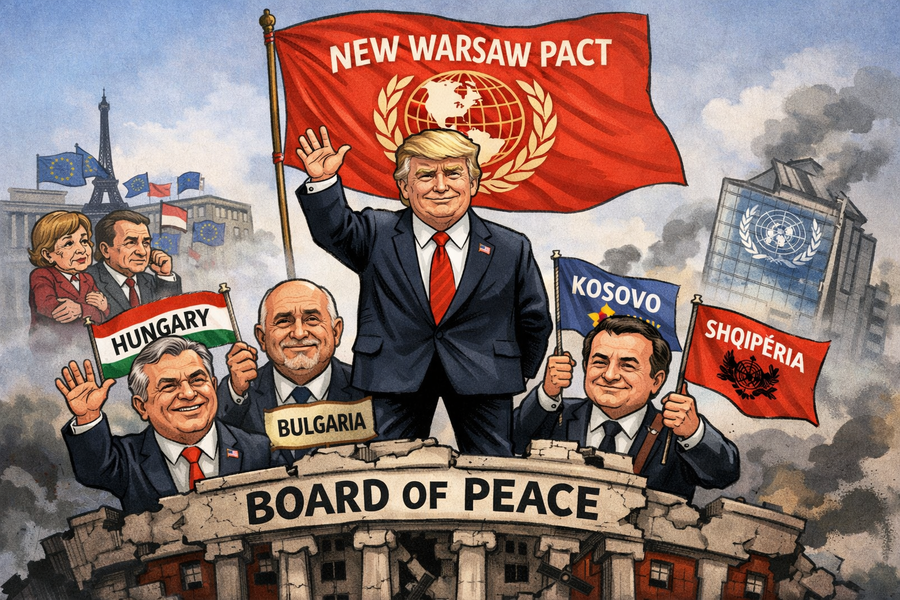
With only two EU countries on board; Bulgaria and Hungary, and with the presence of Albania and Kosovo, Donald Trump's initiative resembles more an alternative geopolitical architecture than a universal peace mechanism...
In diplomacy, absences speak louder than declarations. And in the case of the “Board of Peace,” the absence of Western Europe is the clearest political message.
The initiative led by Donald Trump is presented as a global platform for peace and reconstruction. But its real composition shows a different map: only two European Union countries have chosen to be included: Bulgaria and Hungary. Two countries with a strong history in the former communist bloc and with approaches that often diverge from the official line from Brussels.
This is not a coincidence. It is a signal.
A "global" board without Europe?
France, Germany, Italy, Spain; the traditional engines of European politics, are absent. This shifts the geopolitical balance of power towards the East and the Global South. Instead of a classic transatlantic structure, we have a configuration closer to an alternative forum, where the institutional West remains outside.
This raises a fundamental question:
Are we dealing with a peace mechanism or a rival instrument to the existing multilateral architecture?
Albania and Kosovo: pragmatism or dangerous positioning?
In this context, the inclusion of Albania and Kosovo takes on special importance.
Both countries have built their strategic identity on a Euro-Atlantic orientation. Support for American initiatives is not new. But the difference here is that this initiative is not supported by the collective structure of the EU.
Therefore, a dilemma arises:
- Are Tirana and Pristina aligning themselves with a personal political project?
- Or are they trying to secure a direct channel of influence in a new architecture that could gain weight if Trump reconsolidates American global power?
Two realities within the EU
The presence of Bulgaria and Hungary is not just a statistic. It signals an internal rift in the European Union itself. Hungary, long at odds with Brussels over issues of rule of law and strategic orientation, sees this board as a space for maneuver outside the control of traditional structures.
Bulgaria, more pragmatic, seems to want to remain outside any new configuration of American influence.
But the fact remains: Greater Europe is missing.
Peace Board or new influence architecture?
The board's pyramidal structure and Trump's dominant role create the perception of a forum that is more political than institutional. If the UN operates on the principle of multiple checks and balances, this board is seen as a mechanism with a single center of gravity.
This makes it more flexible, but also more controversial.
In geopolitical terms, we have three possible readings:
1. Instrument of pressure on the UN and the EU; a way to create a parallel structure.
2. Platform for countries that feel under-represented in the current order.
3. Tool for personal political consolidation on the international stage.
A strong signal for the Balkans
For Albania and Kosovo, the challenge is not participation, but balancing. Any engagement must be consistent with the European integration strategy. If this board is perceived as an alternative to the EU, then the political cost may outweigh the diplomatic gain.
If, on the contrary, it turns into a real platform of global influence, then Tirana and Pristina may turn out to have read the new winds correctly.
But for now, one fact is undeniable:
This is not a board with a European face. It is a project with an Eastern accent and a strong American core./ Pamphlet


Moj EUROPË, Moj kurvë e motit, Që i re mohit, BESËS dhe ZOTIT. PATER Gjergj FISHTA i ndritë shpirti aty ku është