


 Shkruar nga Diplomatico | Pamfleti.net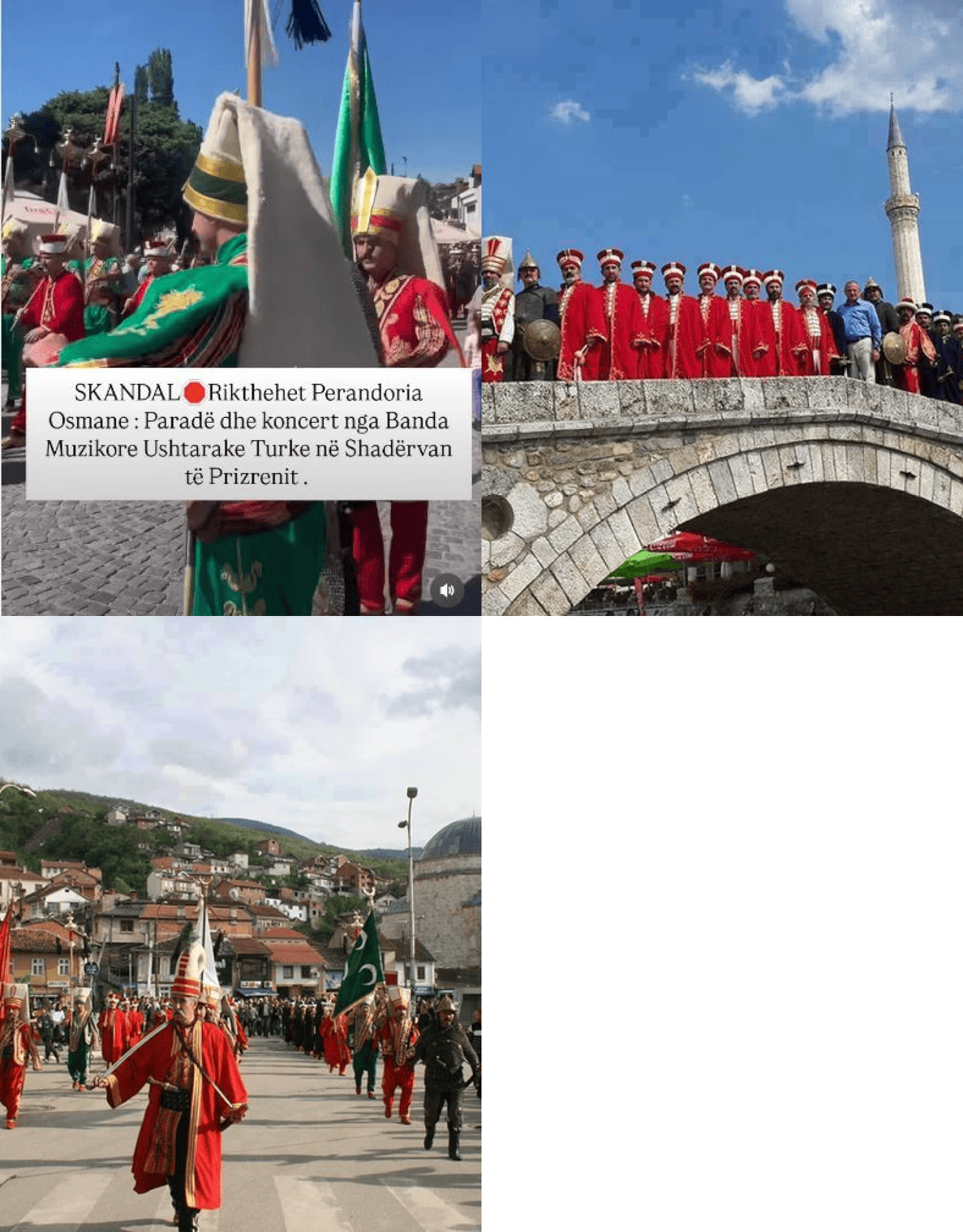
Ottoman parade in Prizren, a return to history or an influence project of Ankara?
The Mehterani march in the heart of the city is no longer seen as a cultural activity, but as a political signal for the reshaping of historical memory and the expansion of Turkish influence in Kosovo.
The Ottoman parade in Prizren is not an old tradition. During the time of Yugoslavia, the ritual of the Mehteran military ensemble parade did not exist. This is also due to the fact that Ataturk's Turkey was a secular state, which did not deal with the return of symbols of the Ottoman past.
Everything changed with the coming to power of Erdogan and the installation of a new neo-Ottoman policy. Ankara began to systematically invest in the restoration of Ottoman memory in the Balkans, using cultural, religious and diplomatic instruments. In this context, the “Yunus Emre” Institute was also established, which in theory promotes the Turkish language and culture, but in practice often serves as a tool for reshaping historical Turkish influence in the region.
A symbolic moment in this process was the entry of Turkish KFOR troops into Prizren in June 1999. While German forces entered as part of a NATO liberation operation, the entry of Turkish troops was accompanied by an atmosphere that for many resembled more a symbolic return than an international military operation. The scenes of that day, with Turkish flags and excessive enthusiasm, remain a point of discussion even today.
Since then, Turkey's symbolic presence in Prizren has become regular. Every year, the "Mehteran" military band, part of the Turkish state ceremonial, organizes parades in the city. These activities coincide with dates related to the entry of the Ottoman Empire into these territories and are accompanied by strong historical symbolism.
The parade takes place on the main streets of the city and stops at Shadërvan, the historic heart of Prizren. There, Ottoman marches are performed and a narrative glorifying the imperial past is reproduced. All this happens with the approval of local and central institutions of Kosovo, while some citizens experience it as a celebration.
But this year, on April 25, 2026, something happened that went beyond the usual symbolism. The band “Mehteran” performed the song “Oj Kosovë, oj Nëna ime”, presenting it as a gesture of rapprochement and brotherhood. For many, this was not simply an artistic performance, but a political message. An attempt to symbolically appropriate a part of Albanian identity and include it in another historical narrative.
This is why this year's parade has provoked stronger reactions. It is no longer just a cultural activity, but an interpretation of history that touches on the deepest sensitivities of identity.
Some critical voices have reacted openly. Arbër Gashi, a Swiss anthropology researcher and activist for “Shoqëria e Re”, has long opposed this phenomenon, seeing it as a distortion of historical memory. Likewise, Catholic cleric Dom Nikson Shabani has reacted sharply, emphasizing that spaces like Shadërvani cannot be transformed into parade stages for symbols of occupation.
Their message is clear: Historical memory cannot be relativized or used as decoration for today's political or geopolitical interests.
This is the crux of the debate. It's not a matter of culture. It's a matter of interpreting history and respecting what it represents.
And this is precisely where the problem lies. When institutions are silent and the symbolism of the past is used without reflection, then history no longer serves as a lesson. It becomes a tool of influence. /Pamphlet



Po po keshtu futet krimbi nga pak, keta jane futur shume thuaj. Po kur e marrin fare nuk kendojne me shqip. Ata edhe dyqanet ne shesh i kane si histori osmane, ose dhe turke po themi meqe bejne tregti
Gjithe ku demonstrim i qelbur i ideologve te ish pushtuesit...dhe kryetari shqiptar i Prizrenit rri i strukurë pa asnje reagim. Gjithandej ne tokat shqiptare, Kosove, Shqiperi, Maqedoni...pushtuesit ende sot bejne cfare duan vet pa i trazuar askush nga banoret vendas shqiptar. Kështu si duket paska qene ne Iliri, prandaj u zhduken duke akomoduar gjithfarë ardhacakesh sllavomongol..
Qetesohu se pervecse injorant je edhe i lig
Merrini me shkelma qafiret musli - sllavo - mongole. Si tre vije Erdogani ne kryeministri e t'i thote kryebalashit tone per bustin e Gjergj Kastriotit, hiqe kete tradhetar e Roma me brez te bardhe rri si mut, cdo presesh me. Sa poshte na kane ulur keta qerratenjte e politikes keta 35 vitet e fundit.
Mire e ke, hajde fillo i pari se me te tjeret pas na ke...
Do vij greqiri sllavomongol e te ju shpetoj, bash me janullatosaqisat. Mirëmban bustin eMitsotaqisit e mos i hidheni vorioleshat se ua ndalin pensionin...gjuhen shqipe dhe tubimet shqiptate edhe ashtu ne Himarën shqiptare ua kane ndaluar...
Bravo. Duhet te kete parada nga gjithe pushtuesit . Xaxaa
Prizreni ka nje pakice te forte Turke dhe ndikimin e nje kulture te vjeter Osmane. Prizrenalinjte dhe shume kosovare, kur serbet ben pastrim etnik, u moren dhe ndihmuan nga Turqia e cila edhe sot eshte nje nder promovuesit e forte te sigurise ne Kosove. Identiteti Otoman eshte i oerzier me identitetin Kosovar dhe nuk ka asgje te keqe. Perrallat si puna e Ben Blushit, dhe e regjimit te Emver Hoxhes tregojani tjeterkujt..