


 Shkruar nga Pamfleti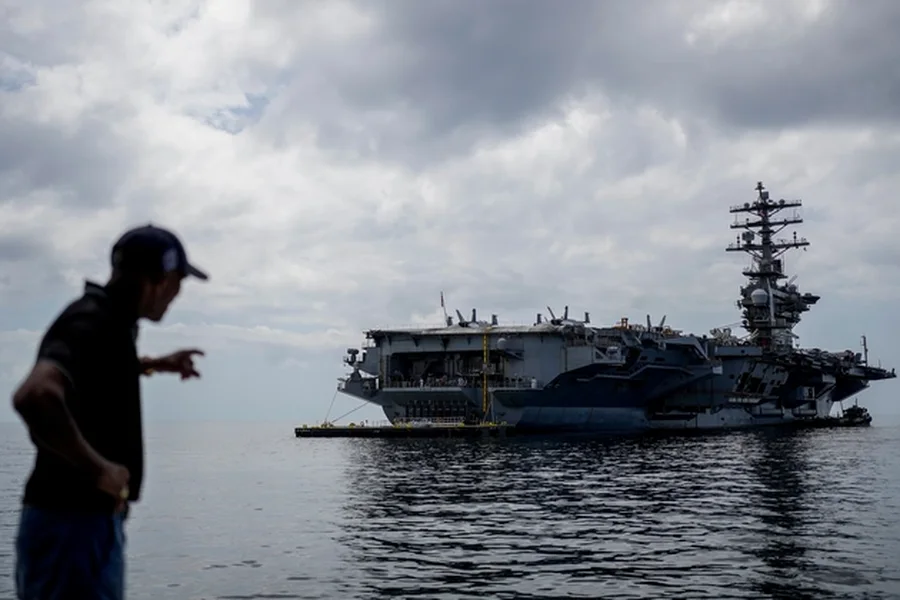
The Navy's presence in the Caribbean has not diminished despite the war with Iran.
The Pentagon has spent months positioning the troops and weapons needed for a possible US military attack on Cuba and, according to reports, only final approval from Donald Trump is missing.
The US president has raised the possibility of military intervention after economic and political pressure failed to topple the communist government in Havana. The increased US naval presence in the region, the largest in the world outside the Middle East, would allow the US to act immediately.
These strategically placed forces create the basis for military action, which could range from capturing the leadership in Havana in a scenario similar to the arrest of former Venezuelan President Nicolas Maduro to a series of precision strikes on selected targets. Such a development would involve the US in the third international conflict of the Trump administration.
"Cuba is in big trouble. Having a failed state just 90 miles off our coast poses a threat to the national security of the United States," US Secretary of State Marco Rubio said on Wednesday during a full cabinet meeting.
The US fleet in the region is somewhat smaller than it was in January, when the US arrested Maduro. However, the USS Nimitz aircraft carrier strike group entered the Caribbean in May, accompanied by several destroyers and guided-missile cruisers capable of delivering precision strikes on land targets.
Meanwhile, advanced US drones and surveillance aircraft have been flying over and around Cuba for months, according to air traffic monitoring websites. Meanwhile, the amphibious assault ship USS Kearsarge and its escorts, carrying about 2,500 Marines, are off the coast of Virginia preparing for a new deployment and could replace some of the ships expected to return to the US.
This military buildup gives the Pentagon a wide range of operational options, although a massive ground invasion would require additional troops.
The USS Nimitz arrived in the region on the same day the US filed charges against former President Raul Castro, in what was interpreted as a public show of force.
"The Nimitz is likely to be there primarily for intimidation, although it could also be used in a military operation if the need arises," said Mark Cancian, a former Pentagon official and currently a senior analyst at the Center for Strategic and International Studies (CSIS).
According to him, the aircraft carrier, along with fighter jets based in Florida and Puerto Rico, would have a key role in any military action against Cuba.
"Air strikes are possible to neutralize Cuban air defenses and enable broader air operations or perhaps to eliminate the political leadership, with the idea of creating a relationship like the one we have with Venezuela. Raul Castro would be the first target," Cancian said.
However, the US administration faces time constraints. Many of the largest warships deployed during the summer are approaching 10 months at sea, far more than the normal six or seven-month period.
This situation has raised concerns among defense officials about crew overcrowding and adds pressure on the US Navy, which is also participating in the blockade of Iranian ships in the Arabian Gulf.
The White House referred questions to the Pentagon, while the US Navy declined to comment on current deployments. Naval Forces Southern Command did not respond to requests for comment.
"These long deployments one after the other will have consequences over time. Keeping ships in the field for so long creates long-term problems when they return to the country, especially in terms of repairs and reconstruction," said a defense official, who spoke on condition of anonymity because of the sensitivity of military operations.
The extended missions come after a record-breaking 11-month deployment of the aircraft carrier USS Gerald R. Ford, which ended this month after the ship sailed from Europe to the Caribbean for the operation against Maduro and then to the Middle East for the war with Iran.
The USS Nimitz is also continuing an extended deployment, which was initially expected to be the last in the ship's 50-year career. It was originally scheduled to return to Norfolk, Virginia, for the removal of its nuclear reactors, but the US Navy decided to keep it in service until 2027.
Also, the amphibious ships USS Iwo Jima and USS Fort Lauderdale have remained in operations since the summer, although the Marine Corps announced on Wednesday that they will return to Norfolk next week.
But these long missions are significantly impacting crews and Marines, who had planned normal rotations and are now months beyond their original return home deadline.
"You don't join the military thinking it's going to be easy; every deployment is uncertain. But when deployments are this long and seemingly endless, it starts to take a toll on your motivation to continue your military career. How much more can I convince my family to accept another contract and keep going at this pace?" said Joe Plenzler, a former Marine Corps officer. / Adapted from "Pamphlet", from "Politico"





Lini një Përgjigje