


 Shkruar nga Pamfleti
European forces would be sent and supported by the US military in the event of repeated Russian violations.
Ukraine has agreed with Western partners that continued Russian violations of any future ceasefire agreement will be met with a coordinated military response from Europe and the United States, according to people briefed on the discussions.
The proposal was discussed by Ukrainian, European and American officials on several occasions in December and January and would include a multi-pronged response to any violation of an agreed-upon ceasefire by Russia. Envoys from Kiev, Moscow and Washington are due to meet again on Wednesday and Thursday in Abu Dhabi for talks aimed at ending the fighting. Under the plan, three people familiar with the matter said, a violation of the ceasefire by Russia would trigger a response within 24 hours, starting with a diplomatic warning and any action required by the Ukrainian military to stop the violation.
If hostilities continued beyond that, a second phase of intervention would be launched using forces from the so-called coalition of the willing, which includes many EU members plus the United Kingdom, Norway, Iceland and Turkey. If the breach escalated into an extended attack, a coordinated military response by a Western-backed force that included the U.S. military would take effect 72 hours after the initial breach, the officials said.
Ukrainian, European and American officials discussed the plan in Paris in December, and talks continued among national security advisers from a coalition of willing countries in Kyiv on Jan. 3, according to a person familiar with the matter. They said Zelensky had also raised the topic of what the U.S. would be willing to offer Donald Trump during the Ukrainian leader's visit to Mar-a-Lago in December.
Britain and France have pledged to send troops and weapons to Ukraine as part of US-backed security guarantees to support a 20-point peace deal aimed at ending Russia's almost four-year occupation.
A European-led "deterrent" force will provide "security measures in the air, at sea and on land" after a ceasefire, with US intelligence and logistics support, leaders of Kiev's key allies said after the Paris meeting.
How a ceasefire is monitored and enforced will be critical to its sustainability. The US has offered to provide high-tech monitoring capabilities along the 1,400km front line. Ukraine has seen Russia violate numerous ceasefires since Russian forces first occupied the Donetsk and Luhansk regions of eastern Ukraine in 2014, under the guise of a pro-Moscow separatist uprising.
The Minsk agreements, signed in 2014 and 2015, aimed to halt the fighting and pave the way for a lasting peace. They were endorsed by Russia, Ukraine, the Organization for Security and Cooperation in Europe (OSCE) and the Kremlin-installed leaders of the two separatist regions.
But the OSCE monitoring mission was limited to observing ceasefire violations. Without an enforcement mandate or Western security guarantees, the ceasefires repeatedly broke down, paving the way for a full-scale Russian invasion in 2022.
Zelensky said in January that the security guarantees negotiated with the US and the contribution from European partners were 100 percent ready and that Kyiv is waiting for our partners to confirm the date and place when we will sign them.
"I told the American side that this is important not only for me, it is also very important... for people to see progress ," Zelenskyy told reporters in Kiev on Thursday.
Many details of the agreement remain unclear and, most importantly, security guarantees depend on a sustainable ceasefire that has yet to materialize.
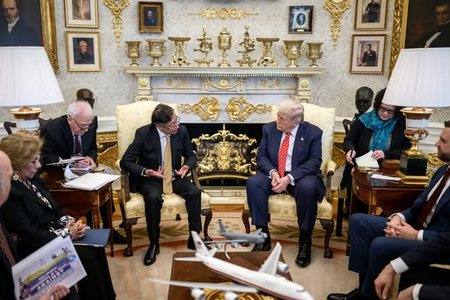
Trump offered Zelensky security guarantees that the Ukrainian president described as similar to those of NATO, similar to the alliance's commitment under Article 5, under which a new Russian attack would trigger a collective response from Kiev's allies. Zelensky said Trump proposed a 15-year guarantee, although Ukrainian officials are seeking to extend it to 50 years.
Last week, Zelensky said that an 800,000-strong Ukrainian army backed by weapons and training was part of a package of security guarantees with the U.S. He wants to sign that document and a post-war “prosperity plan” to rebuild Ukraine with the U.S. before the fourth anniversary of Russia’s full-scale invasion on Feb. 24, which the president believes could give Kiev leverage in negotiations with Moscow and secure Trump’s support in the long run.
The Trump administration has made it clear to Ukraine that US security guarantees are conditional on Kiev first agreeing to a peace deal that would likely include handing over the Donbas region to Russia, the Financial Times previously reported. Zelensky told reporters he did not like the idea of “a swap.”
"My signal was clear: signing the security guarantees is an act of goodwill ," he said.
The issue of Ukraine’s eastern Donbas region has become a sticking point in negotiations, with Kiev refusing to hand over a significant chunk of land that the Russian military has failed to seize, and Moscow refusing to move forward with any peace deal unless its maximalist conditions are met. Russian President Vladimir Putin has said his military is defeating Ukraine on the battlefield and is prepared to continue until it achieves its goals. In recent weeks, Russian missiles and drones have struck critical Ukrainian infrastructure, plunging the capital Kiev into darkness and cutting off heating and water to many of its nearly 4 million residents in the midst of the harshest winter of the war.
Russia has also immediately rejected security guarantees discussed by the US and Ukraine. Former Russian President Dmitry Medvedev said in comments published on Monday that "these guarantees cannot be unilateral," according to Tass.
"These are not guarantees for Ukraine. These are guarantees for both sides: Russia and Ukraine. Otherwise, the guarantees do not work ," Medvedev said.
Moscow has also said it will not agree to any ceasefire until a comprehensive deal is reached to end the war, nor will it accept any deployment of Western troops in Ukraine. Washington has done little to pressure Russia to stop its fighting and negotiate seriously. Instead, Ukrainian and European officials said, the US had pressured Zelensky and made it clear to Kiev that any security commitment from the Trump administration would depend on making painful territorial concessions that match Russia’s demands./ FinancialTimes



Lini një Përgjigje