


 Shkruar nga Pamfleti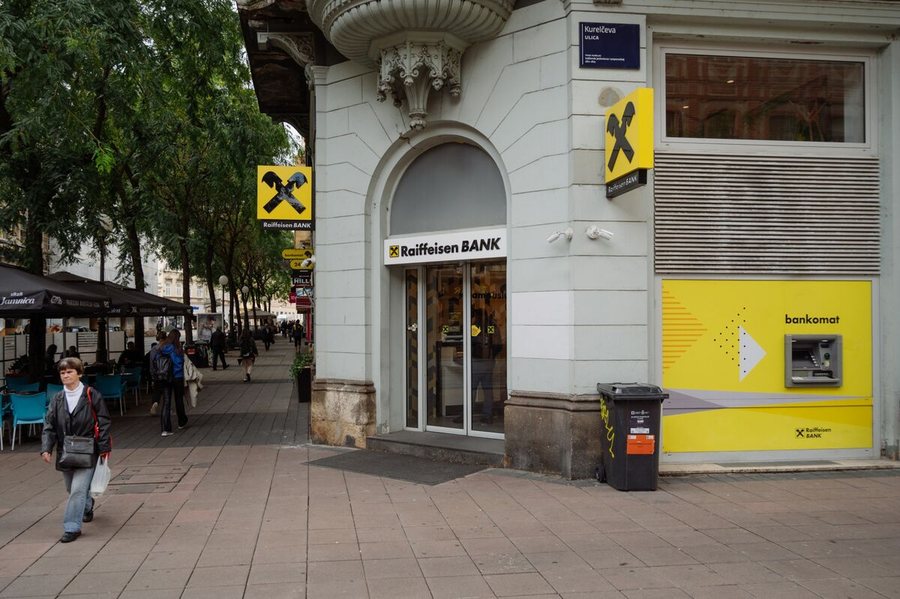
Brussels is considering measures affecting Raiffeisen Bank International, while its exit from Russia remains blocked...
The European Union is considering a 21st package of sanctions against Russia, which is expected to further tighten economic pressure on Moscow. However, its adoption has been blocked due to disagreements among member states, with Raiffeisen Bank International (RBI), the Austrian bank that continues to operate in Russia, at the center of the debate.
According to Bloomberg, the new package could also include measures directly related to Raiffeisen. So far, member states have not reached a final agreement, while Austria has demanded guarantees and compensation for losses the bank suffered in Russia.
Officially, Raiffeisen said that the discussions in Brussels are related to the issue of shares in the Austrian construction company Strabag, which has become part of the dispute between Austria and Russia.
According to international media, Vienna is demanding that the European Union find a solution for the bank's losses after a Russian court ordered the seizure of its activities in Russia. However, some member states oppose any compensation mechanism, arguing that it would set a dangerous precedent and encourage Moscow to target other European companies.

Raiffeisen is the largest Western bank to have continued operations in Russia since the start of the invasion of Ukraine. At the start of the war, its leaders had believed that the conflict would quickly end with a Russian victory and that business would return to normal. This assessment proved wrong.
The bank has tried several times in recent years to sell its Russian subsidiary, but without success. In fact, in the spring, its executives described leaving the Russian market as a "Sisyphean task," admitting that the process had become almost impossible.
According to Bloomberg, the Kremlin is not interested in Raiffeisen leaving, as the bank is considered one of the most important channels for financial transfers between Russia and Europe. For this reason, Russia has blocked the sale of its subsidiary.
Any deal for Raiffeisen's exit from Russia would require the approval of a number of parties, including Austria, the European Union, the United States, Russian authorities and ultimately President Vladimir Putin.
Raiffeisen has been under constant pressure from the US and the European Central Bank to reduce its activity in Russia. Earlier, a Bloomberg investigation reported that through its clients, the bank's Russian unit had provided financial services to companies linked to the Russian military industry supply chain. The bank has denied these allegations and stated that it fully complies with international sanctions.
Despite political pressure, business in Russia remains very profitable for Raiffeisen. In the first nine months of 2024, the Russian subsidiary generated over $1 billion in net profit, while paying 227 million euros in taxes to the Russian budget.
The 21st package of sanctions is also expected to include new measures against Russian banks, an expansion of the list of sanctioned individuals and companies, and other financial restrictions. However, until a compromise is reached among member states, its adoption remains pending. /Pamphlet







Po mire keshtu do arrihet paqja. Keshtu arrihet deshperimi. Ne deshperim cdo gje ndodh. Lihet gjithnje nje rruge dalje.