


 Shkruar nga Pamfleti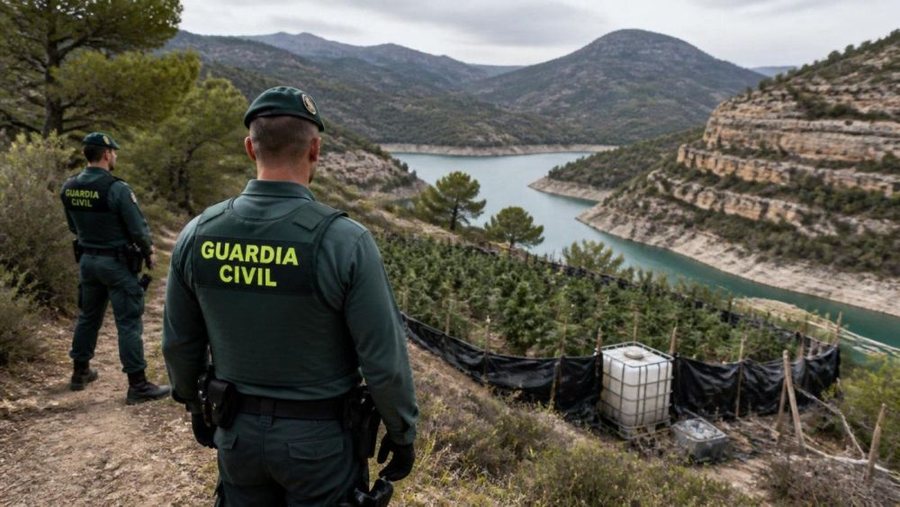
The fall of Lazarat shifted the criminal model towards Catalonia. 12 years later, Albanian networks in Lleida combine outdoor plantations with indoor cultivation facilities, in warehouses and apartments, to reduce risks and speed up production...
The fall of Lazarat, in southern Albania, in June 2014 did not end a criminal pattern, but rather shifted it to the pine forests and rural areas around Lleida and La Franja. Twelve years later, this system of hidden camps, irrigation tanks, buried generators and makeshift cannabis drying facilities coexists with a more discreet pattern, located inside warehouses, apartments, basements, farms, villas and village houses.
The paradox is clear. The system that was born to hide plantations in the wild in remote areas has ended up also relying on urban and suburban properties to reduce exposure to authorities and accelerate crop replacement, while Lleida has become one of the key points of this transformation.
In July 2019, the Seprona unit of the Spanish Civil Guard discovered 2,427 cannabis plants on the right bank of the Santa Anna reservoir, in Os de Balaguer. The plantation was equipped with a water pumping system powered by an electric generator.
The operation ended with the arrest of a 32-year-old Albanian national. A year later, in September 2020, the Catalan Mossos d'Esquadra police dismantled a cultivation of more than 1,800 kilograms of marijuana near the Camarasa reservoir, in a rugged area of the La Noguera region, and arrested five Albanian nationals.
Also in July 2020, the “Templon Osbale” operation linked an outdoor plantation in the Noguera Ribagorzana corridor to a building in Monzon and a logistics villa in Lleida. This operation ended with the arrest of four people of Albanian origin and showed that the cultivation did not operate as an isolated enclave, but as a network with logistical support on both sides of the administrative border between Catalonia and Aragon.
Earlier, in November 2019, the Spanish National Police had seized 16,000 cannabis plants, equivalent to 3,500 kilograms of biomass, in open spaces within pine forests in Agüero and Murillo de Gállego, in the pre-Pyrenees of Huesca. In that operation, people linked to a group of Albanian origin were arrested.
The main foci of this activity in the province of Lleida lie in La Noguera, Alt Urgell and Pallars. This map includes municipalities such as Coll de Nargo, Figols i Alinya, Soriguera and Tremp, while in Huesca the activity extends from the pre-Pyrenean forests of Gallego to Sobrarbe and Ribagorça.
Part of this criminal corridor was also mentioned during the wave of shootings that the Mossos d'Esquadra links to the marijuana market in Catalonia.
The networks moved from the forest to the warehouse
David Mora, sergeant of the Mossos d'Esquadra, described this model change with a very significant comparison.
"The agricultural economy of grass had begun to coexist with the economy of stolen kilowatts: fewer camps among the pines, more industrial warehouses; fewer buried pipes, more overloaded transformers; less aerial surveillance, more abnormal consumption of electricity ," says David Mora, a sergeant of the Mossos d'Esquadra.
The expansion of plantations into closed environments, in warehouses, apartments, basements, farms, villas and village houses, responds precisely to this logic.
Indoor cultivation reduces the risk of detection, allows for more controlled production cycles, and makes it easier to quickly replace crops when police dismantle an installation.
In April 2026, a police operation in the La Mariola neighborhood dismantled a network that combined marijuana trafficking with weapons, ammunition, cash, electricity fraud, and real estate.
The investigation also pointed to a suspected alliance between Albanian drug traffickers and local clans, a development that adds territorial roots to the logistical scheme of these networks.
This combination between cannabis plantations, electricity fraud, and armed violence has also appeared in recent Civil Guard activities, albeit in different contexts.
The operation in La Mariola ended in April 2026 with the seizure of marijuana, weapons, ammunition, money and assets related to criminal activity. /Adapted from Pamphlet by APD/








Lini një Përgjigje