


 Shkruar nga Pamfleti
How LIDL's entry into Albania was delayed and why Rama is selling it today as a success...

The Prime Minister speaks of the arrival of the German network as an achievement of the government, but market sources say that negotiations have dragged on for years, amid uncertainty, strong interests and a lack of guarantees for fair competition...
Rama presented LIDL as proof that Albania has entered a new level for foreign investment. But behind this facade lies a long history of delays, doubts and a market that, according to sources, has offered the German giant neither clear rules nor real security.
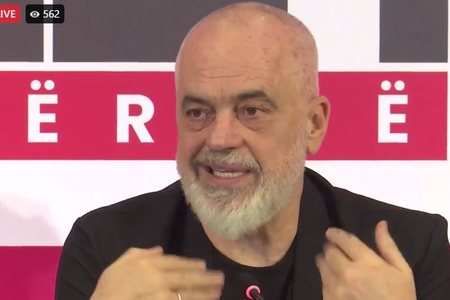
Prime Minister Edi Rama appeared before foreign investors and announced the arrival of the German chain LIDL in Albania as big news. He presented the move as an indication that the country has entered a new stage for foreign investment.
LIDL is one of the largest retail chains in Europe. The company is known for its low prices, high sales volume and strong focus on low-income groups.
In his statement, Rama said that LIDL representatives are in Albania and are working on opening the first facility. He also added the political phrase that sought public effect: "When the Germans come, you really are on another level."
But market sources say that this story did not start now. According to them, the contact and preliminary agreements with the Schwarz group, which owns LIDL, are old and the entry into the Albanian market has been delayed for years.
Instead of a clear and fast process, the company has faced a turbulent market, uncertainty, and a climate that does not guarantee fair competition.
According to the same sources, during this time the retail market has undergone strong movements. New operators have entered, structures with financial problems have been acquired, and the idea has been created that the arrival of a European giant would change the balance of Albanian retail.
During this period, several companies from Kosovo entered the Albanian market, taking over supermarket chains that were carrying debts and financial difficulties. According to sources, they were presented with the idea that the future presence of LIDL could increase the value of these structures or bring about subsequent cooperation opportunities.
But LIDL, according to information circulating in the market, refused to blindly enter an environment where the rules remain unclear. The company seems to have demanded one fundamental thing, law enforcement, the same standards for everyone and a guarantee that it will not face hidden costs, market distortion and selective favors.
This is the crux of the matter. Rama is today presenting the entry of LIDL as a political success. But the multi-year delay itself raises a simple question: why didn't a large German chain enter Albania earlier, if the business climate was as favorable as government propaganda sells it?
Unofficial sources say that the company has suspended any concrete engagement for a long period, precisely because it has not found the security that an investor of such magnitude seeks. The same sources say that the German side has not sought privileges, but only a functional state, enforceable law and serious administration.
This also explains the distance that, according to some sources, LIDL has kept from the political use of its name. Rama tried to turn the arrival of the chain into a decoration for meetings with investors. But if the company actually enters the market, it is expected to do so according to its own commercial logic, not as part of a government propaganda campaign.
This is where the contradiction begins. The Prime Minister talks about success. The market talks about delays. The government talks about an excellent climate. The investor, according to sources, has requested basic guarantees that a normal state should provide without negotiation.
If LIDL opens its first point in Tirana, this will not be enough to wash away the history of procrastination. On the contrary, it will make it even more visible. Because it will become clear that the obstacle was not the lack of interest of the German investor, but the environment he was forced to enter.
The Prime Minister attempted to use LIDL's entry politically, saying that "when they come it means we are at a high level." In fact, Albania, since the time of Ramiz Alija until today, has regularly rejected the entry of powerful German capital, starting from Deutsche Telekom, industry, tourism, and even LIDL.
A senior German official told Edi Rama in a meeting with him that "the Albanian people should know the reason why German investments in Albania are being rejected. We know, he told them, even in detail, but the Albanians should know it too. If you don't tell them, we will tell them".
This phrase has terrorized the prime minister, because if the truth is revealed about who is behind this dirty game against the Germans, he could fall within a week. / Pamphlet



Sepse Ramiz Alia ishte pjesë e skalioneve komunisto- fashiste anti kombëtare shqiptare.
Nuk e le Zamua me Sandrin, as Lidl e as kend. Mos harroni keta monstra nxorren jashte Carrefour francez me gjithe 2-3 banka… Zamua dhe Sandri jane politika shteterore e Edit dhe Saliut. Te njejtet hoqen qafe dhe Club Med. Bizneset Gjermane, Franceze, Britanike dhe Amerikane nuk kane vend ne shqiperi se nuk i lene Saliu me Edin nese nuk lene perqindje tek Zamo, Sandri, Çeti, Ulaj etj trima injorante!
Mirë e ka bere, Shqiptaret duan ndonje Harrods, Waitrose, e lart ku e përfillin Lidl.
K do ngordhin dhe keta faqezinjt qe permend ti nje dite
mos shpifni o idioter te pamfletut antishiptar , se une njoh mire kete problem, jane gjermanet ata qe duan siguri dhe kane te drejt