


 Shkruar nga Pamfleti
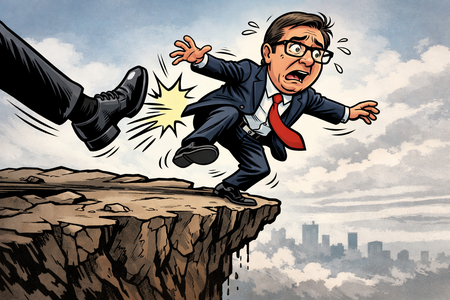
Meloni has built a solid image as a pragmatic leader, maintaining a balance between Brussels and Washington. But the changing political climate in Europe and Trump's decline in popularity are testing that balance. What was once an asset is now becoming a political burden.
For more than three years, Giorgia Meloni's leadership in Italy has seemed unwavering. As her country's first female prime minister, she has left behind the rhetoric of her far-right past and governed with a pragmatic, steady approach.
Her public ratings have remained stable and scandals have been rare - a notable exception in a country accustomed to political instability. Since the start of Donald Trump's second term, she has tried to position herself as a leader who can maintain good relations with him without risking a clash with EU institutions, which oversee Italy's high public debt.
It has been a delicate balance, but one she has managed skillfully. But as Trump's popularity in Europe has fallen sharply and European countries have begun to show more determination towards him, Meloni is now realizing that being the US president's favorite could become a burden.
She came to power in 2022, just 6 months after Russia's complete invasion of Ukraine, with a strong right-wing platform and at the head of a coalition that also included openly pro-Russian voices.
However, she quickly allayed concerns among European leaders who saw her as another Viktor Orbán. Italy has not only supported Ukraine with military aid, but is also part of the so-called “coalition of the willing,” a grouping of countries committed to ensuring Ukraine’s security after a ceasefire.
In his relationship with Trump, Meloni managed to avoid the oscillations between submission and confrontation that have characterized some other European leaders, such as British Prime Minister Keir Starmer.
She seemed to have earned a kind of enduring trust from Trump - partly thanks to her style: cooperative but not servile; partly because of ideological proximity. It is no coincidence that she was the only sitting European leader to attend his inauguration.
Trump himself has called her “a great leader and a friend.” However, Trump’s figure has become increasingly problematic in Europe. During a speech in parliament on March 11, Meloni declared that Italy “is not participating” in the intervention in Iran and “has no intention of participating,” describing the situation as part of an international system “in crisis.”
When Trump sought European support for opening the Strait of Hormuz, the responses from key leaders were tepid. German Chancellor Friedrich Merz made it clear that Germany's military involvement was "not at all out of the question."
Even on March 20, Meloni stated bluntly: “No one is considering an Italian military mission to break the blockade of the strait.” Meanwhile, support for Trump in Italy has fallen sharply — to around 19 percent, or almost half the level of a year ago.
Public opinion is strongly against involvement in the conflict with Iran. Rising energy prices are hitting consumers and businesses, while agriculture is suffering from a shortage of chemical fertilizers. In these conditions, the benefits of rapprochement with Trump seem increasingly unclear.
This perception was also reflected last month, when a referendum on judicial reform became a political test for the government. Turnout was higher than expected and the “No” camp won with about 54 percent.
For the first time, Meloni appeared vulnerable and the opposition felt there was room to act. Until now, her government had come through a series of scandals almost unscathed: from a sex affair involving the Minister of Culture, to fraud investigations against the Minister of Tourism, controversial extradition cases and convictions of senior officials.
In fact, her public approval rating had increased from 41 percent in 2024 to 45 percent at the end of 2025. But this "honeymoon", which has lasted longer than usual, seems to have ended.
is over. After the referendum, Meloni forced the resignation of the Minister of Tourism and a convicted undersecretary, even though these issues were not directly related to the reform.
Recently, Italy reportedly refused permission for US military aircraft to use a base in Sicily for operations towards the Middle East, due to a lack of formal authorization - although the government denied any connection to tensions with Washington.
Italians have an old saying: “From my enemies I defend myself; from my friends God protect me!” In today’s Europe, the costs of being Trump’s friend are increasingly outweighing the benefits./ Pamphlet from the “New York Times”


Lini një Përgjigje