


 Shkruar nga Auron Tare
Albania has long suffered from an old disease, the belief that the world wakes up every morning thinking about us. It is an arrogance that we have inherited from propaganda, not from history.
Professor Sergey Khrushchev was waiting for me in front of the entrance to the University of Rhode Island. I had made a long journey to meet him. I was driven by an old curiosity, to hear not only the memories of his father, Nikita Khrushchev, the former leader of the Soviet Union, but also what he might know about Albania, that small country that, according to our early habit, we have always imagined as the axis around which world history revolves.
After we greeted each other, he showed me the way. I followed him. The professor's steps were slow, but his mind was clear.
As soon as we sat down, I asked him about the visit his father had made to Albania.
"I remember," he said. "I was a boy, but I remember it well. Dad stayed for about three weeks."
Three weeks! It seemed like an unusual amount of time.
What could the leader of a superpower do for three weeks in Albania? – I asked him.
The professor smiled.
"He was simply curious. He wanted to know the country. Moreover, they welcomed him with great honors"
I couldn't escape the temptation.
However, Enver Hoxha later accused him of wanting to destroy Albania. He said that Khrushchev wanted to leave Albanians without bread, advising them to plant oranges instead of wheat.
The professor laughed lightly, with that laugh of people who have heard political nonsense too many times.
“When I helped my father prepare his memoirs, he mentioned Albania to me. He did not appreciate Hoxha. He called him ungrateful and attached to his own greatness. But tell me, why would the Soviet Union want to harm Albania? What interest did it have? Albania was a small country, about which Moscow knew very little” – he paused for a moment and after taking a sip of coffee he continued – “Father thought that your climate was suitable for citrus fruits. Oranges and tangerines had a secure market. You could get wheat in exchange. For the Soviet Union, supplying Albania with wheat did not constitute any burden. Therefore, the accusation that he wanted to let Albania starve was, at best, a political fantasy”
Time, as it often does, has taken its toll. Today, southern Albania is not known for its wheat fields, but for the citrus plantations that cover the hills and fields.
Then I asked him:
But why didn't the Soviets overthrow Hoxha?
The professor looked at me with his blue eyes.
"My son, the Soviet Union had much bigger problems than dealing with Albania. Do you think it couldn't overthrow a provincial dictator, if it really had that intention?"
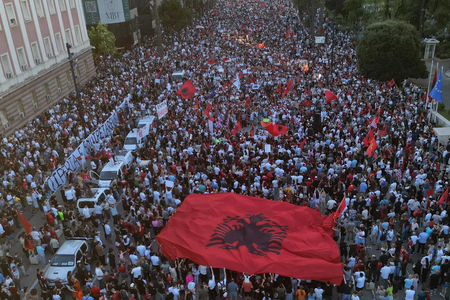
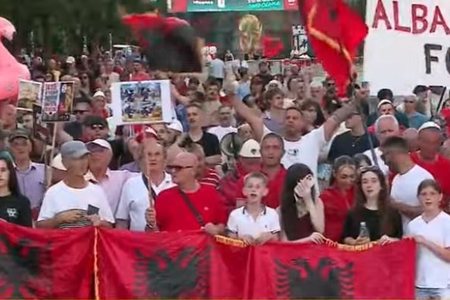
I was reminded of this conversation these days, when in Tirana we hear that behind the protests, the hand of the Russians is hidden.
It seems like the story has only one habit, changing the setting but leaving the same actors.
It used to be said that the Russians wanted to destroy us with oranges, today they say they want to destroy our tourism.
And yet the professor's question remains as simple as it is unpleasant:
Why would Russia have such a great interest in Albania?
Is it possible that the Kremlin is not sleeping at night due to the Albanian Prime Minister's visits to Ukraine?
Or from the promises of the Municipality of Tirana to build a couple of schools there?
Is it possible that Putin can't sleep because Zelensky (the corrupt leader according to US intelligence agencies) honored our Mom with the Princess Olga Medal?
I am not an expert on geopolitics and I do not undertake to give lessons on the great affairs of the world. But one thing seems clear to me, the great powers do not waste their energies on provincial myths. When they have great interests, they act, when they do not, they leave us to deal with the shadows that our own imagination creates.
Albania has long suffered from an old disease, the belief that the world wakes up every morning thinking about us. It is an arrogance that we have inherited from propaganda, not from history.
Cuna, maybe it's not the Russian bear that's disturbing our forest.
Perhaps our forest is most disturbed by our rascals, who whenever they lack an answer to the country's troubles, rush to invent a distant enemy. And when the forest is emptied, when citizens become impoverished and trust fades, they always look for the blame somewhere far away, in the Bear.


Lini një Përgjigje