


 Shkruar nga Gjergj Zefi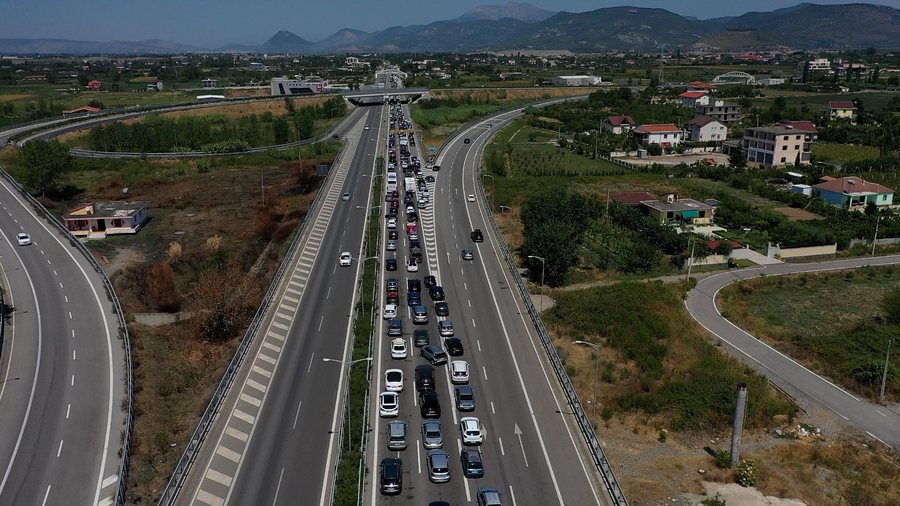
Only 17 kilometers, but with an extraordinary political, economic and regional weight: the delay of this axis has fueled the perception of regional discrimination and raised serious doubts about the way public funds, tenders and priorities are managed in Albania...
The Milot-Balldren segment is no longer simply a delayed infrastructure project. In the way it has been handled over the years, it has become a symbol of a deeper problem: inequality in the distribution of public investments, clientelism in decision-making, and the lack of a clear economic logic in the treatment of strategic axes.
When a segment of only 17 kilometers remains in 'suspended' status for a decade, no explanation is sufficient: bureaucracy, procedures, or technical difficulties.
At this stage, we are dealing with a political and financial failure that produces direct consequences for an entire region.
The perception of regional discrimination does not arise from rhetoric, but from the concrete comparison of investment rates. When certain areas of the country benefit more quickly from new axes, improvements to existing corridors and more visible infrastructural support, while such an important node for the country continues to remain blocked, then the conviction is nurtured that public priorities are not being set on balanced development criteria, but on political preferences. This is why the Milot-Balldren issue is no longer read only as an administrative delay, but as an indicator of a selective approach to the territory.
From an economic point of view, the cost of not building is much greater than presented in the documents.
Every year that this segment remains out of service, transportation costs for businesses increase, transit times for goods are extended, and the efficiency of a corridor connecting Albania with Central Europe is damaged.
In financial terms, this means lost productivity, increased operating costs for transporters, higher fuel consumption, faster depreciation of vehicles and reduced competitiveness for the regional economy. Even when these costs do not appear directly in the state budget, they are paid every day by citizens, businesses and the market.
Moreover, project delays also increase the final bill for the construction itself. In infrastructure, every multi-year delay translates into additional costs: increased material prices, project revisions, new procedural expenses, and the need for technical and financial reassessment. This means that a segment that could have previously been dealt with with a lower fiscal burden, today risks costing more precisely because of inaction. This is one of the most serious paradoxes of public mismanagement: the state postpones investment in the name of savings, but in the end pays more due to the delay.
At the center of the debate has also been the way in which the financing of this axis was conceived, especially through concessionary formulas and public-private partnerships. This is where the notion of clientelism comes in. When the process of selecting operators is accompanied by suspicions of prior favors, contested technical bonuses, or a lack of real competition, then the problem is no longer just legal. It becomes a problem of public trust and fiscal integrity. A state that creates the perception that strategic projects are filtered according to political proximity and not according to financial and technical capacity undermines the very foundations of competition and economic efficiency.
On the financial side, a serious concern is related to the discrepancy between the weight of the project and the real capacities of the operators who intend to take it on. When questions arise about capitalization, liquidity, the ability to secure bank financing or to bear the risk of construction, then the state has no right to act on political grounds. Because in the end, any project based on operators without real financial muscle ends up in one of two scenarios: either it is blocked, or it becomes an additional burden on the public budget. In both cases, the loser is humanity.
Milot-Balldren is a segment of strategic value, not only road. The axis directly affects the movement of people, trade, access to the tourist areas of the north and the role that Albania claims to play as a regional corridor. A government that leaves this node in suspense, while promoting ambitious visions for integration, logistics and development, creates a strong contradiction between propaganda and reality. Because strategic corridors are not measured by promises, but by functionality, travel time, trade flows and economic return.
On the political level, this issue has naturally taken on greater weight, because it affects an area where sensitivity to exclusion is high. Precisely for this reason, the delay is no longer read as a simple procedure, but as a sign of silent regional discrimination. Even if the government does not accept such an approach, the political effect is the same: the belief is created that some areas systematically remain on the periphery of state attention. And this belief is extremely dangerous, because it damages territorial cohesion and feeds long-term distrust of institutions.
In essence, the Milot-Balldren case shows that Albania’s problem is not simply a lack of funds, but a political mindset about priorities. When a short segment, with high economic and regional impact, is not completed for years, while administrative energy is wasted on questionable financing schemes, then it becomes clear that the obstacle is not just technical. The obstacle is the model of governance: a model where clientelism competes with the public interest, where fiscal efficiency gives way to bargaining, and where regional balance is sacrificed for the sake of day-to-day calculations.
Milot-Balldren today remains the strongest proof that infrastructure in Albania is not only a matter of development, but also a matter of power. And as long as such a project continues to remain blocked, any promise of territorial equality, modernization and European standards will sound truncated. Because when a strategic axis is hindered by clientelism, financial uncertainty and the perception of regional discrimination, the problem is no longer just the road. The problem is the very way the state is built./ Pamphlet








ja sa te filloje ndertimin Samiri ne Patok do e bejne rrugen
Ka 30 vite qe vijmë ne bregdet ne Lezhe, dhe rrije si shtaze ne kolone ne vapë te larte. Gjersa jane shtruar e rishkruar rruge shume me sekondare gjithandej vendit. Kurse rruga Milot Lezhe eshte torturë e vërtetë. Kete vere, sikurse veten e kaluar nuk do te shkoj ne pushime te zakonshme ne bregdetin e Lezhës. Ju rrini koke ulur para shkatërruesit Ramaqis.
Shume shpejt shpallet fituesi. E ka marre Salillari dhe eshte lajm i mire. Vetem ai e ben si PPP, ka fuqi financiare.