


 Shkruar nga Florian Naumann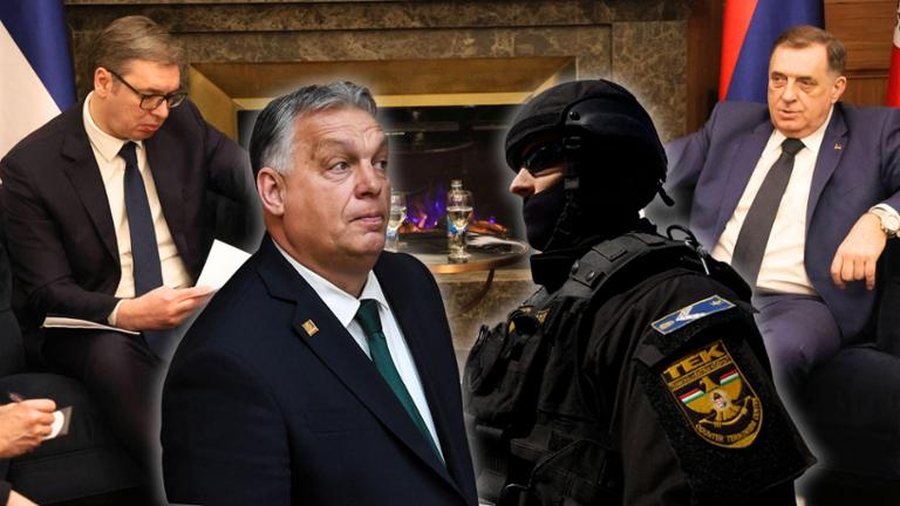
The opening of a Hungarian police office in Bosnia and Herzegovina is seen by experts as part of an authoritarian network with close ties to Moscow...
Since Russia's aggression against Ukraine, an official visit to Moscow is more than diplomacy, it is a political statement. Since 2022, only 6 heads of state or government from the EU and candidate countries have met with Russian President Vladimir Putin. Among them was former Austrian Chancellor Karl Nehammer, who in April 2022 tried unsuccessfully to persuade Putin to change course. Turkish President Recep Tayyip Erdogan also traveled to Moscow for talks. But the other 4 visits were made by politicians known for their friendly stances towards Russia: Viktor Orban of Hungary, Robert Fico of Slovakia, Aleksandar Vučić of Serbia and the leader of the Bosnian Serbs, Milorad Dodik.
Now, a more structured cooperation is taking shape. In late January, Hungary’s elite police unit, the Counter-Terrorism Center (TEK), opened its first permanent office abroad – in Bosnia and Herzegovina, specifically in the Serb-majority entity of Republika Srpska. It is there that Dodik has wielded influence for years and where Vučić talks about the expansion of what he calls the “Serbian world,” a term that many analysts compare to Putin’s concept of the “Russian world.”
Belma Zulčič, director of the Bosnia and Herzegovina section of the “Threatened Peoples” association, sees this development as alarming. She recalls that the presence of TEK is not new. In February 2025, when Dodik was sentenced to 1 year in prison for disobeying the decisions of the UN High Representative, about 40 members of this Hungarian unit entered the country in civilian clothes and then took part in an armed training exercise. According to Zulčič, at that time there was a real fear of an armed clash between the Bosnian state institutions and the Republika Srpska police, with possible support from Hungary.
The clash did not happen. Dodik agreed to avoid prison by paying a fine and resigning as president of Republika Srpska. However, he did not retreat from politics. He recently visited Israel and then, in a television appearance, repeated calls for the independence of Republika Srpska, a demand that remains deeply destabilizing for Bosnia and Herzegovina. The war of the 1990s claimed some 100,000 lives, while the Dayton Agreement created a bi-entity state, but with still fragile stability.
In this context, Zulčić interprets the cooperation with Hungary as an attempt to weaken state institutions and strengthen the structures of the Serbian entity, with the long-term goal of secession from Bosnia and Herzegovina. Officially, the authorities of Republika Srpska present the opening of the TEK office as a “technical” measure for cooperation in the fight against terrorism, migration and security risks.
According to Zulčić, Bosnia is not currently facing a migration crisis and state institutions do not see a real terrorist threat; such rhetoric is used more for domestic political purposes.
Another factor is the electoral situation. On February 8, a part of the presidential elections of Republika Srpska will be repeated, as the November process was accompanied by irregularities. There is a possibility that the opposition candidate, Branko Blanusa, has a real chance. According to Zulčić, the current government seeks to demonstrate strength and create a sense of threat from abroad, while cooperation with the Hungarian entity makes the central state look weak.
Analyst Adnan Čerimagić, a former official in the Bosnian Foreign Ministry, has previously spoken of a political “brotherhood” between Budapest, Belgrade and Banja Luka. According to him, Dodik is gaining international support and arguments against the EU, while Orbán projects himself as a leader who exports his model of governance.
Deutsche Welle has also noted that the Hungarian prime minister shows sympathy for ethno-nationalist concepts, especially in the context of the Hungarian minority in Ukraine.
For Zulčić, the picture is broader: the cooperation in Republika Srpska is part of a problematic pattern of authoritarian networks and hybrid influence in Southeast Europe. She calls the Orban–Dodik connection particularly worrisome, due to its open challenge to European principles of the rule of law and control mechanisms.
A common element, according to her, is the close relations of both with the Russian leadership under Vladimir Putin. /Adapted from Fr.de/





Lini një Përgjigje