


 Shkruar nga Pamfleti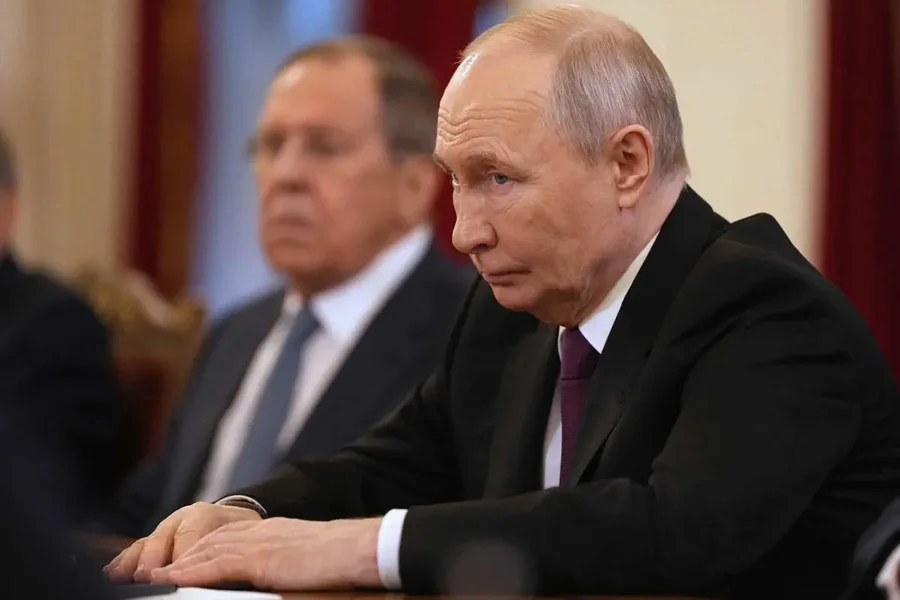
It must be said that the level of alarm in Europe about Putin's possible moves is not evenly divided.
Vladimir Putin may be convinced that now is the best time to strike at the West. This disturbing observation was reported to Politico by several European politicians “with direct knowledge of the discussions” attributed to European defense officials and lawmakers. According to them, the Kremlin leader sees 2027, or at most 2028, as the window in which he will test Western countries’ commitment to NATO. This belief is fueled by Donald Trump’s stay in the White House until January 20, 2029. The US president has often attacked US allies rather than adversaries, while the European Union has yet to complete its military project.
“Something could happen very soon,” Mika Aaltola, a Finnish MEP and member of the European Parliament’s Foreign Affairs Committee, told Politico, adding that “the United States is withdrawing from Europe, transatlantic relations are in a very bad state, and the EU is not yet fully ready to take on its responsibilities alone.”
The alarm raised has been tempered by an important clarification reported by European insiders. Politico's sources explained that European defense officials and politicians, while not ruling out the possibility of Putin launching a direct offensive against a NATO country, believe such an attack is unlikely due to the heavy costs Moscow has incurred from the conflict in Ukraine.
Aaltola himself argues that it is much more likely that Moscow will take a more targeted action or an incursion aimed at "creating ambiguity", hoping to divide NATO during discussions on a possible activation of Article 5 (the clause in the Atlantic Alliance treaty that binds member states to collective defense).
The MEP describes several scenarios that the Federation could implement, from "a drone operation" to initiatives in the Baltic Sea or the Arctic, "against small islands." Aaltola emphasizes that a drone attack does not require troops or border crossings, and "if there are no cross-border attacks, the United States may consider the issue not strategically important."
Ville Niinistö, chairman of the European Parliament delegation to the EU-Russia Parliamentary Cooperation Committee, mentioned the possibility of Moscow committing to “an escalation that would weaken” the Old Continent, “make us feel threatened and reduce support for Ukraine.” This move could cause panic among Western partners.
However, it must be said that the level of alarm in Europe about Putin's possible moves is not evenly divided. Finland and Lithuania are currently the countries most concerned about the Russian threat, while Estonia and NATO are adopting a more cautious approach, stating that any alarmism feeds the Kremlin's tactics. Despite the caution, Estonian President Alar Karis nevertheless urges everyone to reflect on the fact that "nobody expected the war in Ukraine." "We are vigilant. We are ready. We are keeping our eyes open," Karis adds.
Yet once again, it seems that it is not the leader of the Federation, but the US president, who most frightens America's traditional allies. Polish Prime Minister Donald Tusk declared last week that "the greatest threat to the transatlantic community is not our external enemies, but the ongoing disintegration of our alliance."
Trump has called NATO a "paper tiger" and the fear, as a senior European defense official explained to Politico, is that, in the event of a Republican defeat in the midterm elections, the tycoon, in an attempt to regain support for the 2028 presidential election (the year in which he will seek to hand over the baton to an heir to the MAGA movement), could appeal to his electoral base by increasing criticism of NATO and Europe and distancing himself from Ukraine. /Adapted from Pamphlet /





Lini një Përgjigje