


 Shkruar nga Pamfleti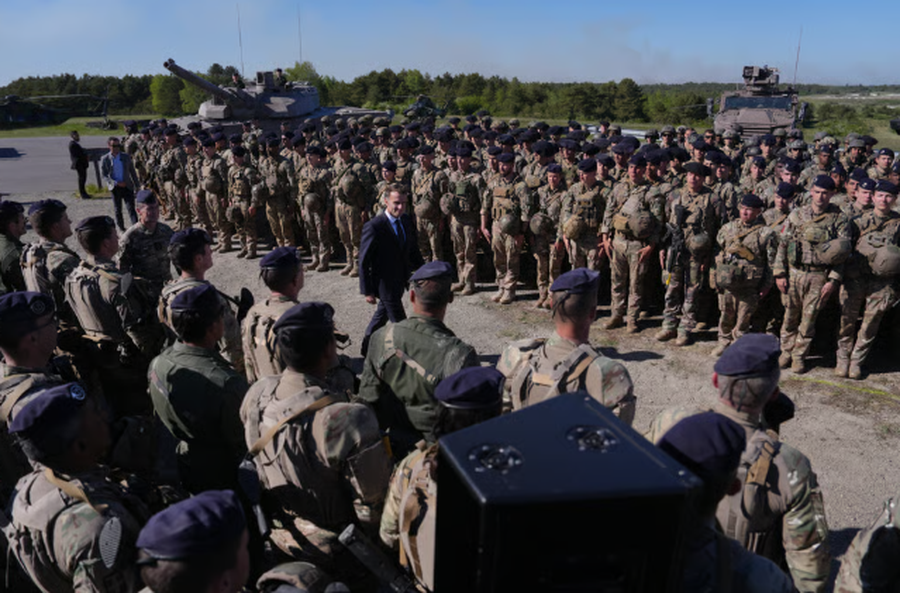
Europeans increasingly want to rely on themselves rather than the U.S. for defense, but there are serious doubts about whether that is possible, according to a new poll shared with POLITICO.
A June poll by Public First in 24 EU countries found that 40 percent of respondents said it would be acceptable for their country to rely on Europe for military assistance, while only 14 percent were open to assistance from countries outside Europe, such as the United States.
“Europeans feel less secure and believe the US is less trustworthy. Whether this translates into a willingness to face some of the acute trade-offs that a more autonomous European defense would entail, particularly the need for greater investment that is not necessarily concentrated in firms in their own country, remains an open question ,” said Anand Menon, director at Public First.
But EU citizens were divided on Europe's ability to do so, with 41 percent saying it is ready to protect them, while 43 percent said it is not.
There is even more doubt over national defense, with 58 percent of respondents thinking their country was not prepared to defend itself and only 27 percent thinking it was.
The poll comes at a time when Donald Trump's administration is questioning NATO's collective defense guarantee, has threatened to annex Greenland, a Danish territory, has reduced the amount of US military assets available to NATO and is withdrawing some troops from Germany.
Under NATO's Article 5, all 32 members, including the US and Canada, are committed to responding if one is attacked. At the same time, many senior intelligence and military officials fear that Russia could attack a European country by the end of the decade.
The White House is pressuring European countries to spend more on defense, something that is likely to be an issue at next week's NATO summit in Ankara, and to take on more of the conventional burden of defending the continent.
Despite doubts about US commitment, most European countries still buy key weapons systems from America and rely on key US capabilities, such as intelligence, space assets and air-to-air refuelling. However, 46 percent of respondents agreed that European countries should produce defence equipment domestically, even if this increases costs.
Earlier this year, NATO Secretary-General Mark Rutte said that anyone who thinks Europe can defend itself without the US is "dreaming," angering some European lawmakers.
But public views reflect some of Rutte's concerns. People in countries on the front line near Russia, including the Baltic states, Romania and Bulgaria, had among the highest doubts about their ability to defend themselves without outside help.
Those governments are strong supporters of NATO, and most want the U.S. to keep troops in Europe. Finland was the only exception, with a large majority of 76 percent convinced their country was ready to defend itself. Finland, a new NATO member, has a robust recruitment program and a well-armed military that is training for a Russian attack.
In 18 countries, a majority of respondents said it was okay for their country to rely on Europe to ensure it had a strong enough military to repel an attack. Finland, France, Poland, Bulgaria, Romania and Greece were the only countries in which a majority said their countries should be able to fight alone.
The French confidence is not surprising. It is the EU's only nuclear power and has a long tradition of independent military capability; most other countries have seen significant increases in defense spending.
The European Union has limited defensive powers, but the bloc is trying to persuade member states to jointly finance and buy weapons to overcome fragmentation in the military industry. There is some discussion of creating a European army, but such a prospect is very remote, if at all. EU-funded programs, such as the €150 billion SAFE arms loan program, limit the participation of non-member countries, angering the United States./ Politico


Lini një Përgjigje