


 Shkruar nga Pamfleti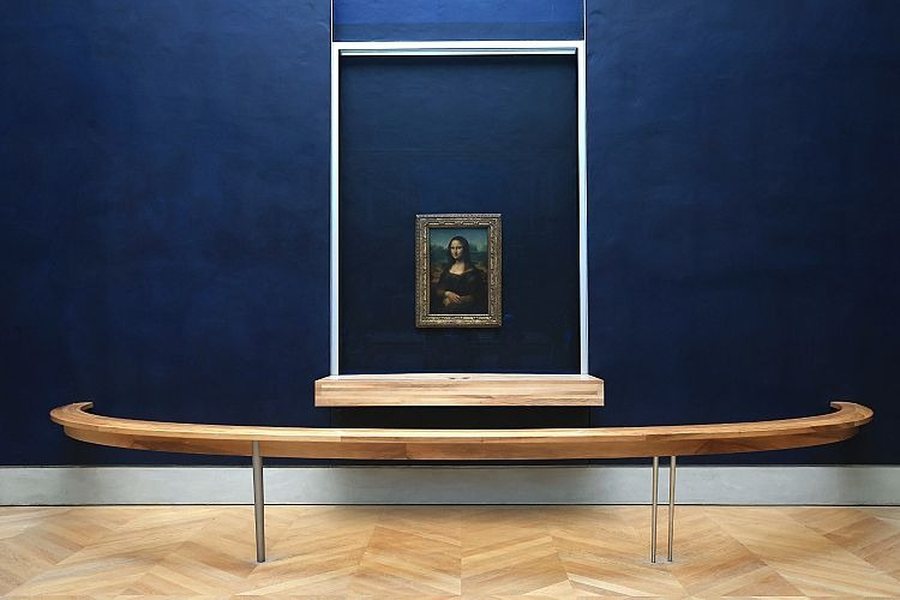
On Sunday morning, a group of thieves allegedly stole nine jewels from Napoleon's collection at the Louvre, using an elevator to reach the museum.
The daring robbery at the world's most visited museum took place while tourists were inside the Apollo Gallery, where part of the French crown jewels are on display.
The theft, which occurred about half an hour after opening, with visitors inside, was among the museum's highest-profile robberies and comes as staff complained that overcrowding and low attendance continue to strain security at France's largest museum.
The Louvre has a long history of thefts and attempted robberies. One of the most famous museum robberies in history occurred there in 1911, when the legendary Mona Lisa disappeared from its frame.
"Mona Lisa" by Leonardo Da Vinci, Louvre Museum, 1911
Leonardo Da Vinci's "Mona Lisa" is undoubtedly one of the most famous works of art in the world and the most popular attraction at the Louvre today.
But before its theft, it was not widely known outside the art world. In 1911, Vincenzo Peruggia, a former employee, hid inside the museum and emerged with the painting under his coat.
After the Louvre announced the theft, newspapers around the world published headlines about the missing masterpiece.
It was found two years later in Florence, after Peruggia tried to sell the painting - an episode that helped make da Vinci's portrait the most famous work of art in the world.
'Jacob de Gheyn III' by Rembrandt, Dulwich Picture Gallery, 1966, 1973, 1981 and 1983
In one of the strangest cases of art theft, Rembrandt's "Jacob de Gheyn III" has become one of the most stolen large paintings in modern history, according to the Guinness Book of Records, nicknamed the "Takeaway Rembrandt," writes A2 CNN.
It was first stolen from the Dulwich Picture Gallery in London in 1966 along with two other works, then again in 1973, 1981 and 1983. The portrait was recovered after each theft and remains on display in the museum today.
However, the most stolen work of art of all time is the Ghent Altarpiece, also known as the "Adoration of the Mystic Lamb" by Jan van Eyck. It has been reported to have been stolen seven times, looted by Napoleon's troops in 1794, as well as by the Nazis during World War II.
Robbery at the Isabella Stewart Gardner Museum, Boston, 1990
It has been called the largest art heist in US history, but 35 years later, the theft of 13 works from the Isabella Stewart Gardner Museum in Boston remains unsolved.
In the early hours of March 18, 1990, two men disguised as Boston police officers loudly entered the museum, saying they were answering a phone call.
They overpowered two security guards, tied them up with duct tape and spent more than an hour stealing 13 works of art, including masterpieces by Rembrandt, Vermeer, Degas and Manet.
Vermeer's "Concert," one of the most valuable stolen items, was possibly worth as much as half a billion dollars, authorities said.
Some of the works, including Rembrandt's "Storm on the Sea of Galilee," were cut from their frames. Those frames hang empty in the museum to this day.
Robbery of the Van Gogh Museum, Amsterdam, 1991 and 2002
Two paintings were stolen by thieves who used a ladder and hammer to force their way into Amsterdam's Van Gogh Museum in 2002.
The paintings were found by Italian police and recovered from the Naples mafia. After being missing for 14 years, they were found and returned to the museum in 2016.
The Van Gogh Museum had also been robbed just a few years earlier, in 1991, when 20 paintings estimated to be worth over 400 million euros were stolen, including the famous "Potato Eaters." They were later found in an abandoned car not far away.
18th Century Jewels, Dresden Green Vault, 2019
In 2019, thieves broke into the display cases in Dresden's Green Vault, one of the oldest museums in the world, and stole diamond-studded royal jewels worth hundreds of millions of euros.
Officials said they made off with three sets of "priceless" 18th-century jewelry, which would be impossible to sell on the open market.
Part of the seized quantity was later recovered. Five men were convicted and a sixth was acquitted of the charges.








Lini një Përgjigje