


 Shkruar nga Pamfleti
How the power pyramid works in Russia and how realistic is the scenario of a coup against the Russian president?
Where is Vladimir Putin? Almost no one can answer this question, as reports in international media increase that the Russian president fears for his safety and is staying in underground bunkers.
According to the Financial Times, citing Western intelligence sources, security measures for the Russian president have been tightened and Vladimir Putin has reduced the use of the official presidential residences in Moscow and Valdai. The same sources say that he spends more time in modern underground bunkers, some of which are located in the Krasnodar region of Russia.
The report claims that the Russian president is focusing less and less on the country's domestic affairs and is increasingly preoccupied with the war in Ukraine, which has entered its fifth year.
This behavior is not unusual for Vladimir Putin, who was a former Russian intelligence agent and is known for his reserved nature. However, recently the Russian president has reduced his public appearances even further and prefers to pre-record his public messages.
View this post on Instagram
Officials who spoke to the Financial Times said he fears a possible assassination or coup attempt against him, but also Ukraine's growing capabilities to strike Russian territory with drones.
The Kremlin frequently releases videos of Putin's public appearances, while the information provided to the media remains vague and standard. Investigative journalists who have analyzed the videos and photos released by the Kremlin have sought details that could reveal more about Putin's real whereabouts at any given moment.
They have noticed changes in the positioning of books in his offices and have found that some videos are presented as new, even though they were recorded earlier. Others have noticed that Putin uses identical offices in his residences, without windows or other elements that could give away information about the location or time of recording.
According to the Financial Times, Putin personally attended Red Square during the Victory Day celebrations and the grand military parade.
Following increasing reports in international media that Putin is spending more and more time in underground bunkers, the Kremlin released a video showing the Russian president at a hotel in central Moscow. There, he was greeted with flowers by a retired teacher. The scene was intended to convey the message that Vladimir Putin remains a leader close to the people, simple and modest.
How real is the threat of a coup in Russia?
The publication of information that Putin fears an assassination or coup, in media outlets such as CNN and the Financial Times, has divided Russian affairs experts.
Some believe that such a scenario, including threats to Putin, is possible. The successful operations of Ukrainian secret services inside and outside Russia make such a scenario plausible, according to some analysts.
Others consider such a development extremely unlikely and see the leaked information as part of an ongoing campaign to destabilize the Russian leadership system.
However, most experts agree on one thing: Putin himself is increasingly concerned about his own security, while economic problems and the growing pressure from security structures on technocrats are deepening tensions among Russian elites.
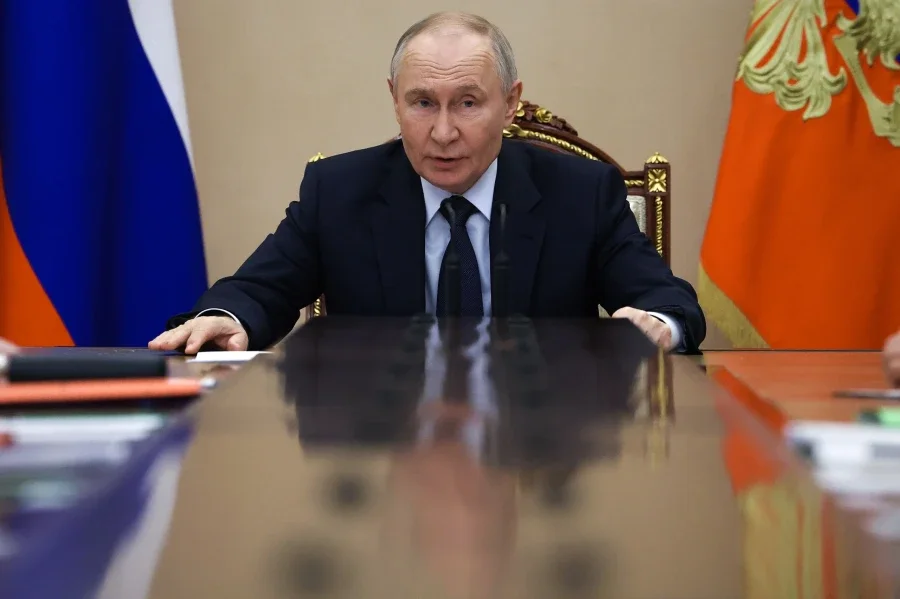
Putin's "divide and rule" strategy
Russian elites do not constitute a homogeneous group with common interests. This was stated by Alexandra Prokopenko, a former adviser to the Central Bank of Russia and a political scientist, during an interview with Carnegie Politics, a platform of the Carnegie Center for Russian and Eurasian Studies based in Berlin.
According to her, this is why there has been no serious coup attempt against Putin so far. The exception is the rebellion of Yevgeny Prigozhin, the founder of the Wagner mercenary group, in June 2023.
Prokopenko describes Putin's power hierarchy as a system of pyramids, each built around a single sponsor. This sponsor controls the distribution of resources and access to decision-making centers in Russia.
However, these sponsors do not cooperate among themselves, which makes it difficult to organize collective action against Putin. As long as they benefit more with Putin than without him, they have no motive to act against him, Prokopenko explains.
However, she does not rule out the possibility that the situation could change if economic resources begin to dwindle. Due to the war and international sanctions, the “pie” that can be shared among Russian elites has been significantly reduced. Often, financial resources are directed towards the military and related industries.
This situation is increasing rivalries and competition between different factions, destabilizing the system on which they operate.
According to Prokopenko, different groups compete for Putin's attention and support, in order to secure a larger share of existing resources.
In this sense, the battle is not really aimed at changing the system, but at securing resources and a seat at the decision-making table.
Putin himself benefits from this dynamic. He divides the Russian elites, forces them to constantly prove their loyalty to him, and reminds them that the wealth and privileges they enjoy today do not stem from the rule of law, but depend on the will of the Kremlin. /Adapted from Pamphlet /



Lini një Përgjigje