


 Shkruar nga Marc Bassets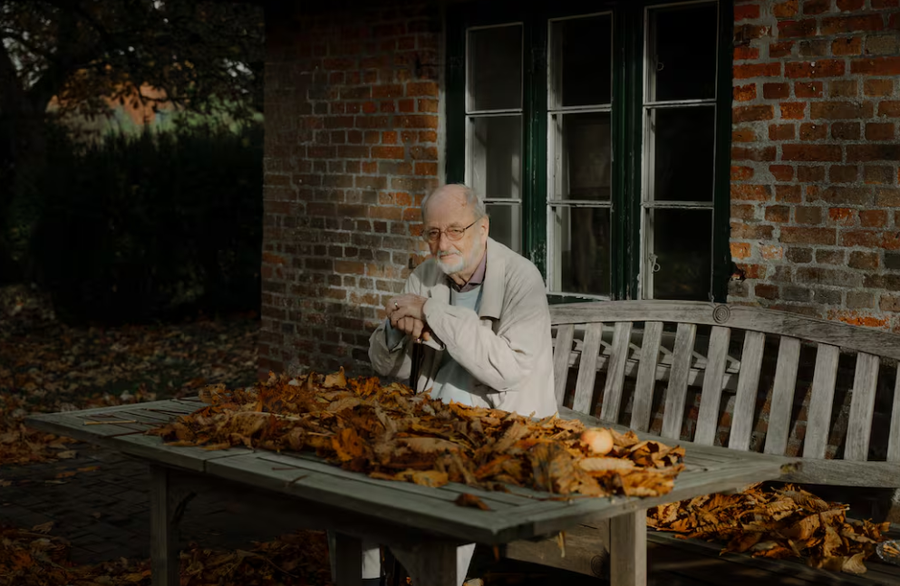
On the 80th anniversary of the trials that ended with the death penalty of the so-called "Butcher of Poland," Hans Frank, and other leaders of the Third Reich, his 87-year-old son says there are only 1 million true democrats in Germany. The rest are prepared to live in a dictatorship again and love it...
Niklas Frank cannot mentally detach himself from his father, Nazi war criminal Hans Frank. He won't be able to do so as long as he has breath. He compares his father to a goblin, an evil spirit that clings to his shoulders, refusing to let go.
He will always have it with him. “ I always hated my father. Now I despise him! ” he says, on a cloudy autumn morning, in his small house in the fields north of the Elbe, a place that seems to have been taken from a Brothers Grimm fairy tale.
Niklas was only 6 years old when his father sat in the dock at Nuremberg. The trial began on November 20, 1945, 80 years ago. Now 87, he has been a widower for 3 years, and as he smokes nonstop, he recounts his memories and laments for Germany and a past that seems endless to him.
" This psychological torture will never end, because the victims seem to be still alive, they swarm inside my brain, " he says.
Niklas Frank was the son of Hitler's main supporter and an administrator in the territories between present-day Poland and Ukraine, where the Treblinka, Majdanek, Belzec and Sobibor extermination camps were located.
The youngest of five siblings, Niklas grew up in the luxury of Wawel Castle in Krakow, from where the “Butcher of Poland” orchestrated the murder of millions of Jews. He was seven years old when Hans Frank was hanged on October 16, 1946, along with other Nazi leaders sentenced to death.
For years, Niklas carried a photograph of his father's corpse with him, as he puts it, "to make sure he was dead." Niklas has repeated his statement for years: " I am against the death penalty, except in the case of my father!"
" I'm selfish. If my father hadn't been hanged, he would have destroyed my brain with his ideology. He was a charming young man. He spoke so fluently and was so inspiring, he probably would have destroyed my brain, and it would probably take me decades after his death to find the truth, " he says now.
Niklas Frank lives in Eklak, a village of 300 inhabitants in the state of Schleswig-Holstein, north of Hamburg. Since the late 1970s, he has worked for the Hamburg weekly "Stern" as a reporter and opinion columnist.
From his childhood in the Krakow ghetto or in the Nuremberg prison, where he visited his father a few weeks before his execution, he was a very observant man. His wife, Hannelor, was a judge in the small town of Itzehoe.
Among the children of high-ranking Nazis, Niklas Frank stands out for his deep remorse, when he published the book “Der Vater. Eine Abrechnung” (The Father: A Reckoning) in the 1980s. The son of the Butcher of Poland confronts his father uncompromisingly, sometimes brutally.
He is an extreme reflection because his father's crimes were such of a society that, starting in the 1960s, made a similar effort: holding parents and grandparents accountable for their crimes, whether committed or not.
And recognizing that this legacy now defines national identity. But few went as far as Niklas. Not all of society shared his stance, and not all of the children of the Nazis.
Another German told himself: yes, Nazism was criminal, but they denied that their parents or grandparents could have participated in it. In his 2017 book “East West Street,” about the origins of international criminal law, Philip Sands brought these two Germanys together in the figures of Niklas Frank and Horst Wachter, the son of Otto Von Wachter, another Nazi criminal who, unlike Frank, managed to escape from Nuremberg.
While Frank accused his father, Wahter justified his own: " I know that the whole system was criminal and that he was part of the system, but I don't believe that he himself was a criminal . "
The conversation with Niklas Frank begins in a small cabin near his house, which he uses to smoke.
He smokes the same Camel cigarettes that his mother, Brigitte Frank, known as the “Queen of Poland,” smoked. On the wall of this room hangs a drawing by one of his grandsons. It is a copy of “Lady with an Ermine,” the same painting by Leonardo da Vinci that Hans Frank stole and hung on the walls of the Vael Castle.
Niklas recalls the few pleasant memories associated with his father, who called him Fremdi, "the stranger," because Hans suspected that Niklas' biological father could be someone else: either Karl Lah, one of his subordinates, or Karl Schmidt, the prominent philosopher of law.
This was the environment in which Hans Frank, Hitler's lawyer in the 1920s, president of the German Academy of Law and Reich Minister without Portfolio before being appointed Governor-General of occupied Poland, moved.
" He became a criminal because he was a coward and because he wanted to advance in his career. In addition, he was fascinated by Hitler," says Niklas, who adds that he has not found any anti-Semitic references in his father's youth diaries.
And what did Hans Frank pass on to his son? " Machoness. And if necessary, I am able to lie very well. This is my father's legacy. However, I have lied very little. I have only done so when I have had a relationship with someone other than my wife, " he replies.
He gets emotional when he remembers that time. He also remembers a scene during his wife's terminal illness: " I was in the back of the house drinking a beer and crying. Suddenly, Auschwitz appeared in my head, Auschwitz, Auschwitz. In a strange way, that image comforted me. Because we were able to live long and even experience a fatal disease like cancer, " says Niklas.
During the speeches he continues to give in schools, he asks young people to imagine that the Jews killed in the extermination camps were their loved ones. So to visualize that horror. How they were taken from their homes, put on trains, forced into gas chambers. He himself has done this exercise a thousand times. "How many times have I mentally sent my wife to the gas chamber, our daughter, our three grandchildren! And I feel only one millionth of the fear that we caused to millions of innocent people," Niklas emphasizes.
Meanwhile, he tells young people: "Enjoy life, but don't forget that you are Germans. So you should remember what your grandparents and great-grandparents did or saw, and did nothing to stop it. Please react immediately if you encounter people who speak in an inhumane manner."
Niklas emphasizes that these boys and girls are "not responsible" and "should not feel guilty," but he does not trust Germans. He sees with alarm the rise of anti-Semitism and in the statements of even moderate politicians about immigrants, a tone that reminds him of another era.
He cites the electoral successes of the far-right Alternative for Germany party, which won 21 percent of the vote in the last parliamentary elections. All of Germany's efforts to confront the crimes of the Nazi era, a model effort for many, have a different meaning for Hans Frank's son.
“ We live in the best democracy we’ve ever had, but it was built by Nazis ,” he stressed. Niklas also argues that after World War II and the arrival of democracy, “ they obeyed the new system, just as they had obeyed the Third Reich . ”
"I assume that in Germany there are only 1 million true democrats. The rest are prepared to live in a dictatorship and love it," he claims./ Adapted from "Pamphlet", taken from "El Pais".


Lini një Përgjigje