


 Shkruar nga Pamfleti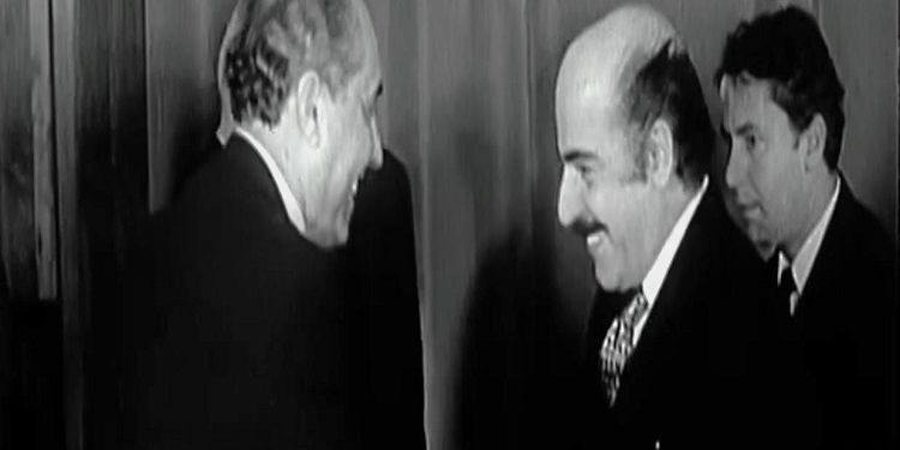
The history of communist Albania's international relations is full of twists and turns, where ideology and major alliances often dictated the fate of bilateral relations. One of these specific, but little-documented, moments is the 1973 attempt to establish diplomatic relations between communist Albania under Enver Hoxha and the Iranian Monarchy under Shah Mohammad Reza Pahlavi.
Ceremonial at the Presidium of the People's Assembly
In March 1973, in the premises of the Presidium of the People's Assembly (today the Presidency building), an official ceremony was held that marked an important diplomatic step. The Ambassador Extraordinary and Plenipotentiary of the Monarchy of Iran, Alinaghi Said Ansari, presented his credentials to the Chairman of the Presidium of the People's Assembly of the People's Republic of Albania, Haxhi Lleshi. This meeting was not simply protocolary, but reflected the political line that Enver Hoxha's official Tirana was following, towards one of the largest states in the Middle East.
In this reception, in addition to the main protagonists, high-ranking personalities of the communist regime also participated, such as the member of the Presidium of the People's Assembly, Kahreman Ylli, and the Minister of Foreign Affairs at the time, Nesti Nase. Their presence at that ceremony is also documented by the film diary made by the filmmakers of the Kinostudio "Shqipëria e Re", as well as the photos taken by the photographers of ATSH (Albanian Telegraph Agency). Likewise, in the photos in question, the presence of the career diplomat Abdi Baleta and the Secretary of the Presidium, Xhafer Spahiu, is also seen.
It is worth noting that Iranian Ambassador Ansari was not resident in Tirana, but at that time, he served as Iran's representative in Rome and from the Italian capital, he also covered Albania, the small communist state in the Balkans, one of the poorest on the European continent.
China's influence and geopolitical reality
This attempted rapprochement between communist Albania and Iran did not come by chance. Official Tirana at the time was following in the footsteps of its main ally, Mao Zedong's People's Republic of China, with which it had been closely linked since the break with the Soviet Union in 1961.
Beijing had established very close relations with the Shah of Iran, and Enver Hoxha, under this influence, tested the possibility of communication with Tehran. However, this brief “melt” of ice would soon be hit by developments in the Middle East.
The Yom Kippur War and the Breakdown of Relations
Just eight months after the ceremony of presenting credentials in Tirana by the Iranian ambassador to Rome, who would also cover Albania, in October 1973, the Yom Kippur War broke out between Israel and the Arab states.
Iran, led by Shah Pahlavi, positioned itself as a key supplier of oil and weapons to Tel Aviv, with Golda Meir aligning herself with the US, under Richard Nixon. This positioning of official Tehran caused a chain reaction in the communist states of the "Eastern Bloc", led by the Soviet Union led by Leonid Brezhnev.
Communist Albania, which held a radical stance in favor of Arab countries of the Baath Party line (such as Egypt, Syria, Iraq and Libya), after these events, decided to break off any attempt at relations with Iran. Tirana's rhetoric immediately hardened. According to official Tirana, Shah Reza Pahlavi was transformed from a potential partner into a "puppet of American imperialism and Israeli Zionism."
The Cancellation of the Embassy and the End of an Era
After this, the plan to open an Iranian embassy in Tirana was finally canceled. From October 1973 until the triumph of the Islamic Revolution in January 1979, Iran remained the target of Albanian propaganda, accusing it of being a “tool of American imperialism,” etc. Enver Hoxha did not stop accusing the Iranian monarchy of being “a threat to peace in the Middle East,” thus closing a chapter that began with handshakes in Tirana and ended with open ideological hostility.
The above are also reflected in Enver Hoxha's Political Diary (published in several issues by Memorie.al), which were later included in his book "Notes for the Middle East", published in Tirana in April 1984, a year after his death./ Memorie






Lini një Përgjigje