


 Shkruar nga Pamfleti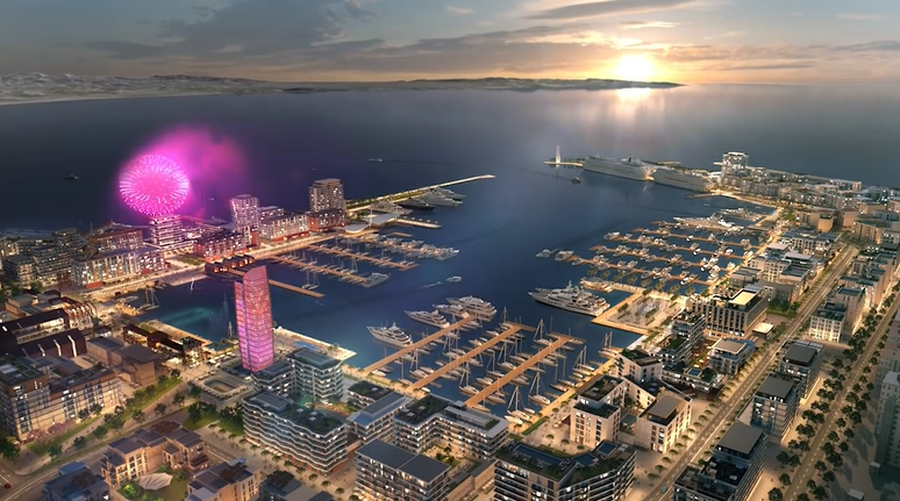
The Port of Durres, the investment that challenges the principles of the rule of law
A shocking report published by Carnegie Europe sheds light on the dark behind-the-scenes of the gigantic project at the Port of Durres, placing Albania at the center of a so-called "corrosive capital" investment scheme. The project, promoted by the government as the renaissance of the Albanian coast, has turned out to be a transaction fraught with a lack of transparency, favoritism towards foreign investors, and shifting costs onto Albanian taxpayers.
The €2 billion plan to transform the port into a luxury marina with towers, hotels and superyacht berths is backed by the UAE-linked Eagle Hills company, also known for controversial projects in the Balkans. But the Carnegie report shows that behind the facade of development lurks financial risk and environmental degradation.
According to the document, half of the initial capital of 160 million euros is guaranteed by the Albanian state, while the bulk of the fund will come from the money earned from the speculative sale of real estate. Most worrying: the project has been granted extraordinary privileges, such as exemption from social contributions and the lack of open tender procedures. This open contradiction with EU state aid rules has also cost Albania the withdrawal of a grant of 28 million euros by the European Commission.
The report compares the project to similar schemes in Belgrade and Montenegro, where the principles of the rule of law have been sidelined in favor of "rapid modernization," at the expense of institutions and nature. Meanwhile, the relocation of the commercial port to Porto Romano is turning into a parallel project covered by public funds, where environmental risk and costs exceeding 600 million euros are once again burdening the state.
What begins as a "coastal renaissance" is in fact a transformation where the public loses and investors gain through personalized laws and opaque procedures. The report calls Durrës the clearest example of corrosive capital, which finds ground in places with weak governance and little public control.
In the end, the Albanian government promised thousands of jobs and prestige in the tourism arena. But for now, citizens face a hefty financial bill, displaced pollution and an alarming lack of accountability. Meanwhile, the marina shines, but beneath the surface lie problems that deepen the crisis of trust in public institutions.
PART OF THE REPORT
Porto Romano: The Environmental Cost of Corrosive Capital
While the Durrës Yacht and Marina project exposed the financial mechanisms of corrosive capital, Porto Romano revealed its environmental cost. What began as a redevelopment of Albania’s main port for luxury tourism has created a chain reaction of ecological displacement, institutional obscurity, and public accountability. Under the banner of modernization, pollution has not been cleaned up, but displaced, and accountability has been replaced by discretion.
When the Albanian government reclassified Durrës as a tourist center, it pledged to relocate commercial ships north of Porto Romano—an industrial area already damaged by decades of oil and chemical waste storage. Construction of the new cargo port began soon after the marina agreement was signed, transforming a private redevelopment into a two-pronged transformation largely financed by public funds. Official documents describe Porto Romano as a state-of-the-art green port, yet feasibility studies are incomplete, impact assessments are delayed, and rehabilitation plans are few.52 The dredging and land reclamation needed to build deep berths risks churning up toxic sludge containing heavy metals and hydrocarbons, threatening nearby wetlands and aquifers that support local fishing and agriculture.
Closed Chapter, Bypassed Laws, Montenegro Case
Montenegro, one of the countries most advanced towards EU membership, although it has closed several chapters such as the one on public procurement, has signed investment agreements that bypass basic EU rules. The 2025 agreement with the United Arab Emirates allowed for the leasing of state-owned land for up to 99 years without public competition, exempting projects from procurement and urban planning. This legal exemption was made through a special act that prevailed over existing law – a method increasingly used in the region to favor large investments without institutional control.
Velika Plaža, Investment Spectacle on Laws and Nature
In the coastal town of Ulcinj, the multi-billion-euro project on Velika Plaža, one of the longest beaches on the Adriatic, was promoted as an example of modernization. But in reality, the agreement between the government and the investor Eagle Hills excluded any obligation for tender or transparency. Public land risked being turned into private property, while local communities – especially Ulcinj’s Albanians – were excluded from the real benefits. Resistance from civil society, including environmental organizations and the mayor himself, led to the suspension of the project, but not a complete halt to the negotiations that are still ongoing in the shadows.
Belgrade, Where Laws Are Made for Investors
The Belgrade Waterfront project is a blatant case of foreign capital exploiting governance loopholes. The investor from the United Arab Emirates received exemptions from tenders, taxes and urban planning, while the Serbian government changed laws to accommodate the project. What was promoted as a symbol of urban renaissance, in fact became synonymous with state capture, abuse of public property and lack of transparency. Citizen protests against the project turned into political movements, showing that in the face of abuse, organized resistance is possible. /Pamphlet





Lini një Përgjigje