


 Shkruar nga Pamfleti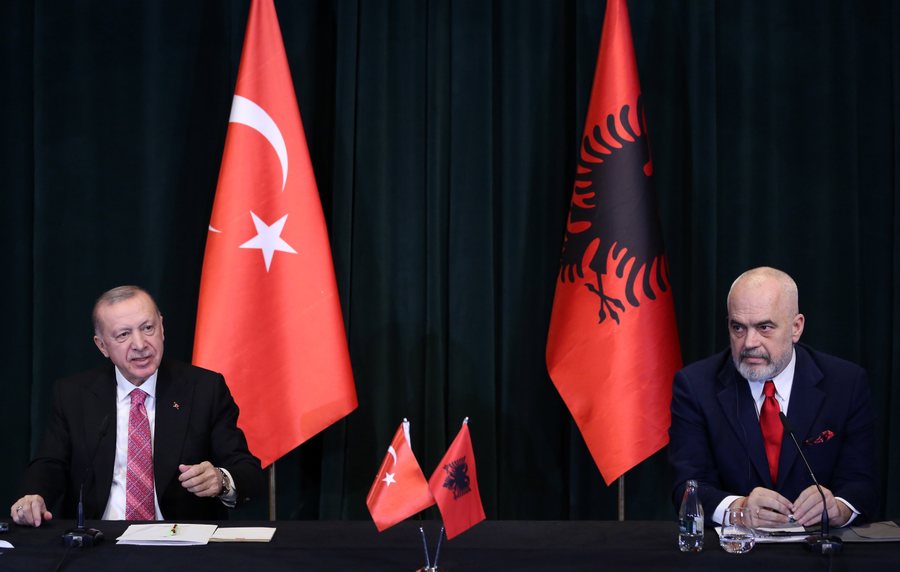
Edi Rama's visit to Israel, Turkey's stance on Gaza, the Iranian dossier, and the mysterious meeting with the Turkish ambassador show that the relationship between the two leaders has not officially broken down, but has entered the gray area of diplomatic mistrust.
The relationship between Edi Rama and Recep Tayyip Erdoğan is no longer one of ceremonial photographs, declarations of “brotherhood” and uncontested Turkish investments in Albania. Officially, Tirana and Ankara still talk about “excellent relations”. But diplomacy, as always, is not read only from communiqués; it is read from silences, from cold formulations and from messages conveyed through ambassadors.
The Pamphlet article about the meeting between Rama and Turkish Ambassador Ceyhun Erciyes raises a strong thesis: Erdoğan did not want Rama at the NATO summit in Ankara, or at least did not want him without first receiving political guarantees. The claim is based on diplomatic sources, so it should be treated as an indication, not as a publicly proven fact. But the indication is not without political basis.
Fact: there is no diplomatic divorce
Turkey and Albania remain strategic partners. In 2021, Rama and Erdoğan elevated the relationship to the level of strategic partnership and established the High-Level Cooperation Council.
In February 2024, Erdoğan stated that bilateral trade had reached around $1 billion and that the new target was $2 billion. He also said that Turkish investments in Albania were approaching $3.5 billion.
Even the Turkish embassy in Tirana presents the relationship as stable: in 2025, the trade volume reached around $1 billion and Turkey ranks among the leading investors in Albania.
So, we don't have state collapse. There are no ambassadors being recalled, no harsh public statements, no cancellation of agreements.
But there is a political cold snap.
The main rift is called Israel.
In January 2026, Rama made a high-profile visit to Israel and delivered a speech in the Knesset, with special state protocol.
For Ankara, this was a serious signal. Erdoğan has built his entire regional discourse on Israel's opposition to Gaza. Even in the meeting with Rama in New York, the Turkish Presidency emphasized that Erdoğan spoke about Israel's violations in the Palestinian territories and the need for states to act together to stop them.
In this context, Rama appeared in the opposite direction. Turkish media, including Daily Sabah, reported on the protests in Tirana against his visit to Israel and pro-Israeli statements.
This is no editorial coincidence. In Turkey, state-run media outlets are often used as political thermometers. When they start attacking a friendly leader, the message is usually not just journalistic.
The Iranian dossier: the most sensitive point
Rama has asked Ankara to close an Iranian office near the Turkish embassy in Tirana. This has not been officially confirmed, but if true, it touches a strategic nerve.
Albania has been aligned against Iran for years, especially after harboring the MEK and after cyber tensions with Tehran. Turkey, meanwhile, although a NATO ally, maintains communication channels with Iran for regional, energy and security reasons.
Here Rama is not simply asking for an administrative favor. He is asking Turkey to choose between a NATO ally and a traditional balance of its eastern policy.
NATO as the scene of a silent clash
If it is true that Ankara would prefer President Bajram Begaj instead of Rama at the NATO summit, then we have a strong personal signal. In diplomacy, choosing the level of representation is not a formality. It is a message.
However, this part remains publicly unconfirmed. Therefore, the most accurate formula is this: not proof of Rama's expulsion, but a possible indicator of a new distrust in the Rama-Erdoğan personal relationship.
Rama-Erdoğan relations have not broken down. But they are no longer untouchable.
Turkey still has major interests in Albania: economy, defense, religion, cultural influence, and strategic presence in the Balkans. Albania needs Turkey as a security and economic partner. But Rama is increasingly playing into the Israel–US–EU axis, while Erdoğan demands political loyalty in the issues where he has invested his international capital.
This is the real rift: not between Albania and Turkey, but between Rama and Erdoğan's expectation of a loyal ally in the Balkans./ Pamphlet



Lini një Përgjigje