


 Shkruar nga Pamfleti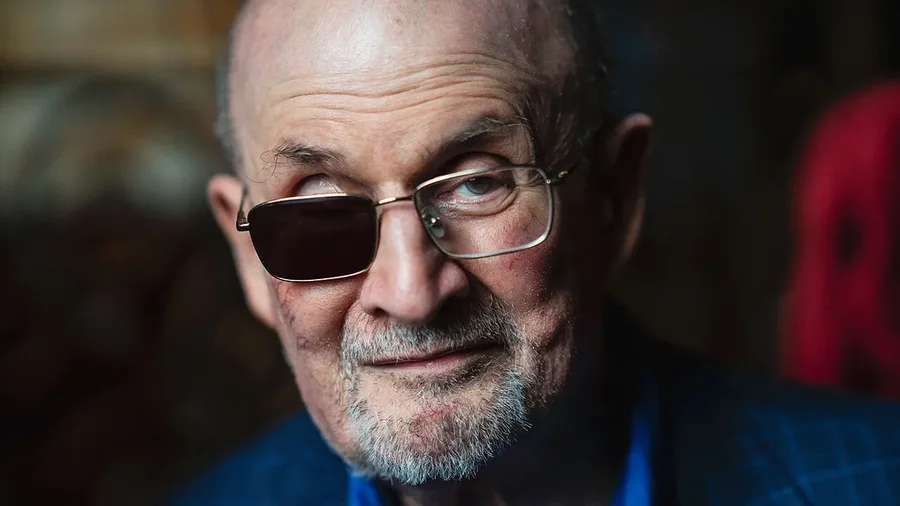
A long-persecuted author on humor, charlatans, and death
A faint scar is visible on his cheek. A darkened lens covers the spot where his right eye used to be. Yet for a 78-year-old man who was stabbed 15 times by a rabid fanatic, he is surprisingly cheerful.
For nearly half his life, Sir Salman Rushdie has lived under sentence of death, after a desperate ayatollah told Muslims it was their duty to kill him for writing a novel that allegedly insulted the Prophet. Despite a near-successful assassination attempt in 2022, he has survived long enough to write a brilliant new collection of short stories, The Eleventh Hour.
One of the (less obvious) things that annoys Sir Salman about his fame for fatwas is that people overlook the comedy of his writing. Sitting in a side room at Cliveden, a British country house that hosts a literary festival, with bodyguards standing solemnly in the background, the writer expands on this theme.
" Since the attack on [The Satanic Verses] wasn't funny, it was assumed that the book couldn't be funny. And people stopped writing about me as if my writing had humor in it ," he says.
This matters, because humor matters. In addition to bringing joy, it is a weapon in the fight against oppression. “ Lack of humor is a characteristic of narrow-mindedness; there are very few humorous dictators. Also, humor excites people more than anything else, as we see from the recent treatment of comedians in America ,” he says.
His new book slyly mocks a wide range of targets: religious fanatics, political charlatans, death itself. In a delightfully piano-playing satirical tale of revenge called “The Kahani Musician,” a secular Indian woman begins to feel a “sliver of doubt” about her husband’s atheism, “a doubt that would come to the forefront of her thinking when [he] walked out of their marriage to pursue a religious scam.” The guru in question preaches that money is “more than okay”; and “money, happy to be given spiritual approval, poured into his accounts.”

The satire is personal. Sir Salman’s life has been tainted by anti-Enlightenment thinking, by the idea that words should be answered with steel. He says he never saw the knife that blinded him in one eye. What struck him in court about the man who wielded the knife, a Lebanese-American named Hadi Matar, was “how good he was at everything.” At 24, with no previous criminal record, he had tried to kill a stranger in front of hundreds of witnesses. He would never get away with it. (He was sentenced to 25 years in prison in May.) Yet he was prepared to destroy his own life to end another. “ It’s a mystery ,” Sir Salman shrugs.
Sir Salman fears that freedom of speech is in “bad shape.” He cites the climate of fear in India and the absurd book bans in some American schools of works such as “Huckleberry Finn.” Attacks from what he calls “traditional” sources — conservatives and authoritarians — are continuing “with force.” However, he is particularly irritated by censorship from progressives, which “weakens your argument when you try to argue against oppression coming from the other side.” He throws up his hands at the killing of Charlie Kirk, a right-wing speaker who some on the left only half-heartedly condemned. “People shouldn’t be killed. Murder is a bad thing.”
He sees similarities between religious cults and MAGA. In both cases, followers compete to show their devotion to the leader and their hatred of his enemies. In a story called “Oklahoma,” he describes a “criminal king” who surrounds himself with courtiers who flatter him and accuse his opponents of crimes of which he is guilty. This king also changes the meanings of words, so that when he marries two nieces, the word “incest” is removed from the vocabulary and over time he redefines “rape as love, terror as patriotism, harassment as good governance.”
Writers are “guardians of language,” Sir Salman argues. When the powerful twist words to hide the truth or change the rules, writers have a duty to point this out. (Think of Mr. Trump claiming that the “figurative war on drugs” is a real war, as a justification for seizing extraordinary powers.)
Writers also have a role to play in what Sir Salman has called “a [figurative] global war of stories – a war between incompatible versions of reality”. He sees this in Vladimir Putin’s rewriting of history to justify the invasion of Ukraine; also in the Middle East (“two incompatible narratives about the history of this very small piece of land”); and in India, where Hindu nationalists insist they have been victimised by Muslims (“it is very strange that the 85% majority should feel that they are the aggrieved party.”) “Each side feels that their story is being subsumed and suppressed by the other story. So yes, stories can be the death of you.”
The fact that he was almost killed naturally makes him reflect on mortality. Asked about aging, he laughs: “I’m against it.” In “Oklahoma,” he asks how people should face the last days of life: calmly or furiously? One character says that some fools are “calm idiots [and] grateful for ‘beauty’ and ‘love.’” But Sir Salman offers a more subtle answer. “It doesn’t have to be one or the other. It can be both. You can be calm on Tuesday and furious on Wednesday.” /Adapted from “Pamphlet” by “The Economist”


Lini një Përgjigje