


 Shkruar nga GIAN ANTONIO STELLA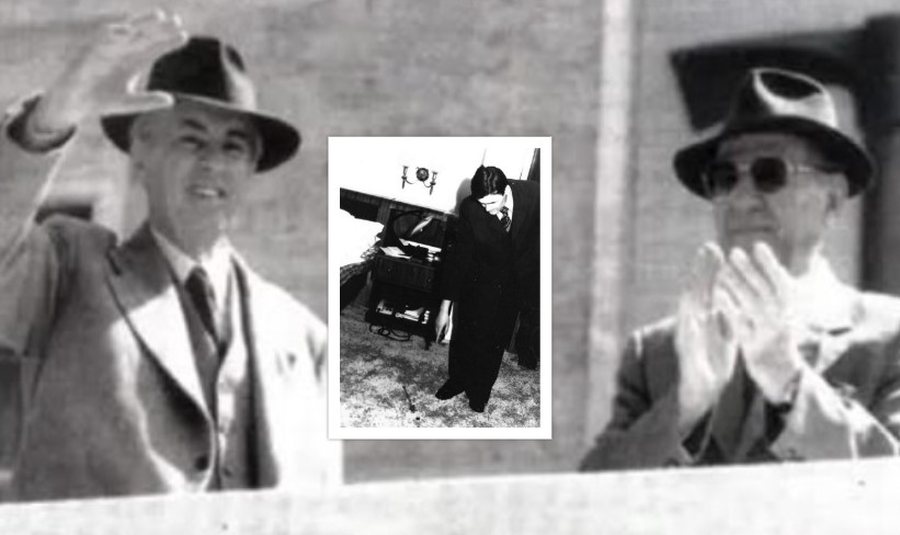
It has been 40 years since the death of the communist leader, who ruled the country from 1944 to 1985. Roland Sejko's "State Film" chronicles the brutal propaganda, and will be screened in Venice on September 4.
"So, the decision is: to expel Mehmet Shehu posthumously from the party for serious criminal offenses that contradict the party line." It is December 17, 1981, and the central committee of the Party of Labor of Albania, to the proposal to remove from the communist Olympus the recently deceased prime minister, praised without interruption for seven terms and 27 consecutive years, did not flinch. Of course, no one remembers anything similar since the time when the body of Pope Formosus, 11 centuries ago, was taken from the tomb, tied to a chair so that it stood upright, tried by his successor, Pope Stephen VI, and sentenced to death (a strange sentence, on a corpse) and then thrown into the Tiber...
But how can you say no to Enver Hoxha, the world's longest-serving dictator, now in power for 37 years, 4 more than Kim Il-Sung in Korea, 15 more than Fidel Castro in Cuba, 21 more than Mobutu in Congo? The Supreme Comrade has decided: "Let's vote: whoever is in favor, raise your hand." Everyone. "Who is against? Nobody. Long live the Party!"
Roland Sejko's film "State Film", produced by Istituto Luce-Cinecittà, will be presented on September 4 during the Venice Film Festival.
There is no sound, no introduction, only subtitles to facilitate the viewing of an extraordinary collection of propaganda videos that speak for themselves. Footage shot over decades by diligent servants of the regime to build the epic history of that savage satrap. Among these servants, as Sejko himself confessed in Alfredo C.'s film "The Image Machine" (Silver Ribbon for Best Documentary Film 2022), was Alfredo Ceçhetti, a director from the Istituto Luce sent to sing the praises of the Duce in Albania, who remained trapped there after September 8 and who in 1944 joined the service of the new Albanian Duce.
The director, who has lived in Italy for more than 30 years, but was born and raised in the Land of the Eagles, from which he fled on the first ship that left Durres for Brindisi in March 1991, remembers them well. The desperate tears of the subjects over the death of the despot in 1985. The huge six-door Mercedes 600, with the curtains closed, driving along the poor streets between carts, donkeys and people on foot, only on foot. The festive marches of young men in vests, holding picks in their hands, a symbol of work and perhaps of Leon Trotsky's split skull. The drills of schoolchildren with large gas masks to escape the toxic attacks of the capitalists.
And then the modest Balkan majorettes waving red flags and bowing to the command, composing slogans praising the regime with their troops. The teachers who taught the children, as the documentary film recounts, that the Communist Party was "an impregnable fortress." Theatrical performances that first glorified the support of the Soviet Union and then friendship with Mao's China, with Albanian actresses in make-up and with almond-shaped eyes.
And always and everywhere he is, the Supreme Comrade. He blesses the crowds. He dives into the pool. He visits the factories. He shoots ducks. He smiles at Joseph Stalin, smiles at Nikita Khrushchev, smiles at Zhou Enlai while, after breaking with Tito, he gradually switched sides to remain fixated on power. Ready to vomit on the "traitors" of the moment: "The cruel dreams of the imperialists, Titoists, Khrushchevites and their servants have turned to dust. The inevitable rupture with the Soviet revisionists is proof that our party does not spare those who betray the principles of Marxism-Leninism. We did not join China for a few rags, but for a revolutionary union... We gave Mao Zedong and the Chinese leaders a series of thoughts. When we saw that China was sinking deeper and deeper into the revisionist swamp..." And here, in the late 1970s, thousands of Chinese technicians were loaded onto buses heading to the airport. Deng Xiaoping? "A stinking fascist."
The objective: to exalt the "purity" of Albanian communism. Or more precisely: the cult of the leader. Against anyone who was a nuisance. Even if it were, indeed, the historical right wing.
"Mehmet Shehu killed himself. His grave political mistake was approving his son's engagement to a girl whose relatives included six or seven enemies of our state." A Balkan Romeo and Juliet? Not at all: "Documents and irrefutable evidence have been discovered that show that Shehu was working for the American secret services since before the war." Moreover: "during the war he was recruited by the Yugoslav secret services and the KGB."
Conclusion: "He served everyone with zeal." And here is where comrade Mehmet, a partisan with the Garibaldi Brigades in Spain since 1936, is buried.
Such was Enver Hoxha, the indomitable author of 40 books (forty!) on Marxism-Leninism, who claimed to have graduated (falsely) from Montpellier and was obsessed with building "true" communism.
Unforgettable, in State Film, is the scene where he, with a pale face, listens to the ministers' reports: "many complex and unresolved problems have accumulated... The availability of goods has greatly decreased... Queues in stores have increased... Some food products are sold with ration cards..."
Old and sick, perhaps already aware that his statues would be toppled in hate-filled riots, but still the ruler of an iron-fisted regime that would outlive him for 6 years, until 1991, he spent the last months of his life in his villa, cared for by his wife, Nexhmije.
Reclining in an armchair, with a black hat and a large scarf around his neck, he held what looked like a portrait of Aristide Bruant by Toulouse-Lautrec. A doctor who knew him from his years in France said that “he always spoke, thought, dreamed in French.” He ignored one word: liberté . /Adapted from Corriere /




Lini një Përgjigje