


 Shkruar nga Pamfleti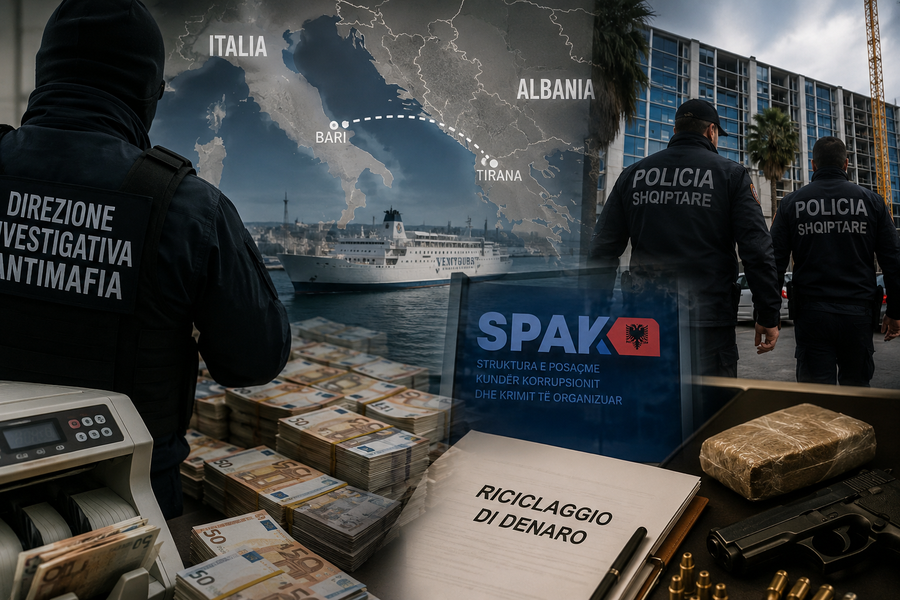
The big operation between Bari and Tirana, here's how the mafia contributes to the "dark" development of Albania
The "bridge" between Puglia and Albania is a criminal axis that winds across the Adriatic. From Bari to Tirana, it is no longer just a route for drug trafficking, but a consolidated relationship, fueled by the profits of Italian and Albanian clans operating in southern Italy and in the "bloated" economy of the Balkan country.
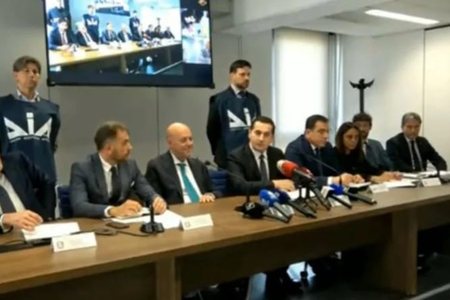
Today, that part of the sea is considered the backbone of one of the most sophisticated money laundering and drug trafficking systems in Europe. The anti-mafia operation carried out in the early hours of yesterday morning, coordinated by the Anti-Mafia Directorate in Bari and SPAK in Tirana under the umbrella of Eurojust, marked a turning point.
It was not just about uncovering a serious crime, but about lifting the curtain on a systemic phenomenon, rooted for years, where dirty money from clans flows from Puglia to the Albanian economy, deeply distorting its transparency.
Once again, Italian anti-mafia justice was in action in collaboration with the Albanian Special Prosecution, created in 2019 and dedicated exclusively to the fight against corruption and organized crime. The aim was to merge into a single investigation the alerts collected by Eurojust, the European agency for criminal judicial cooperation based in the Netherlands.
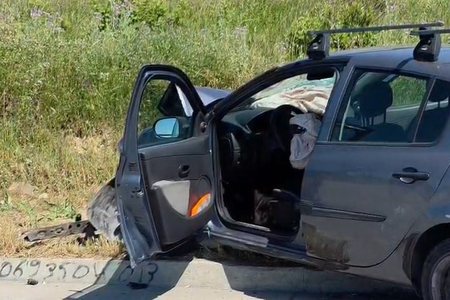
The starting point was the bloodshed in the rural areas north of Bari. The fourteen security measures issued yesterday close the circle around the tragic end of Francesco Divisti, the 26-year-old hairdresser from Barletta, who disappeared on the night of April 25 last year. Divisti, a young man who worked in his father's salon and who his mother described as a normal and caring boy, ended up the victim of a ruthless mafia execution.
Lured into a trap after a fight in the Settefrati neighborhood of Barletta, the young man was executed with several bullets. His body was then transported to an abandoned building between Canosa and Minervino Murge and set on fire to eliminate all traces, in a macabre return to the mafia technique known as the "lupara bianca".
The discovery of the half-burnt body required months of DNA analysis and ballistics expertise to arrive at an investigative truth that today sees five people from the local criminal world under investigation, among them Nicola and Saverio Dibenedetto, Antonio Lanotte, Francesco Sassi and the Albanian Igli Kamberi.
As the Bari prosecutor, Roberto Rossi, emphasized, the murder of Divisti was not an isolated episode, but the result of a conflict born within the dynamics of the mafias rooted in Puglia. For the first time, the Italian authorities officially contest the mafia method against an Albanian organization that operated directly on Italian territory.
This murder represents the "transmission belt" between territorial violence to control drug trafficking and sophisticated financial mechanisms that serve to launder dirty money. The panorama emerging from the investigations is much broader and was initially outlined by Operation "Bridge" in May 2025. That investigation, with 52 arrests and seizures of millions of euros, showed how organized crime had industrialized money laundering.
At the center of the system were the so-called “cash mules”: international bus drivers connecting Bari to Tirana. Taking advantage of their daily commute, they carried backpacks filled with cash, hiding hundreds of thousands of euros on each trip. Authorities documented illegal transactions worth over 4.5 million euros, money that physically crossed the Adriatic to evade bank controls.
Once in Tirana, this money was invested in key sectors of the Albanian economy. Investigations documented systematic reinvestments in the real estate market and luxury tourism, transforming the profits of drug trafficking into elite towers and restaurants. Among the seized companies stands out "Majestic Konstruksion", while the infiltration also affected the media, with the seizure of operators such as "Vlora Cable".
This flow of capital has created what Eurojust and SPAK call a “bloated” economy. A system where the apparent growth is not related to real market dynamics, but to the need of the clans to launder drug profits. The alarms raised by judicial authorities, from Roberto Rossi to Klodjan Braho, are clear.
The Albanian mafia is described as an "enormous international force", a "tumor" capable of affecting the development of entire economic sectors. Yesterday's operation confirms that the link between Puglia and Albania is symbiotic: the brutality of the executions serves to guarantee the stability of an economic empire that extends beyond borders.
The unraveling of Divisti's murder is considered only part of a broader strategy to crack down on the transformation of transnational crime, brutal in bloodshed and refined in financial balance sheets.
The cooperation between the DDA of Bari and SPAK in Tirana shows that only a united front can confront these criminal "holdings", which pollute the legal market of both countries with capital derived from drug trafficking. / Adapted from "Pamphlet" by "Lidentita"


Lini një Përgjigje