


 Shkruar nga Hannah Roberts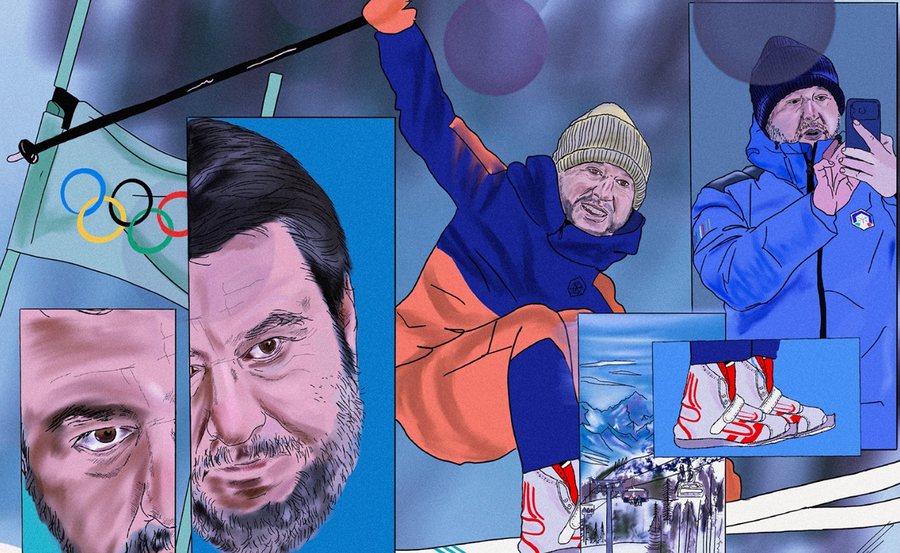
The Italian deputy prime minister is looking at the Milan-Cortina Olympics as an infrastructure boost to regain political clout, but the strategy carries huge risks...
For Italy's Deputy Prime Minister, Matteo Salvini, the Milan–Cortina Winter Olympics are not primarily about sports. They are directly related to his political survival.
Salvini, once the dominant figure on the Italian right, is now a junior partner in the government led by Prime Minister Giorgia Meloni. His authority has been further weakened by divisions within the Lega party, including the departure of deputy Roberto Vannacci, who this week created a rival political force.
In this context, the Olympics offer something more concrete than political rhetoric: major public investments, infrastructure projects and jobs in northern Italy, the traditional stronghold of the Lega.
The geographical reach of the Games and the billions of euros involved turn the sporting event into a vast regional development program, which Salvini hopes to use to bolster electoral support.
During a visit to an Olympics-related construction site in Lombardy, Salvini presented the project as a historic opportunity to build long-term infrastructure. With irony towards critics, he declared that the Olympics were being “exploited” to build works that would serve the region for decades.
However, this strategy has many opponents. The opposition 5-Star Movement MP, Gaetano Amato, argues that Salvini is trying to repair relations with the party's northern base, unhappy with the League's shift towards nationalism and controversial projects such as the Messina bridge. According to him, the funds and contracts linked to the Olympics are intended to win back votes through concrete investments.
According to political scientist Daniele Albertazzi of the University of Surrey, the Olympics reinforce Salvini's image as a "man of action," in contrast to opponents he portrays as obstructionists. But the risk is high: any cost overruns, poor management or lack of promised legacy could become a political liability for him.
The League has considerable control over Olympic projects, directing key ministries, host regions and implementation structures. This has facilitated the financing of long-standing infrastructure projects in the north, but has also led to environmental problems and local concerns, including the felling of hundreds of trees and construction in geologically hazardous areas.
Criticism has also come from within the party. Luca Zaia, the former president of the Veneto region, has opposed attempts to present the Olympics as Salvini's personal project, emphasizing the crucial role of regional authorities. According to him, these investments are works that Italy should have carried out regardless of the Olympics.
Amato questions the sustainability of this strategy. If the Olympics are plagued by failures, environmental damage or unfinished infrastructure, as happened after the Turin Winter Olympics in 2006, Salvini risks being left without other major projects to support his political ambitions. /Adapted from Politico /



Lini një Përgjigje