


 Shkruar nga Pamfleti
Russian scientists are developing a neurotechnology program codenamed "PJN-1," which will implant chips in the brains of pigeons and cameras in their bodies, turning them into remotely controlled flying vehicles similar to drones.
The ambitious program is reportedly linked to an artificial intelligence institute run by Katerina Tikhonova, the daughter of Russian President Vladimir Putin. The Times and The Telegraph report that these “cyborg pigeons” could be used for covert surveillance of targets or even for military operations, similar to the current use of unmanned aerial vehicles.
The technology is being developed by Neiry Group, a Moscow-based startup, which claims that pigeons have advantages over traditional drones due to their greater flight range, endurance, and ability to access hard-to-reach areas.
According to the technical description, small electrodes are inserted through the birds' skulls and connected to a stimulator placed on their heads, allowing operators to steer them left or right via remote control. A small solar-powered device, worn like a backpack, contains the flight control system and is connected to a camera on the front of the bird's body.
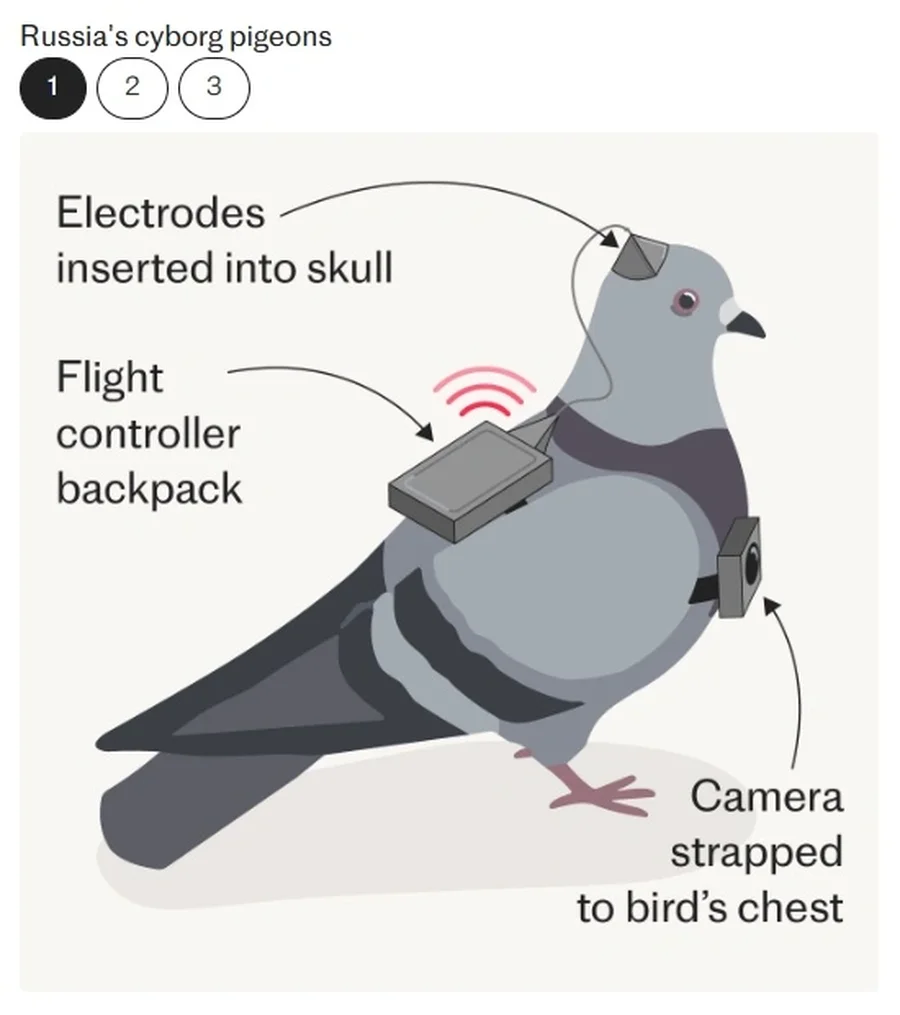
Neiry Group claims that these “biological drones” can travel up to 500 kilometers per day and can be used for infrastructure monitoring, industrial facility inspection, restricted airspace operations, and search and rescue missions. Although the company describes the project as a civilian surveillance tool, security experts believe that the technology could easily be adapted for military purposes.
Professor of neuroscience at Georgetown University and Pentagon science advisor James Giordano told Bloomberg that, theoretically, these "bio-drones" could also be used to transport biological agents into enemy territory.
Neiry CEO Alexander Panov said the technology is not limited to pigeons. He said the system could be adapted for other bird species, such as ravens for heavier loads, gulls for coastal surveillance, or albatrosses for large areas of the sea.
Reports point out that the use of animals for military purposes is not unknown to Russia. According to sources, Moscow has also used trained dolphins to protect naval bases in the Black Sea, as well as experimenting with other unconventional means of warfare.
Concerns about Neiry Group's ties to the Kremlin grew after an investigation by independent media outlet T-Invariant revealed that the company had received around 1 billion rubles in funding, partly from sources linked to the Russian state. A significant portion of the funding came from the National Technology Initiative, a program launched by Vladimir Putin in 2014 to strengthen Russia's position in global technologies.
According to claims, Neiry collaborates with the Institute of Artificial Intelligence at Moscow State University, which is headed by Katerina Tikhonova, making this project even more sensitive from a political and geostrategic point of view.







Lini një Përgjigje