


 Shkruar nga Leonid Ragozin
Zelensky, who is being pursued by a large-scale corruption investigation involving his inner circle, appears to have no cards to play against Russia or his Western allies...
Ukrainian President Volodymyr Zelenskyy’s artistic skills have earned him a reputation as a public relations genius, recognized by both friends and foes. United States President Donald Trump, who has openly attacked him in public, has called the Ukrainian leader “the greatest salesman on Earth.” A much more sympathetic voice, New York Times columnist David French, recently portrayed Zelensky as “the new leader of the free world.”
But Zelenskyy’s public relations genius may do little to change the battlefield dynamics in the Russia-Ukraine war. In recent weeks, the administration and its allies have tried hard to create the impression that the war may be approaching a turning point. But the realities on the ground tell a different story.
For example, there were official claims that in February, Ukraine made more territorial gains than Russia. Some pro-Ukrainian war monitoring platforms have supported these claims, while others have not. It is important to note that these calculations can be complicated given that there is a large gray area along the front line in which control is unclear. The advances themselves are measured at 150-200 square kilometers per month. In other words, the methodology can be manipulated to draw the desired conclusion: that Ukraine is gaining ground.
In reality, there is nothing to suggest a significant change in the battlefield dynamics that have existed for at least two years now. Most importantly, Russian troops are currently encircling a number of industrial cities in the northern Donetsk region. Their advances along the northern border, in particular, are extending the active front line by hundreds of kilometers, which is making Ukraine’s personnel shortages even more acute.
Four years into the war, the Ukrainian military has been forced to resort to brutal campaigns to enforce compulsory military conscription, pulling young men off the streets of cities and villages. Meanwhile, Russia is still able to lure volunteers by offering hefty compensation.
Ukrainian officials have also claimed that Russia is losing more troops than it is able to recruit, based on dubious casualty figures. Zelensky, in particular, has stated that the Russians suffered their highest monthly casualty rate in March of this year - 35,000. But his statement contradicted his own Defense Ministry, which claimed that the highest monthly Russian casualties exceeded 48,000 in January 2025, with an average monthly rate of approximately 35,000 throughout 2025.
Zelensky’s chief of staff, former military intelligence chief Kyrylo Budanov, also disputed the narrative that Russia is facing major difficulties with personnel deployment. He acknowledged in a recent interview that the failure of Russia’s mobilization efforts was not imminent. It should be noted that Ukraine is conducting a successful drone campaign to damage Russian oil facilities. But it is doubtful whether this will change anything beyond providing dramatic footage of oil tanks on fire for broadcast by television networks.
In April, Russian oil revenues surged to $9 billion, thanks to the US-Israeli war against Iran. The windfall Russia received in a month is equivalent to 10 percent of the loan Ukraine will receive from the European Union over the next two years to help finance its war effort.
There is no denying that Russia has suffered huge economic losses due to the war, and Russian President Vladimir Putin has acknowledged this. But the Russian economy is showing much the same decline as other European economies, also affected by the wars in Ukraine and Iran.
Russia’s per capita gross domestic product (GDP) adjusted for purchasing power parity (a measure of living standards) now exceeds that of less wealthy EU countries such as Romania and Greece, according to IMF charts. The same indicator for Ukraine is on par with Mongolia and Egypt, while the country’s critical infrastructure is in ruins and millions of Ukrainians have fled the country, most of them permanently.
With Ukraine’s prospects bleaker than ever, pro-Ukrainian audiences are eagerly awaiting any news from Russia that they hope could signal a “break in the regime.” Last month, an Instagram video by Russian influencer Victoria Bonya made waves in the West for her bold criticism of government policies. There may be frustration in Russia, but the regime is far from falling.
However, this narrative serves to distract Ukrainian and EU citizens from the painful truth that the war is heading towards a stalemate at best and towards the collapse of Ukraine at worst. Zelenskyy may have received a lifeline with the $90 billion loan, but the lack of vision and winning strategy from him and his allies is shocking.
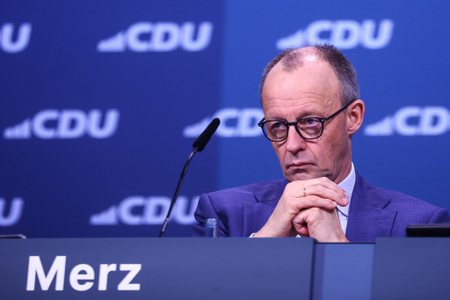
Reality is beginning to set in. German Chancellor Friedrich Merz recently suggested that Ukraine would have to cede some of its territory to Russia to end the war, but in exchange for a faster path to EU membership. The EU’s defense chief, Andrius Kubilius, has gone further, claiming that Ukraine’s NATO membership was out of the question and that EU membership would be a “complicated process.” Instead, he proposed a military union of Ukraine and other European countries, an idea that Moscow will reject, interpreting it as NATO through the back door.
What these contradictory statements demonstrate is that the main bargaining over the contours of peace is currently taking place not so much between Zelensky and Putin, but between Zelensky and his Western, mainly European, allies.
As Budanov recently argued, the positions of Kiev and Moscow may be closer to what is realistically achievable in peace talks. But Zelensky must show at least some kind of gain for Ukraine when a very unpalatable version of a peace treaty is finally signed. Ideally, that gain would be EU membership or real security guarantees, but as the statements by Merz and Kubilius suggest, the chances of achieving both are slim.
Disillusionment among Ukrainians is already palpable. The head of the Ukrainian parliament’s fiscal committee, Danylo Hetmantsev, said European officials should first stop using Ukrainians as “a tool for solving someone’s geopolitical tasks” or as a “human shield.” They have no right to determine Ukraine’s fate, he insisted.
But Zelensky, who is being pursued by a large-scale corruption investigation involving his inner circle, appears to have no cards to play against Russia or his Western allies. The status quo in which he holds the position of a war leader serves him well, but it is becoming increasingly unsuitable./ Adapted from "Pamphlet" by "Aljazeera"



Ah po, Al Jazeera!????