


 Shkruar nga Pamfleti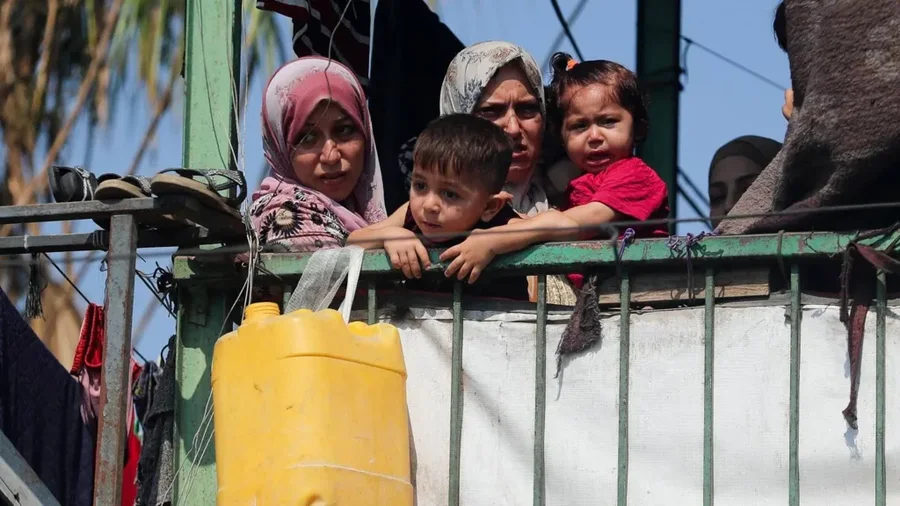
Negotiations between Israel and Hamas in Qatar over a new ceasefire in Gaza and a deal to release hostages are on the verge of failure, according to Palestinian officials familiar with the details of the discussions.
A senior official told the BBC that Israel had "bought time" during Prime Minister Benjamin Netanyahu's visit to Washington this week and had deliberately blocked the process by sending a delegation to Doha with no real authority to make decisions on the main points of disagreement.
They include the withdrawal of Israeli troops and the distribution of humanitarian aid.
Before leaving the US on Thursday, Netanyahu struck a positive tone, saying he hoped to reach a deal "within a few days."
He said the proposed deal would see Hamas release half of the 20 living hostages it still holds and just over half of the 30 dead hostages during a ceasefire that would last 60 days.
Since last Sunday, Israeli and Hamas negotiators have participated in eight rounds of "close" indirect talks in separate buildings in Doha.
The negotiations were led by Qatari Prime Minister Sheikh Mohammed bin Abdul Rahman Al Thani and senior Egyptian intelligence officials, while US envoy Brett McGurk also participated.
The mediators have conveyed dozens of verbal and written messages between the Hamas delegation and the Israeli delegation, which has included military, security and political officials.
But on Friday evening, Palestinian officials familiar with the negotiations told the BBC that they were on the verge of failure, with both sides deeply divided on several contentious issues.
They said the most recent discussions had focused on two of these issues: the mechanism for providing humanitarian aid to Gaza and the extent of the Israeli military withdrawal.
Hamas has insisted that humanitarian aid should enter Gaza and be distributed through United Nations agencies and international aid organizations.
The second major point of disagreement is the extent of the Israeli withdrawal.
During the fifth round of talks, Israeli negotiators reportedly handed the mediators a written message stating that Israel would maintain a limited "buffer zone" inside Gaza that was between 1 km and 1.5 km (0.6-0.9 miles) deep.
Hamas, according to a Palestinian official who participated in at least two of the rounds of talks, saw this proposal as a possible starting point for compromise.
However, when Hamas requested and received a map depicting Israel's proposed withdrawal zones, the document contradicted the previous message, showing military positions much deeper. The map reportedly showed buffer zones that were up to 3 km (1.8 miles) deep in certain areas and confirmed a continued Israeli presence over large areas of territory.
They covered the entire southern city of Rafah, 85% of the village of Khuzaa east of Khan Younis, significant parts of the northern cities of Beit Lahia and Beit Hanoun, and eastern neighborhoods of Gaza City, such as Tuffah, Shejaiya, and Zeitoun.
Hamas officials saw the map as a dishonest maneuver by Israel, further damaging trust between the parties.
Palestinian officials accused the Israeli delegation of deliberate delay to create a positive diplomatic backdrop for the Israeli prime minister's recent visit to Washington.
The official also claimed that Israel was pursuing a long-term strategy of forced displacement under the guise of humanitarian planning.
He claimed that Israeli Defense Minister Israel Katz's plan to relocate Palestinians to a "humanitarian city" in Rafah was part of a broader effort to permanently relocate them.
Under the plan, Palestinians would be subjected to security checks by Israeli forces before being allowed to enter and would not be allowed to leave.
Critics, both domestically and internationally, have condemned the proposal, with human rights groups, academics and lawyers calling it a plan for a "concentration camp".
The UN says 86% of Gaza is within Israeli militarized zones or covered by Israeli evacuation orders.
With the talks at a critical juncture, the Palestinian side is calling on the US to intervene more forcefully and pressure Israel to make meaningful concessions.
Without such intervention, mediators warn, the Doha negotiations could fail completely.
This is a scenario that would further complicate regional efforts to achieve a lasting ceasefire and avoid a wider humanitarian catastrophe in Gaza.
Diplomats in Doha say there is still a narrow window for compromise, but the situation remains fragile. "This process is hanging by a thread," said one regional official, adding that "if something doesn't change dramatically and quickly, we could be heading for a collapse."
The Israeli military launched a campaign in Gaza in response to the Hamas-led attack on southern Israel on October 7, 2023, in which about 1,200 people were killed and 251 others were taken hostage.
At least 57,823 people have been killed in Gaza since then, according to the Hamas-run territory's health ministry. / Adapted from BBC Pamphlet/






Lini një Përgjigje