


 Shkruar nga Francesco Brusa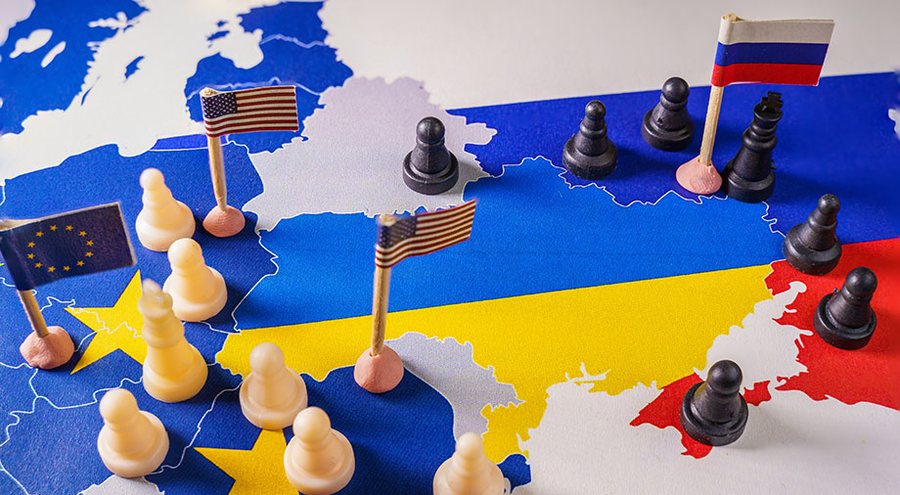
The open-account conference to rebuild Ukraine, amid hopes for "final victory" and "multilateralism," raised only $10 billion...
At the opening of the Conference on Reconstruction of Ukraine, the impression was that various European and American leaders were speaking directly to the public, but with their "domestic audience" in mind.
Everyone agreed on the basic vision: we are ready to support Kiev until the end, and thanks to such unity, it will be possible to bring the country out of the ravages of war; indeed, we can hope for a "real economic and social miracle."
References to the Marshall Plan abound in this regard, including the emotional investment of European governments in the continent's post-war reconstruction efforts.
This was first mentioned by Ukrainian President Volodymyr Zelensky, who was greeted with prolonged applause, as was White House Special Envoy Keith Kellogg, who even made comparisons to Afghanistan and Iraq.
But precisely beneath the rhetoric of cohesion (accompanied by high-sounding historical parallels) nuances and divergences can be seen, reflecting the hesitations of different countries: while for Estonian Prime Minister Kristen Michal, the goal of supporting Ukraine is a "final victory" over Russia ("there is no plan B", she warns), other representatives prefer less clear formulas, already heard on many occasions to the point that they now seem very vague, such as a "just ceasefire" (Greek Prime Minister Mitsotakis) or a "peace through multilateralism" (Spanish Prime Minister Sánchez), or in any case "until we manage to bring Vladimir Putin to the negotiating table" (German Chancellor Merz).
It is Merz himself who raises the issue of internal divisions within the European coalition. In his speech, he reproaches Slovakia for its obstructionism regarding sanctions against Moscow (the 18th package is still awaiting approval). On the other hand, he flatters Washington: "dear Americans, be with us!" he says, trying to curry favor with the unpredictable US leadership. And then comes the almost sugary response from Kellogg (whose presence Giorgia Meloni boasts about): "we are here with you," he says, speaking briefly in German. But it is fair to wonder in what sense, especially when, thousands of kilometers away from Rome, US Secretary of State Marco Rubio is meeting with Russian Foreign Minister Sergei Lavrov. Despite everyday opinions, it is now clear that the White House is pursuing its own path regarding the Ukraine dossier, even seeking to use it as a "testing ground" to redraw relations with the rest of the world.
The US envoy is clear: according to him, Ukraine’s reconstruction is an opportunity to embrace a “new type of governance” and a “new model of capitalism” at the global level, reimagined through entrepreneurship with its three ESG pillars (management, society and environment). Indeed, everyone agrees on this: public investment alone is not enough; the key is to enable Kiev to attract private capital (in a “balanced combination of multilateral and bilateral partnerships”, according to Minister Giorgetti). Ukraine’s Minister of Economy, Yulia Svyrydenko, herself has confidently announced “large-scale privatizations” that will impact the country and allow it to move towards integration with the European Union.
In this regard, a further ambiguity: while the leaders gathered in Fuksas's Cloud proudly allocate 6-figure sums for humanitarian aid and infrastructure reconstruction projects, they simultaneously do not hide the fact that all this is intertwined with the development of the defense and military sectors, now identified as the main driver of industrial growth for the continent. But with what political direction?
Some of those present timidly try to mention the "rule of law" as the compass that should guide massive investment; others, in full harmony with the "Cold War" atmosphere that permeates much of the discussion, revive the concept of a "free world" that will be protected from external threats.
After all, the much-vaunted Marshall Plan arrived on the ruins of a conflict that was already over; yesterday, reconstruction was envisioned, while Moscow launches its most ferocious attacks since the invasion.
Therefore, it is likely that Zelensky is in Rome, but has his head in London, where the Volunteers have gathered and are greeting from afar, promising concrete steps to "secure" Ukrainian skies. /Adapted from Pamphlet by Il Manifesto/





Lini një Përgjigje