


 Shkruar nga Pamfleti
Albania ranks slightly higher than the bottom 3 countries, but lagging behind Serbia and Montenegro...
The International Monetary Fund's forecasts show a significant increase in GDP per capita in euros across Europe by 2030, however, without drastically changing the ranking based on purchasing power parity.
Gross domestic product per capita is one of the most basic tools for comparing economies and in most of Europe, the trend is increasing.
However, an increase in an index does not necessarily mean that a country is outperforming others.
Rankings change as all economies move together. Often, a country's position in the rankings captures the picture better than the absolute number. So which countries are expected to be at the top by 2030, and will there be any significant shakeups?
Euronews Business examined the Fund's forecasts for the world economic outlook for 2025 and 2030, both in terms of nominal GDP per capita and in terms of purchasing power parity (PPP), which takes into account price differences between countries.
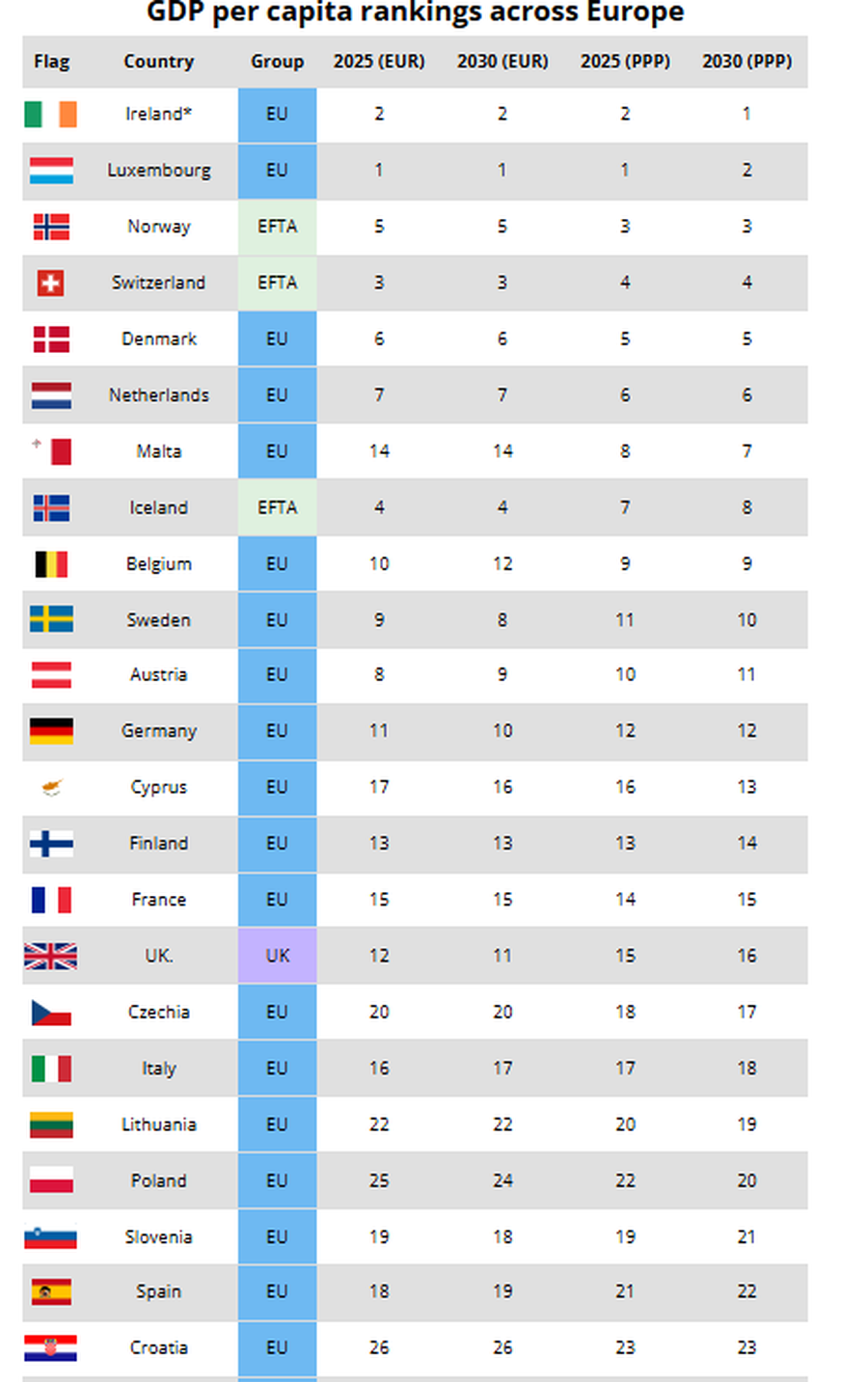
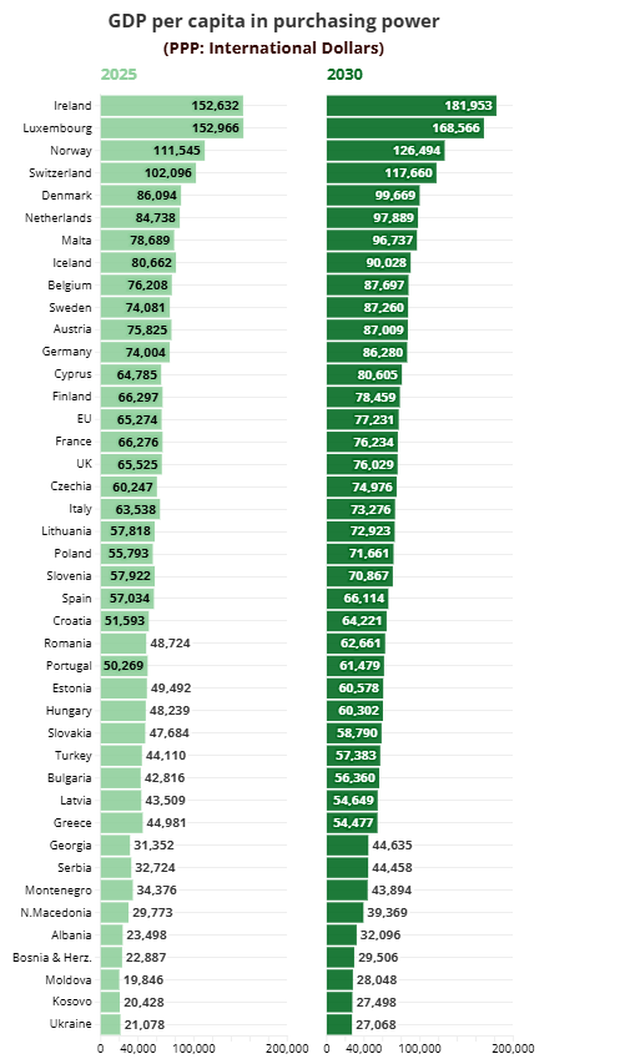
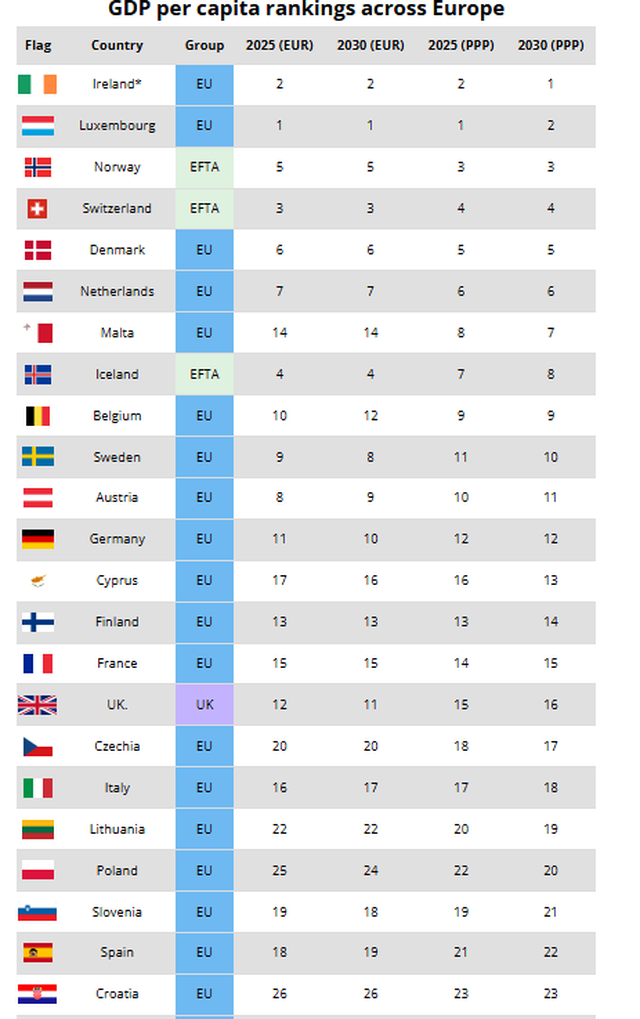
Ireland is expected to top the ranking based on purchasing power parity by 2030, surpassing Luxembourg, which came first in 2025, among 41 European countries (European Union member states, candidate countries, EFTA members and the United Kingdom).
However, this figure comes with an important caveat. Ireland's GDP is heavily influenced by the presence of multinational companies and, as the head of the Institute of Economic and Social Research, Alan Barrett, points out, gross national income (GNI) better reflects the country's real economic activity.
Based on World Bank data on GNI in 2024, Ireland would not even be in the top four.
Norway, Switzerland and Denmark are expected to complete the top 5, with their positions remaining stable between 2025 and 2030.
Of the five largest economies in Europe, Germany ranks 12th, followed by France in 15th and the United Kingdom in 16th. Italy is in 18th and Spain is in 22nd.
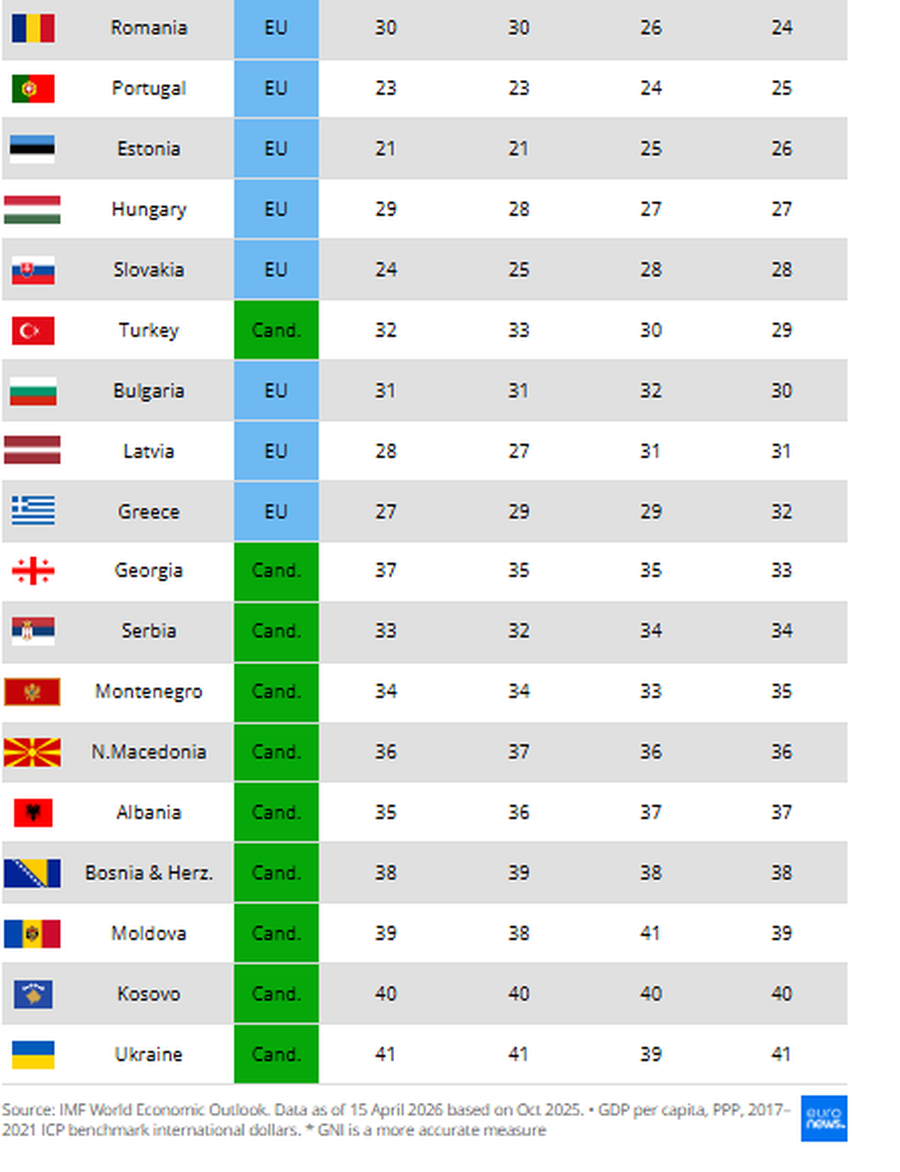
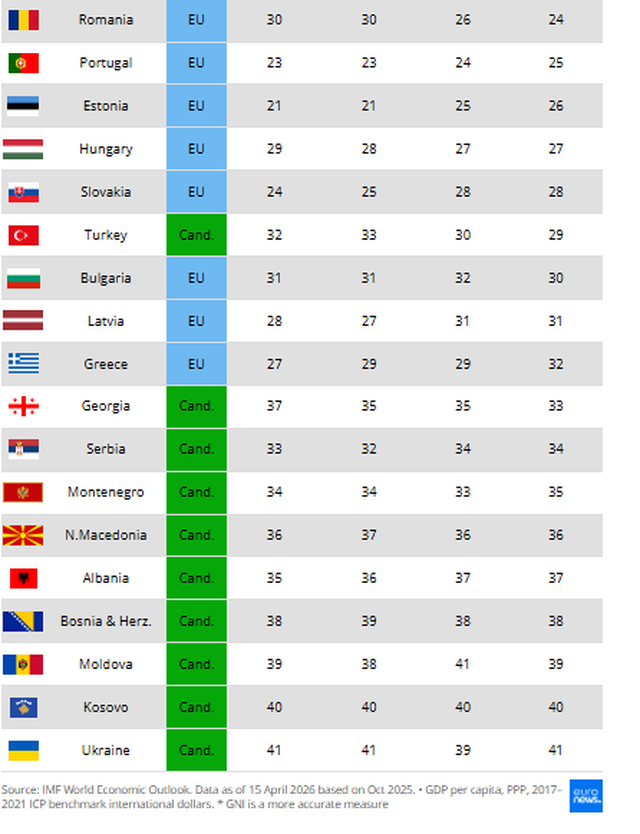
The last positions are dominated by candidate countries for EU membership, with Ukraine, Kosovo and Moldova at the bottom of the list.
Albania ranks slightly higher than the bottom 3 countries, but lagging behind Serbia and Montenegro.
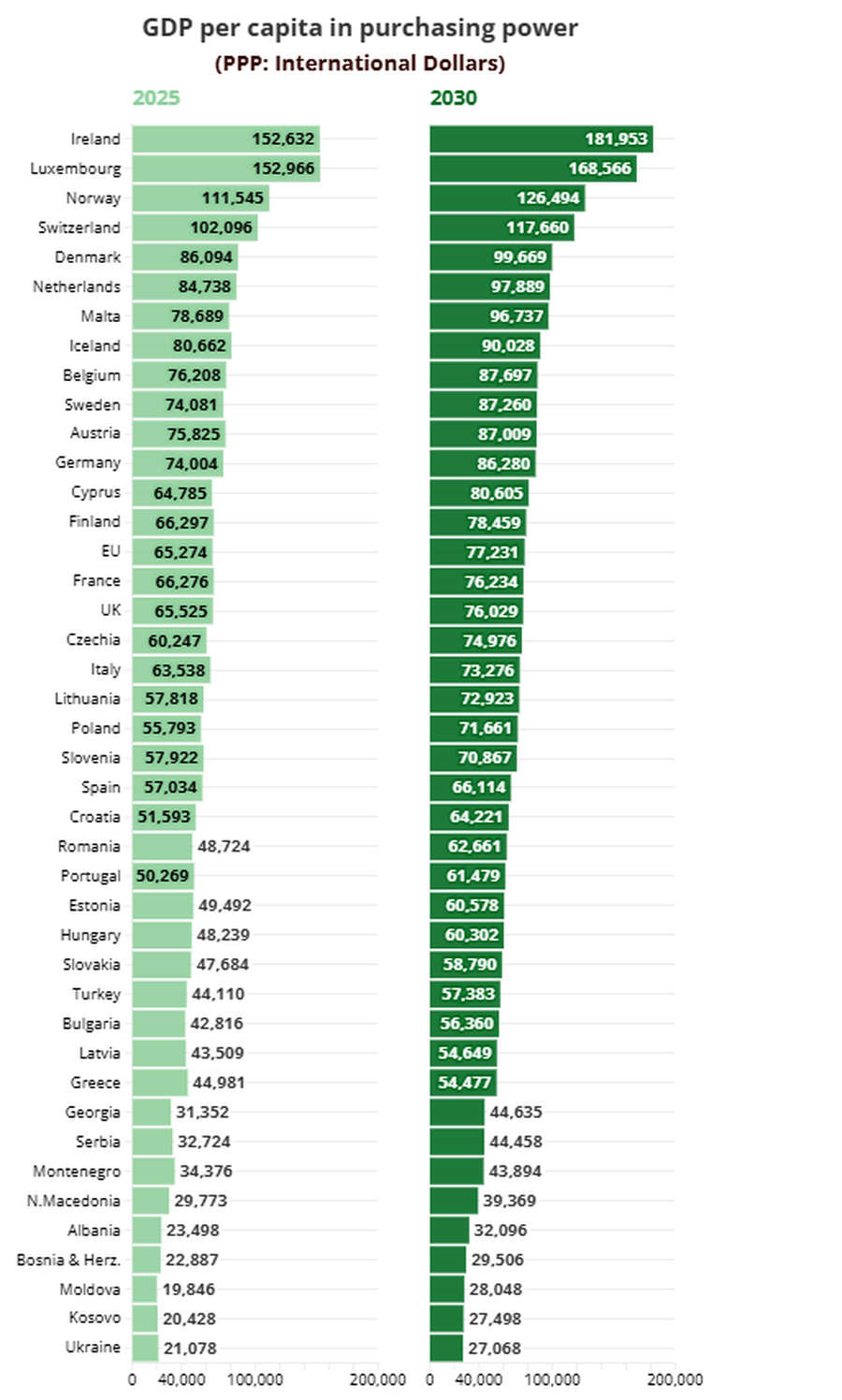
The exception is Turkey, which is projected to rank 29th by 2030, above three member states: Bulgaria, Latvia and Greece.
Fifteen countries are expected to maintain their position unchanged between 2025 and 2030. Greece sees the biggest decline, falling from 29th to 32nd place, while Cyprus sees the biggest increase, from 16th to 13th place.
No other country is projected to move more than three places.
The difference between nominal prices and prices in purchasing power parity terms also reveals significant discrepancies. Malta, Romania, Poland and Turkey rank significantly higher in purchasing power parity than in nominal terms, indicating that real standards of living are higher than the absolute figures suggest.
In contrast, in countries such as Estonia, the United Kingdom, Iceland and Latvia, the ranking based on purchasing power is lower than the nominal one.
At the top of the list, the differences are striking. Ireland and Luxembourg stand out by a large margin, with estimated GDP per capita of $182,000 (about 168,000 euros) and $167,000 (about 154,000 euros) respectively in international dollars.
This is followed by Norway and Switzerland, which are expected to exceed $115,000 (around €106,000) by 2030.
Denmark leads with $100,000 (around 92,000 euros), almost double that of Greece, which is the lowest among member states at $54,000 (around 50,000 euros).
Among the major economies, Germany has the highest purchasing power ($86,000 or around 79,000 euros), while Spain has the lowest ($66,000 or around 61,000 euros), with a difference of around 31%.
Outside the Union, the picture is even bleaker: Almost all candidate countries are below $50,000 (approximately 46,000 euros), while some are below $30,000 (approximately 28,000 euros), about half the Greek level.
In nominal euro terms, the gap is even wider. The International Monetary Fund's projections put GDP per capita from 7,276 euros in Ukraine to 152,417 euros in Luxembourg by 2030.
Even without Luxembourg and Ireland (137,819 euros), the differences within the Union remain considerable.
Denmark ranks third among member states with 84,128 euros, followed by the Netherlands (79,613 euros), Sweden (73,104 euros) and Austria (67,406 euros).
Germany, with €65,924, is in 10th place overall and is the only one of the five largest European economies to enter the top ten.
The United Kingdom comes in 11th place with €64,360.
Outside the European Union, Switzerland (127,846 euros), Iceland (108,366 euros) and Norway (93,046 euros) are also in the top five overall.
Again, the ranking is closed by Ukraine, Kosovo and Moldova, while Albania leaves Bosnia and Herzegovina behind. /Pamphlet/






Lini një Përgjigje