


 Shkruar nga Gjergj Zefi
Recent statements from Washington and Tehran point to the new crisis of global diplomacy: the politics of impulse is replacing state responsibility, as the world moves dangerously closer to another major conflict.
From Washington to Tehran, the rhetoric of recent days resembles more a nervous contest between teenagers than the communication of political leaders who carry the fate of millions of people on their shoulders.
One declares that he was ready to strike, but “the Gulf allies wouldn’t let him.” The other threatens “surprises” if the war resumes. Amidst this verbal theater, markets fluctuate, regions destabilize, and the world is held hostage by personal egos, electoral calculations, and displays of force that resemble spectacle more than diplomacy.
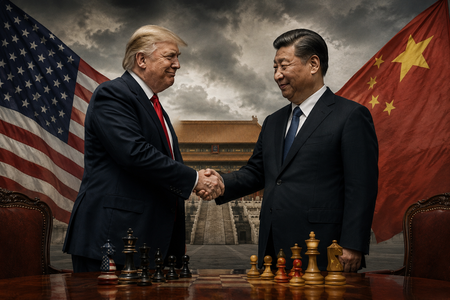
Donald Trump, with his usual ultimatum-style, is treating a nuclear crisis like a televised negotiation. The message coming from Washington is not that of a superpower in control of the situation, but of an administration vacillating between military pressure and fear of the consequences. When the US president hints that he was “an hour away from an attack” but backs down after phone calls from Arab allies, the problem is not just diplomatic; it is a matter of strategic seriousness.
On the other hand, Tehran chooses the language of “surprises.” It is a vague formula, built to produce fear, uncertainty and psychological effect. But diplomacy is not built on riddles and coded threats. When an entire region lives on the tension of missiles, militias and energy crises, such statements do not sound like strength; they sound like irresponsibility.
The biggest problem is that this climate is normalizing impulse politics. Global leaders are communicating with the world through spur-of-the-moment emotions, spontaneous statements, and media games. One day they talk about frontal war, the next day they talk about negotiations. One day they warn of “major strikes,” the next day they seek diplomatic solutions. This instability is far more dangerous than the military rhetoric itself.
In this picture, the Gulf countries are appearing more rational than the very powers that claim to control the global order. Saudi Arabia, Qatar, and the Emirates know that the war will not remain on military maps; it will enter their economies, energy infrastructure, social stability, and world markets.
The world does not need leaders who speak like commanders in action movies. It needs cool diplomacy, strategic clarity, and political responsibility. Because a conflict between the United States and Iran is not a duel of egos between two men looking to look tough in front of the cameras. It is a crisis that could ignite the Middle East, hit the global economy, and produce consequences that no one will be able to control later.
History has shown that the most dangerous wars do not always start from long-term plans. They are often born from leaders who lose their sense of proportion and start believing their own propaganda. Wasn't that the case with Hitler?!/ Pamphlet



Bota nuk ka me leader por, breshka, hardhuca, gjarberinj, buburreca, minj, urithe e lista vazhdon deri te babreksi i fundit.