


 Shkruar nga Pamfleti
Under the banner of peace: is the new Board turning into a legitimizing platform for authoritarian regimes?
The Peace Board, an initiative aimed at promoting stability and post-conflict reconstruction, starting with Gaza, met for the first time in Washington on February 19. Representatives from some 27 member states and several observer countries were at the table. Funds were pledged, reconstruction, a transitional government, the disarmament of Hamas, and an international stabilization force were discussed.
On paper, such an initiative seems necessary. Gaza needs reconstruction, the region needs stability, the international community needs a coordination mechanism. But beyond the diplomatic statements and official photos, an inevitable question arises: who is building peace, and with what credibility?
The composition of the Peace Board raises serious dilemmas. Many of the leaders involved represent political systems characterized by strong central control, restrictions on the opposition, and pressure on the media.
Mostafa Madbouly , Egypt's prime minister since 2018, acts under the presidency of Abdel Fattah el-Sisi, a figure who has consolidated power for more than a decade, amid criticism for restricting political freedoms.
Hakan Fidan , Turkey's foreign minister and former intelligence chief, has been one of the architects of President Recep Tayyip Erdoğan's policies, especially after 2016, a period marked by increased institutional control and a crackdown on political opponents.
Hun Sen, the leader of Cambodia's ruling party, is the successor to a system dominated by the same political force for decades. He took over after the resignation of his father, Hun Sen, in a transition that critics have described as a family consolidation of power.
In Central Asia, Kassym-Jomart Tokayev in Kazakhstan and Shavkat Mirziyoyev in Uzbekistan lead systems that, despite some declared reforms, remain characterized by strong political control and limited space for real opposition.
To Lam in Vietnam represents a one-party regime, where political pluralism does not exist and state control over institutions is complete.
In Europe, Viktor Orbán , in power since 2010, has built the so-called "illiberal democracy" model, with profound changes in the justice system, the media, and institutional balances.
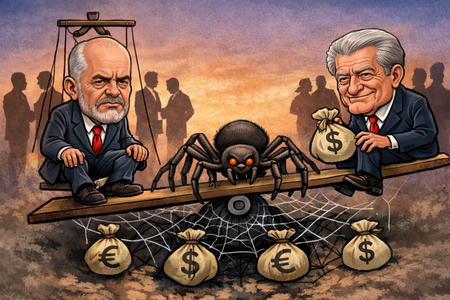
In this panorama, the participation of Albanian Prime Minister Edi Rama takes on a special dimension. Rama comes to this forum with a fourth term in power. His government has faced internal accusations of corruption and ongoing political tensions. Relations with the American administration are not at their highest point. And his engagement in such forums also serves as an instrument for internal political consumption.
While the idea of an international mechanism for peace and reconstruction is a worthy aspiration, the involvement of leaders with a long history of political dominance or authoritarian practices raises questions about real priorities. Many of them have a primary focus on maintaining control in their countries, and not necessarily advancing democracy or transparency. The only country that really has an interest is Kosovo, which is not a member of the UN and other organizations. But all the others, including Edi Rama, do so only for political credo in their countries. /Pamphlet


Lini një Përgjigje