


 Shkruar nga Pamfleti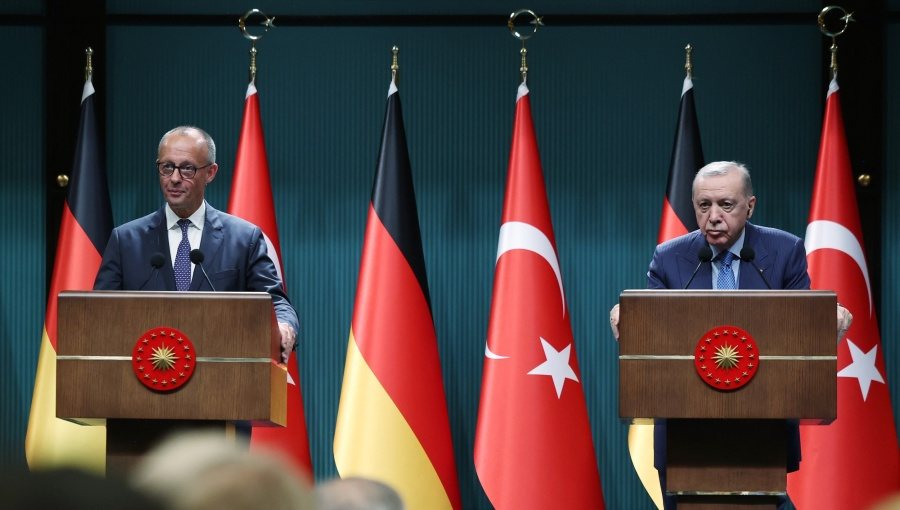
A joint press conference held in Ankara by Turkey's leader, Recep Tayyip Erdogan, and his German counterpart, Friedrich Merz, on October 30 was not without tensions between host and guest.
Merz was visiting Turkey for the first time as German Chancellor. He calmly stated that he considers Turkey a close partner of the European Union and wants to develop bilateral economic relations.
"I personally, and the German government, see Turkey as a close partner of the European Union. We want to continue to facilitate the path to Europe," Merz said at the press conference. Turkey has been trying to join the European bloc for decades.
Merz added that he and Erdogan spoke about migration and wanted to make further progress on repatriating failed asylum seekers. The EU pays Turkey a fund each year to ensure its external borders are not overwhelmed by migrants trying to reach the continent through its borders.
But Merz and Erdogan exchanged some harsh words regarding the plight of Gaza.
Erdogan said Germany showed ignorance of Israel's "genocide" and attacks on Gaza, while the German leader said Berlin had stood by Israel since the latter suffered the cross-border attack by Hamas on October 7, 2023, and that he believed that the Israelis had since then exercised their right to self-defense.
"It would have only taken one decision to avoid countless unnecessary casualties. Hamas should have released the hostages earlier and handed over its weapons," Merz said.
He concluded that he hoped the war was coming to an end with the ceasefire agreement brokered by the US and supported by Turkey.
The latter played its part in a "coordinated clampdown" that forced Hamas to surrender and paved the way for applause for Donald Trump as a peacemaker.
A UN investigation has concluded that Israel committed genocide in the Gaza enclave. Israel has rejected all accusations of genocide as politically motivated, while claiming that its military is taking steps to minimize harm to civilians in Gaza.
In other comments, Erdogan referred to the potential for NATO allies Turkey and Germany to focus on joint defense industry projects. Merz recently approved a deal that will see Turkey pay billions of dollars to buy Eurofighter Typhoon fighter jets. British Prime Minister Keir Starmer, who met Erdogan in Ankara on October 27, this week confirmed the deal. The United Kingdom, like Germany, is a member of the Eurofighter consortium.
He also reiterated Ankara's long-standing desire to join the European Union.
Merz did not address this point directly. Instead, he spoke of Turkey as a close partner of the EU, outlined his hopes that bilateral economic relations could develop, and mentioned the transport sector and migration as two areas where there could be more cooperation.
On the day of Merz's visit to Turkey, The Economist newspaper published an article titled "Turkey's President is Moving Towards the Destruction of Democracy."
On the eve of the visit, the World Justice Project released its latest Rule of Law Index, which showed that Turkey had fallen one place compared to last year. It fell to 118th place out of 143 countries assessed.
Also ahead of the visit, Human Rights Watch director general Philipp Frisch urged Merz not to ignore Turkey's attack on rights and democracy.
Merz's visit also coincided with a new academic study warning that the European Court of Human Rights (ECHR) is at risk of legitimizing Turkey's authoritarian turn by relying too heavily on subsidiarity, a legal doctrine that tells Strasbourg judges to defer to national authorities if those authorities appear to be applying the court's standards.



Lini një Përgjigje