


 Shkruar nga Pamfleti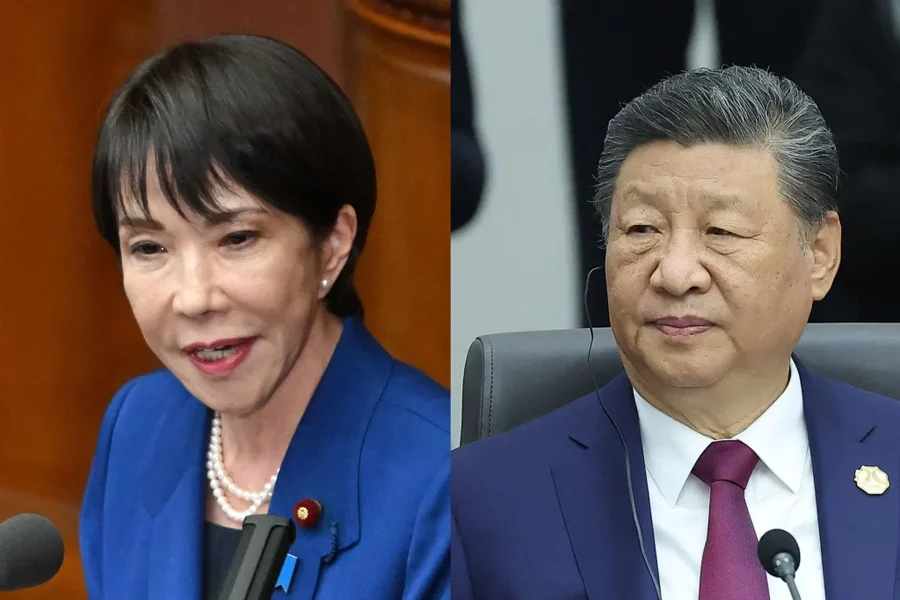
Tokyo-Beijing on the verge of a clash: How Takaichi's sentence ignited the most dangerous crisis in Asia
" If China were to deploy warships and use force, this could be considered a situation that threatens Japan's survival ."
With this statement, given in response to a possible Chinese blockade of Taiwan, Japanese Prime Minister Sanae Takaichi ignited one of the most serious diplomatic crises in recent years between the two Asian powers.
Beijing's reaction was harsh and immediate: over four hundred thousand seats on tourist flights were canceled, imports of Japanese fish products were suspended, the distribution of films and cultural content was postponed, while patrols around the disputed Diaoyu/Senkaku islands were significantly increased. These punitive measures were accompanied by direct demands for the withdrawal of the statement, which China considers a violation of the "One China" principle, but also by open threats, including that of the Chinese consul general in Osaka who underlined in a post that "there would be no choice but to cut off that dirty head without any hesitation".
Takaichi's statement breaks with Tokyo's traditional stance, characterized for decades by a policy of so-called "strategic ambiguity" on the Taiwan issue, where the "One China" principle is officially accepted but any change to the status quo by force is opposed. By describing a possible Chinese intervention as an existential threat, the prime minister opened the discussion about a more active role for the Japan Self-Defense Forces in a future crisis, striking an important internal sensitivity for the Chinese Communist Party, for which the Taiwan issue is a fundamental part of political and national identity.
For China, Taiwan is not simply a territorial issue. After the founding of the People's Republic, the Kuomintang forces defeated in the civil war took refuge on the island of Formosa, while the idea of reunification became an unchanging objective of the Party. With the arrival of Xi Jinping, this goal became part of the ambitious project of "national rejuvenation". However, the current tensions with Japan do not stem only from Taiwan, but from a deep clash of historical memories.
After Mao Zedong’s death, the traumas of the Cultural Revolution and economic failures forced the Party to construct a new narrative of legitimacy. Patriotism was placed at the center of social education and closely linked to economic recovery. World War II, called in China the “war of resistance against Japanese aggression,” was repurposed as the fundamental moment that justified the Party’s role as the protector of the nation. The Nanjing Massacre, the sexual slavery of “comfort women,” and other atrocities of the Japanese military became irreplaceable elements of national identity and powerful political instruments. According to this logic, any sign coming from Japan that is perceived as a return to the militarism of the past gives the Communist Party space to legitimize its position domestically through a reactive nationalism.
On the other hand, Takaichi's statements are rooted in the tradition of postwar Japanese conservatism, which has often sought to downplay Japan's imperial-era aggression, presenting it as part of the violent climate of the past century. This political approach was most notably embodied by Shinzo Abe, who, during his terms in office, sought to free Japan from the constraints of the postwar era and give the country a full role on the regional and global stage. He saw the growing role of the Self-Defense Forces not as a threat, but as a sign of the sovereign normality of the Japanese state. Sanae Takaichi is a direct heir to this political line, which considers Japan a key player in the Indo-Pacific security architecture.
The current clash between Beijing and Tokyo over Taiwan is, in fact, a clash of two different narratives about history and identity. For China, the revival of painful memories of Japanese aggression strengthens domestic legitimacy and requires vigilance against any signs of Japan’s military normalization. For conservative Japan, the desire to overcome its “post-war complex” has become a catalyst for rethinking its role as an independent power in the region.
These two worldviews, fueled by memories that often disagree on even the most basic facts of the past, are now clashing on East Asia’s most delicate issue. As this crisis shows, coming to terms with history is never simply an academic matter; it is a political act that shapes today’s foreign policy and, in this case, the future of stability in the Indo-Pacific. / Adapted from “Pamphlet” by “Inside Over”





Gjaku i te pareve dhe e shkuara e hidhur nuk falet e sherri mes kafsheve njerez do shkoje ne pafundesi.