


 Shkruar nga Mark Galeotti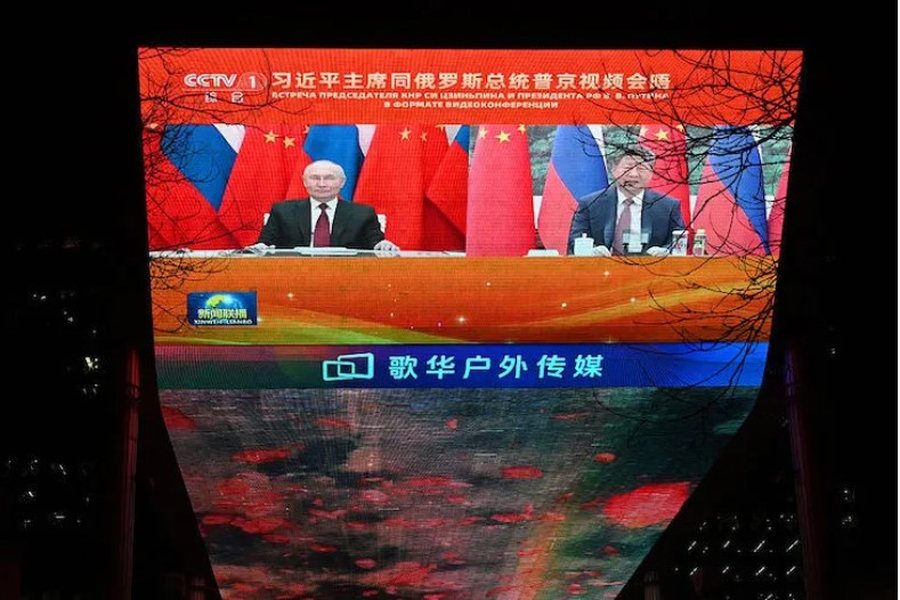
The rapprochement between Moscow and Beijing is deepening, but concerns are growing within the Russian elite about an increasingly unbalanced dependence on China...
The closeness between Xi Jinping and Vladimir Putin was reaffirmed this week. In a video call on Wednesday, the Russian president declared that “for Russian-Chinese relations, one can say that every season is spring,” while his Chinese counterpart called Putin an “old and dear friend” and stressed the need for a “master plan” to further deepen ties. However, the reality is less harmonious than the rhetoric.
Russia's need to sell energy, to secure industrial machinery and dual-use equipment, not weapons but useful for war, such as trucks or medical supplies, has made Moscow increasingly dependent on its former "little brother."
Last week, the secretary of Russia’s Security Council, Sergei Shoigu, visited China, where he and the Chinese foreign minister, according to official statements, “synchronized their watches” ahead of talks between the two leaders. Although Shoigu’s role is powerful but vaguely defined, a member of his team admits that he is concerned about the growing inequality of the relationship: Shoigu, he says, “does not want to go down in history as the man who sold Russia to Beijing.”
There is reason for this concern. While Putin repeatedly emphasizes rapprochement with China, the concrete indicators are less convincing. Polls show that Russians consider China the country with which they have the friendliest relations, but a clear majority still would not want Chinese neighbors or in-laws.
Putin has said that 56,000 Chinese students study at Russian universities, but this figure is far lower than the more than 140,000 Chinese students in the United Kingdom. Also, although street signs in central Moscow are being equipped with Chinese translations, there are complaints that the influx of tourists benefits Chinese travel agencies more than local businesses, as the latter face pressure to cut prices.
This situation reflects the relationship as a whole. Bilateral trade has stabilized at around £150 billion a year, and the massive influx of Chinese goods into Russia has not always been a pure benefit. While the West offers Ukraine loans and aid, China demands payment and exploits Russia’s difficulties to negotiate favorable terms. Russian gas, for example, is sold to China at almost cost. Western sanctions only worsen this situation. Even the planned 15 percent increase in the capacity of the Power of Siberia pipeline does not compensate for the losses from the European market.
Meanwhile, China is replacing Russia in regions where Moscow once had dominant influence. Central Asia, which Russia saw as its zone of hegemony through its role as security guarantor and main economic partner, is increasingly leaning towards Beijing. The nuclear sector is also no longer secure for Russia. Rosatom has contracts to build plants in Kazakhstan and Uzbekistan, but China National Nuclear Corporation is being offered as a cheaper and faster alternative. According to sources, Rosatom quietly complains that Chinese companies are willing to cut profits and pay higher bribes to win contracts.
This has created a generational divide within the Russian elite. Putin values the fact that he is perceived as Xi Jinping’s closest ally, which gives him international weight and contradicts the Western narrative of Russia’s “isolation.” Above all, he needs China as long as the war in Ukraine, which he considers politically and historically existential, continues. If winning requires making concessions to Beijing, he is willing to accept them.
The next generation of politicians, however, fear that when they come to power they will be running a country dependent on China. They do not openly challenge this line, but they try to signal their concerns to the Kremlin. The Federal Security Service reports an increase in Chinese espionage in Russia since 2022. The Union of Industrialists has identified cases of dumping by Chinese companies. Even Sergei Chemezov, one of Putin’s closest friends and head of the military conglomerate Rostec, has called for protective measures for the domestic car industry. The Ministry of Economic Development has quietly approved plans to increase domestic processing of rare earth minerals to reduce dependence on China. Meanwhile, the Ministry of Defense, while using Chinese equipment and conducting joint exercises, continues to update its contingency plans every year in the event of an aggression by Beijing.
As one ministerial adviser puts it: “It’s a kind of survival instinct. We do what we can, given that we can’t change the way the Kremlin sees this relationship.”
Putin's top foreign policy adviser, Yuri Ushakov, described the 85-minute conversation between the two leaders as "direct, confidential, warm and friendly." But for many members of the Russian elite, that description is not necessarily reassuring. /Adapted from The Spectator /



Lini një Përgjigje