


 Shkruar nga Pamfleti
The Thwaites Glacier in Antarctica, often known as the "Doomsday Glacier", is melting faster than previously predicted, according to a new study by scientists at the University of Edinburgh.
According to researchers, the glacier could lose up to 200 gigatons of ice per year by 2067, a higher rate than the current loss of about 150 gigatons per year that has been recorded over the past two decades.
This accelerated ice loss could add about 0.5 millimeters per year to global sea level rise, a contribution that could exceed the impact of all the world's mountain glaciers.
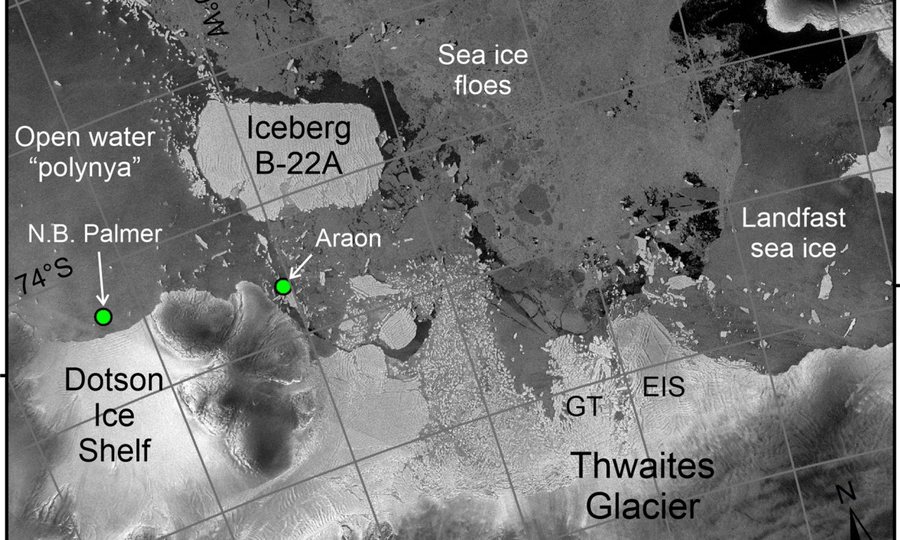
The Thwaites Glacier is a giant mass of ice, roughly the size of the United Kingdom, and contains enough freshwater to raise sea levels by around 65 centimetres if it were to melt completely.
The researchers emphasize that a complete collapse is not expected in the near future, but the study's lead author, Dr. Daniel Goldberg, warns that the glacier is on a trajectory that could lead to major destabilization in the future.
Thwaites functions as an “ice river,” transporting ice and snow from a large part of the West Antarctic Ice Sheet into the Amundsen Sea. For this reason, its stability is critical to the entire ice system in the region.
Satellite data shows that as the glacier thins, its flow to the sea accelerates, making it one of the fastest-changing glaciers in Antarctica. Studies show that it is now losing ice five times faster than in the 1990s.
The study, published in the scientific journal Geophysical Research Letters, used an ice sheet model calibrated with satellite data to simulate the future development of the glacier.
The results showed that the fastest melting occurs in deep cavities in Antarctica's bedrock, which extend up to 100 kilometers, allowing warm ocean water to penetrate under the ice more easily.
While global warming caused by human activity is warming the Amundsen Sea and accelerating ice melt, researchers suggest that the geology of the terrain beneath the glacier may also play an important role in this process.
Based on current emission projections, researchers estimate that a major glacier collapse could occur within about 200 years.
However, the glacier reacted late to climate change and is currently responding to changes that began in the 1980s, which means that even measures to reduce emissions may only have an effect in the very long term.
Scientists point out that reducing greenhouse gas emissions could significantly delay the collapse process, postponing it for centuries.








Lini një Përgjigje