


 Shkruar nga Christopher Lamb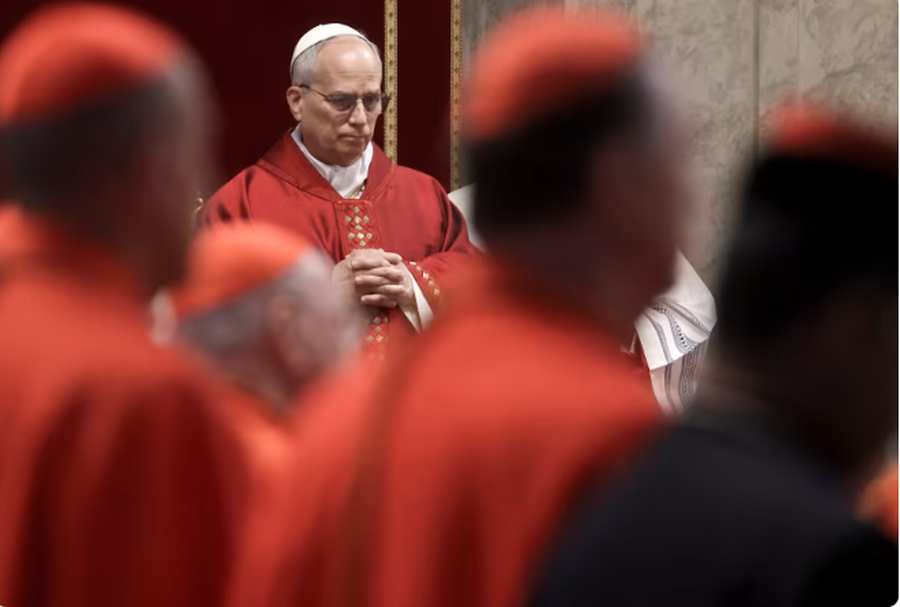
First American Pope Calls for Peace and Negotiations, Rejecting the Use of Religion to Justify Conflicts
On Tuesday evening, in Castel Gandolfo, Pope Leo XIV answered a question about the possible escalation of the war in the Middle East. He was asked if he had a message for President Donald Trump and other leaders of the United States and Israel.
His response was clear. The first American pope spoke in English and expressed hope that Trump would find a “way out” to end the war with Iran. He called for an end to violence and the start of negotiations.
It is rare for popes to mention world leaders by name, and this is one of the first times Leo has publicly mentioned Trump. It shows how heavy the weight of the war is on him, as well as his intention to be heard directly in the White House.
This stance highlights the contrast between two major American figures on the global stage: on the one hand, Pope Leo, born in Chicago and with a quiet and reserved profile; on the other, President Trump, a figure constantly present on the media agenda and in global politics.
A strong voice for ending wars
Although not a confrontational pope, Leo is increasingly speaking out against the US-Israeli war with Iran. This comes as US Secretary of Defense Pete Hegseth presents the war as backed by God, using biblical references.
Pope Leo opposes this approach. On Palm Sunday, he declared that “Jesus is the King of Peace, who rejects war and cannot be used by anyone to justify it. He does not hear the prayers of those who wage war, but rejects them.” He added, quoting Holy Scripture, that those who wage war have their hands “filled with blood.”
Italian theologian Marcello Neri, in an analysis for the Appia Institute, emphasizes that the first American Pope clearly rejects the logic of justified violence in the name of God.
Despite his soft-spoken profile, Pope Leo shows strong resolve. He has called for an “Easter truce” and is increasingly emerging as a leading voice for ending the conflicts. On Good Friday, he held separate phone calls with the presidents of Israel and Ukraine to promote peace.
Cardinal Robert McElroy, the archbishop of Washington, told CNN that the global devastation brought about by this war shows the mistakes that led to the attack on Iran and that for believers of the “Prince of Peace” there is only one duty: an immediate end to the conflict. He added that the pope warns against the idea that God is automatically on our side, even when the war is morally unjustifiable.
McElroy, an expert on American foreign policy, believes that the war in Iran does not meet the criteria of Catholic doctrine for a “just war.” Timothy Broglio, archbishop for military services in the US, also expressed a similar position, emphasizing that the threat from Iran has not yet been realized and the response is preventive.
Pope Leo's first Holy Week and Easter after his election take place in a context of war. He is adjusting to a new role that has thrust him into the global spotlight, even though it was previously not expected that an American would be elected pope.
The 2025 conclave, following the death of Pope Francis, elected Cardinal Robert Prevost as his successor. His experience of over two decades in Peru made him a figure with an international profile, not closely associated with the United States.
His election recalls that of Pope John Paul II in 1978, the first non-Italian in 450 years and a key figure during the Cold War. Some analysts see similarities between John Paul II's opposition to the Iraq war in 2003 and Leo's current stance on Iran.
Analyst and author Sohrab Ahmari, in a statement to CNN, notes that the Pope's warnings are being ignored, while some Catholic Trump supporters try to downplay or contradict them. He described the war as "clearly unjust."
At 70, Pope Leo has time on his side, and his pontificate is expected to outlast the current U.S. administration. As the first anniversary of his election approaches, he is consolidating himself as a quiet but determined voice in a turbulent world. /Adapted from CNN/


Lini një Përgjigje