


 Shkruar nga Auron Tare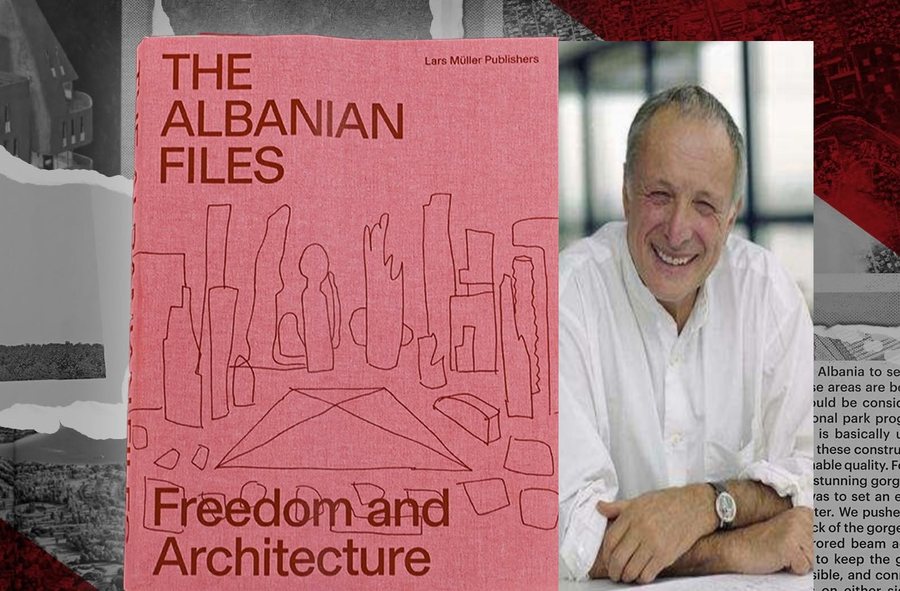
The Albanian File is not simply the story of an architectural project. It is the anatomy of a mindset. A mindset that is not content to change the landscape inherited from history, but aims to impose its own stamp on history...
"Never let architects lead your dreams. They always seek their own eternity."
These were the words of a quiet man who, that May morning, strolling through the enchanting forest of Butrint, was amazed by the nature of the ancient city. The person who was looking at the cyclopean walls with curiosity was a British architect. He had come to Butrint with a mutual friend and, after visiting the entire city, we went to the great plain of Vrina to see the traces of the aqueduct built in the time of Emperor Augustus.
As soon as I told him that Butrint had a Roman aqueduct, he was eager to see it, often speaking of Augustus’ great zeal for monumental construction, as an expression of the dominance of his will over imperial spaces. As we followed the 3km footprints across the vast Vrina plain, the conversation about architecture and its impact on the landscape was an extraordinary lecture for me.
The architect who was marveling at the landscapes of Butrint was called Richard Rogers, a name that meant nothing to me at the time. After a long day of walking, we returned to Corfu, where over dinner in a former quarry converted into one of the most beautiful water spaces in the Mediterranean, I listened to one of the most interesting lectures on architecture and its impact on the landscape.
It was a debate between some architects, who, as I understood, had been friends since their early youth and had worked together for a long time on various projects around the world. Somewhere they had parted ways, as their perspectives no longer matched, but they had remained good friends. Later, much later, I learned that I had been lucky enough to participate in a clash of “titans” that took place at that table on the edge of the former medieval quarry.
In addition to the person who had wandered with me in the fields of Vrina in the footsteps of the Roman aqueduct, there was also an architect named Norman Foster that night. At the stone table, among the topics that revolved around many modern or ancient works, Butrint occupied the primary place.
“You see,” Richard Rogers addressed me for a moment, smiling, “remember what I told you this morning, don't let architects guide your dreams. We seek immortality in what we create.”
I was reminded of all of this when I reread not only the Dutch architect's letter on his proposal for the Albanian royal crown, but also the pages of that book that has now taken on the value of a testimony.
The words of one of the most prominent masters of 20th-century architecture, Richard Rogers, still ring in my memory. Autocracies are not content to rule over people; they seek to enslave both the landscape and historical memory. Every despot cherishes the illusion that his power will outlast time and that his name will remain engraved on the cities he builds or the landscapes he destroys.
Therefore, The Albanian File is not simply the narrative of an architectural project. It is the anatomy of a mindset. A mindset that is not content to change the landscape inherited from history, but aims to impose its own stamp on history. It is not enough to touch monuments, but seeks to possess the memory they carry. It is not enough to build on the land, but wants to build on the conscience of a nation.
And when power begins to believe that history is the raw material of its ambition, then architecture ceases to be art and becomes a tool of political vanity.
***
Richard George Rogers, Baron Rogers of Riverside CH FRIBA FCSD FREng RA (23 July 1933 – 18 December 2021) was an Italian-born British architect noted for his modernist and functionalist designs in high-tech architecture. He was a Senior Partner at Rogers Stirk Harbor + Partners, previously known as the Richard Rogers Partnership, until June 2020.
Rogers was perhaps best known for his work on the Pompidou Center in Paris, the Lloyd's building and Millennium Dome, both in London, the Senedd building, in Cardiff, and the European Court of Human Rights building, in Strasbourg. He was awarded the RIBA Gold Medal, the Thomas Jefferson Medal, the RIBA Stirling Prize, the Minerva Medal, and the Pritzker Prize.





Lini një Përgjigje