


 Shkruar nga Gjergj Zefi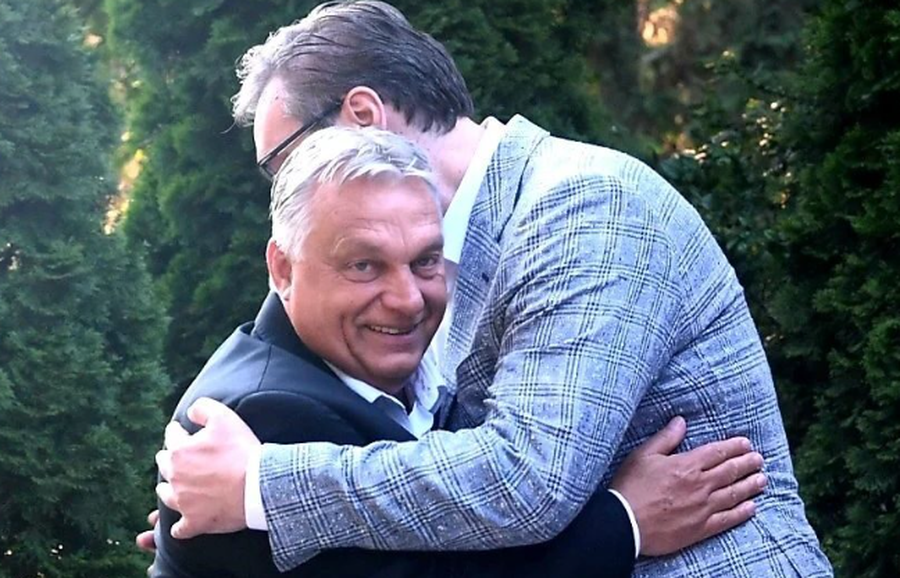
In the shadow of a memorial ceremony, Hungary and Serbia quietly sign a new political alliance in the Balkans, while Albanians remain silent...
Viktor Orbán's surprise visit to Subotica, under the official pretext of receiving a memorial award, is a weighty political act that goes beyond local ceremonial.
On the stage of an ethnically mixed city, where the Hungarian community still retains political and symbolic weight, Orbán came not only to honor the late Ištvan Pastor, but to send a geopolitical message that also affects Albanian interests in the region.
Orbán and Vučić appear as two leaders who are crafting a regional alliance based on controlled nationalism, selective integrations, and a "filtered" Europe, where loyalty to Brussels is always relative.
Serbia needs an internal European shield, Hungary needs a loyal ally to the south that helps it expand its influence. Both sides use the minority issue to build bridges of influence; Vučić with Serbs abroad, Orbán with Hungarians in Vojvodina, Slovakia, Romania and beyond.
This “friendship award” is in fact a silent trophy for the Orbánist doctrine: a Balkans that supports controlled autocracies, where local players see democracy as a means, not an end. Orbán knows the terrain he finds himself in well, a shaky periphery of the EU, where such awards and ceremonies translate into symbolic power. In this sense, Subotica was not a random stopover. It was a signal point.
For Albanians in the region, this development should be read carefully. It is not a Serbo-Hungarian issue, but part of a new map of influence, where alliances are built on historical, ethnic and energy grounds, not always in line with Western interests and true European integration. A Hungary that increases its influence in Serbia is also a more divided EU for the Balkans. A Serbia that embraces Orbán is a more unpredictable neighbor.
For Albanians in the Presevo Valley, Kosovo, and North Macedonia, this Serbian-Hungarian rapprochement should raise diplomatic alarms. Alliances that officially promote “interethnic coexistence” are in reality platforms for controlling minorities for domestic political purposes.
Just as Orbán uses diaspora Hungarians to consolidate power in Budapest, Vučić has built a parallel institutional network with Serbs in northern Kosovo and parts of North Macedonia. Therefore, any such act, no matter how ceremonial it may seem, is part of a slow strategy to establish control over the region through “smart friendships”. The silence of Tirana and the lack of reaction from Pristina and Skopje makes this even more worrying. In a Balkans where influences are being redistributed, whoever remains silent loses. / Pamphlet






Si te ushqehesh me ushqim serbi cfare mund te presesh.