


 Shkruar nga Gjergj Zefi
The seizure of the Iranian ship and the language of revenge are pushing the crisis beyond the diplomatic threshold, putting the talks and the fragile ceasefire itself at risk...
What is happening is no longer a crisis that can be described in the usual language of diplomacy, because diplomacy itself is being used as a facade, while on the ground the brutal logic of imposition is at work.
On one side, readiness for talks is declared, on the other, force is used in one of the most sensitive spots on the globe. This is the paradox that makes the moment so dangerous: the parties talk about reducing tensions, but act as if they are preparing for the next round of confrontation.
The seizure of the Iranian ship in Hormuz is not just a naval episode, nor a technical incident, nor a routine act of pressure. It is a signal stripped of all diplomatic embellishments that the crisis is entering a phase where each side is testing not only the nerves of the other, but also the real limits of international restraint. And when this happens just hours before attempts to keep talks alive, then we no longer have serious diplomacy, but diplomacy under the threat of a gun.
The essence of the clash is this: Washington seeks to maintain strategic control and present the operation as an application of force and discipline in a vital corridor, while Tehran reads the same action as humiliation, provocation, and violation of the very minimum framework that was supposed to keep the ceasefire alive. This division is not just propagandistic; it is a dangerous political division, because each side has already constructed its own version of reality and now demands that that version be accepted at the table.
In this climate, negotiation does not come as a means of compromise, but as an extension of the battle by other means. Iran has signaled that it has no plans to sit down for a new round of talks after the seizure of the ship, while the American camp has talked about sending a team to Islamabad, precisely when the act that poisons the very premise of dialogue has been produced on the ground. Such a conversation, even if held formally, will arrive 'dead' in Pakistan, because the minimal trust has been hit where it hurts the most: in the coherence between 'what is said and what is done'.
This is where the real slide into the spiral of violence begins. Crises do not always erupt with a grand, declared decision; they often slide through acts that each side considers limited, justified, or necessary. A ship seizure, a threat of retaliation, a delegation announced for talks, a refusal to participate, a ceasefire that continues to exist only on paper. This creates a climate in which no one declares the end of diplomacy, but everyone behaves as if it has ceased to function. This is the most dangerous phase, because each side continues to maintain the public alibi of peace, while practically building the conditions for another clash. At this point, no one wants to appear weak, no one agrees to retreat without cost, and no one enters into talks in a spirit of compromise. What remains is only the need to maintain prestige, to show determination, and not to appear timid in front of domestic opinion. This is where diplomacy loses its weight, and its place is taken by strategic pride, which in the Middle East has often been the shortest path to disaster.
The fact that the Iranian president has spoken about the importance of the diplomatic path, but at the same time stressed that distrust of the US remains necessary, summarizes the current situation better than any other statement: no one has officially closed the door to negotiations, but everyone is putting their hands closer to the handles of weapons. This is not a fragile peace; it is a temporary suspension of a conflict that continues to breathe. And when the dimension of Hormuz is added to this landscape, the weight of the crisis becomes much greater than the US-Iran relationship itself. Hormuz is not a peripheral strait. It is a global strategic artery, an energy hub and a point where any military movement crosses the borders of the region. This explains why the incident has shaken not only political calculations, but also markets, energy and international expectations for minimal stability. A ship stopped in that space never remains just a ship; it becomes a symbol of strength, a test of will and a test of nerves in a scene where a miscalculation can explode with disproportionate speed.
In this prism, today's talks are not only at risk because they could be canceled. They are at risk because they could take place in an environment where their meaning is consumed before they even begin. The table is useful only when the parties believe that through it they can avoid a clash. But when one party enters the table having demonstrated strength and the other enters, if it enters, with the feeling of having been publicly challenged, then the conversation loses its de-escalation function and becomes a new stage for the continuation of the duel. This is why the situation of April 20, 2026 is much more serious than it seems on the surface. We are not facing a classic diplomatic dispute, but a clash where the instruments of peace are being used while the ground is being prepared for revenge. And this is the most dangerous possible recipe: talks without trust, a ceasefire without calm, statements without coherence, and a region where every move is interpreted as a precursor to the next blow.
The conclusion is grim, but clear. It is not just the ceasefire that is faltering; the very idea that this crisis can still be kept under control with the classic mechanisms of diplomacy is faltering. When force enters the scene on the eve of talks, speech loses authority. When each side sees the other as unreliable, negotiations become theater. When Hormuz turns into an arena of demonstrations, the region enters the red zone. This is the real picture: not an isolated incident, but a crisis that is sliding, step by step, into a spiral where any justification for “limited action” can produce unlimited consequences. Today, it is not only the talks that are at risk. Today, the idea that they can still serve to stop the slide is at risk. And this is alarming, because when diplomacy is late, history usually speaks the language of force./ Pamphlet


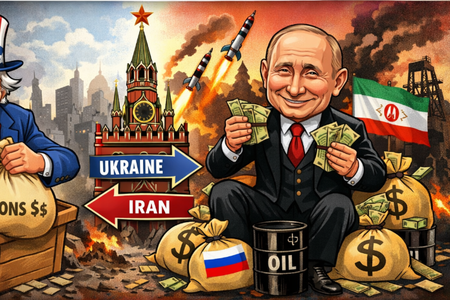
Thjesht fare, mbajne embargon e nxjerrin te dy palet parate e luftes e njekohesisht ujku ne Iran e cakalli ne Ukraine bejne qejf ne mish njeriu. Por me te fituarit jane ata qe kane Bankat. Fashizmi universal po sundon boten.
Don Trapi ka arrite ne piken “E VDEKJES”,(ne terminollogjine mekanike),pra alla shqiptarce :”I KANE SHKU PORDHET NE PLANC”. Asnjehere nuk ka qene I besueshem,por keto dy muajt e fundit ka arrite REKORDIN NE M A S H T R I M. Iranianet,te mire a te keqinj,e njohen PERFUNDIMISHT se kush asht ne te vertete KOMANDANTI I USHTRISE te USA-ve. Ne ditet e para ushtria e tij vrau “pa dashje “ 165 njeres,ku 154 ishin femijet shkolle,vajza. A mund te quhet USA SHTET TERRROST? Ne se do t’a bente IRANI!?….E po asht shtet terrorist.