


 Shkruar nga Pamfleti
Fear of silent rebellion in the Socialist Party...
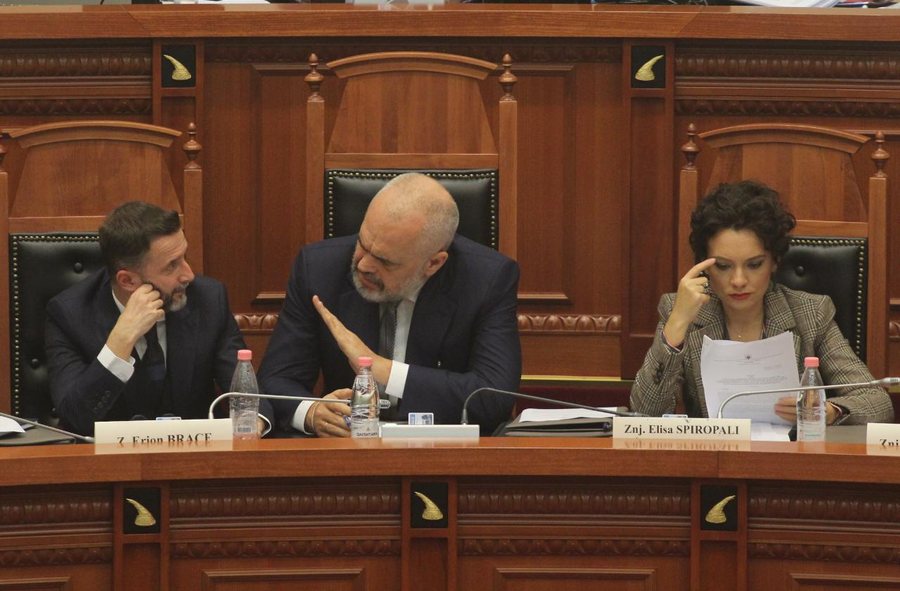
The clash with Erion Braçe does not endanger the majority's numbers, but the prime minister's reaction reveals another concern: the deputies who remain silent in meetings and speak at the tables...
The verbal clash between Edi Rama and Erion Braçe at last Friday's meeting of the Socialist Party parliamentary group constitutes a refrain that has been repeated in several meetings of the majority.
Braçe has been openly critical of some of the Prime Minister's positions and decisions. The media has covered some of these clashes, while the socialist MP himself has publicly explained his objections.
However, the tense relationship with the veteran MP, who has also announced his candidacy for mayor of Tirana, does not seem to constitute a political problem for Edi Rama in itself.
Brace often criticizes and disagrees with some decisions of Rama and his government, but he does not represent an actor who could jeopardize the majority numbers in the Assembly.
He has voted against some laws and, in other cases, has chosen not to participate in the vote. However, Erion Braçe does not lead a group within the majority and has not positioned himself at the head of any faction that aims to overthrow the government. In the votes that the party dome has considered part of its political line, Braçe has generally remained loyal. He has repeatedly presented this stance as part of his political philosophy.
Brace retains influence within the Socialist Party and enjoys popularity among a section of the majority's supporters. Despite this, he has not attempted to build or lead a faction that could threaten Rama's power.
But at last week's parliamentary group meeting, the prime minister used a phrase that openly expressed his concern about a possible rebellion within the party.
Taking cue from Erion Braçe's criticism, Edi Rama asked MPs to say the same things in the party that they say at the tables.
This statement shifts the focus from Braçe to the MPs who are not speaking out. Rama is not only worried about the critic who clashes with him publicly. He is more worried about those who remain silent in meetings, but express their dissatisfaction outside the official party structures.
Critical groups and internal rivalries are not a new development in the Socialist Party. The majority has consistently had actors and groups that have opposed senior leaders or clashed for positions and influence.
So far, this situation has served Edi Rama well. He has used resentments and rivalries to maintain control through the logic of “divide and rule.” This time, however, the majority leader no longer seems to control the situation with the same certainty. The silence that has taken over the broad socialist group may seem much more threatening to him than the noisy clashes of the past.
Rama managed previous conflicts by using privileges and punishment as appropriate. In this way, he managed the ambitions and demands of different political groups. The Prime Minister knew these interests in detail through the demands that were presented to him, but also through the information he provided for internal meetings and conferences.
Any critical movement was carried out openly and was usually directed against figures below Edi Rama in the power hierarchy. Critical factors within the majority had neither the necessary support nor the opportunity to maneuver at the highest levels.
Today, the situation is different. The effort to remove Edi Rama has taken on institutional dimensions in several political centers at home and abroad. This panorama includes important European countries, such as Germany, but also influential circles within the European left.
If these factors supported or encouraged an internal movement, even a small group within the majority could multiply its political weight.
In this new balance of power, Edi Rama controls a large parliamentary group, but his position appears more fragile than before. A vote leak or a breakdown of discipline within the group, in an unstable political environment, would weaken the prime minister's authority and encourage further centrifugal movements within the majority.
Under these conditions, Rama seems to have lost some of his actual control over domestic developments, even though he has increased pressure on MPs. The weakening of power feeds long-term leaders' fear of political betrayal. This fear can push a leader to make hasty decisions, which then produce chain reactions and deepen the crisis.
For this reason, Edi Rama uses controlled clashes as a means to provoke and identify signals of rebellion within the party. The clash with Erion Braça serves as a test for the hall, not just as a response to a critical MP.
But this time, Rama failed to discover what he was looking for. Intuition may signal to him that discontent is spreading, but the prime minister fails to fully identify it, measure it, or connect it to concrete names and groups.
This is the political picture of loss of control. The leader perceives the danger, but cannot locate it. He hears the voices across the tables, but does not hear them in the party meetings. And when the silence of subordinates scares the government more than public opposition, leadership has entered the most dangerous phase of its weakening./ Pamphlet





D.m.th Brace ka rene dakort me pare me Ramen qe sebashku " te bejne sherr". Po, keto mund ti beje Brace! Ama vetem kaq! Keta jane deputetet tane, qe u ka zene bytha myk nga kartigja ne parlament.