


 Shkruar nga Pamfleti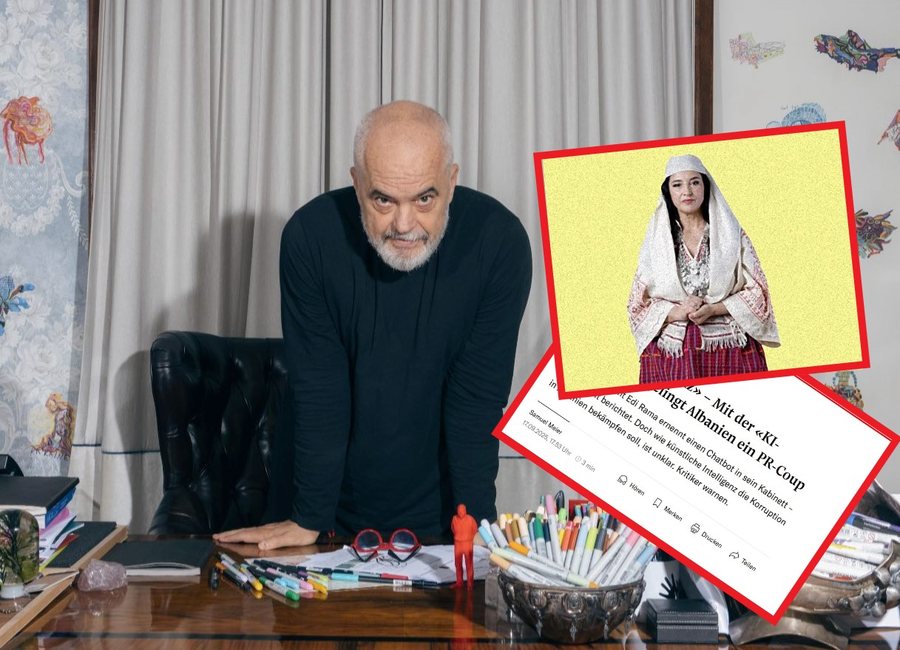
From painted palaces to the 'robot minister': Rama, a master of showmanship and not of reform
The prestigious Swiss media outlet “ Neue Zürcher Zeitung ” (NZZ) has dedicated a long article to the introduction of Albania’s “first female Minister of Artificial Intelligence,” Diella, seeing it as another example of Edi Rama’s politics of spectacle. Instead of seeing this initiative as a technological revolution, the NZZ sees it as another performance by the Albanian prime minister, who knows how to attract global attention with symbolic gestures, but without changing the country’s structural problems.
The newspaper emphasizes that Albania remains one of the most corrupt countries in Europe and that public procurement, where “Diella” is supposed to be used to bring transparency, is precisely the area most susceptible to abuse. According to NZZ, Rama has not provided any technical details about how the algorithm works, what data it is trained on or who will monitor it, raising serious doubts about the effectiveness of this project.
Experts cited in the article warn that the lack of transparency could make it even more difficult for civil society and independent institutions to control public procurement. Instead of bringing about an “anti-corruption revolution,” “Diella” risks becoming a digital facade to cover up the same old logic of power.
NZZ places this episode in the continuity of Rama's image politics: from painting palaces in Tirana in colors during his time as mayor, to the recent spectacles with the banning of TikTok or kneeling before Giorgia Meloni. According to the Swiss newspaper, all these grand gestures have changed very little the reality of Albanians, while they have served Rama to consolidate power and attract international attention.
In the end, NZZ gives Rama a hard slap: after all the propaganda about "digital ministers" and "total transparency", in reality only great shadows of doubt are seen about the way the government uses technology to control, not to open up the system.
The article of the "Neue Zürcher Zeitung"
At first glance, the traditional attire alone suggests that Diella is no ordinary minister. Prime Minister Edi Rama introduced her on Facebook as the “Minister of Artificial Intelligence,” one of 17 members of his cabinet. Her name, which means “Sun” in Albanian, was chosen to symbolize the light that this technology would bring to one of the darkest sectors of the Albanian state: public procurement. Rama promised that thanks to her, the awarding of public contracts would become “100% uncorrupted.”
According to Rama, Diella was “promoted” to the government because of her “hard work” as a chatbot on the E-Albania platform, where she has been helping citizens navigate online forms for official documents since the beginning of the year. As minister, Rama says, she will guarantee “speed, quality and full transparency.” Her presentation immediately became global news, from the BBC and NBC to Al Jazeera and other media outlets, which raised the question of whether the day will come when artificial intelligence will govern people. Rama, a master of symbols and political spectacle, celebrated on Facebook by saying: “Diella conquered the world press.”
This is not the first time Rama has used strong visual and symbolic gestures to attract attention. Since his time as mayor of Tirana, he transformed the city by painting the drab buildings in bright colors, a facade that gave the city a modern image but did not change the structural problems. Even later, Rama has made sensational moves: the proposal for an almost cashless Albania, the ban on TikTok for a year, or the gesture of kneeling before the Italian Prime Minister Meloni.
In this context, Diella is seen as a new part of the politics of spectacle. But the reality is more complicated. Albania, according to Transparency International, remains one of the most corrupt countries in Europe, with public procurement among the most problematic points. The law on “strategic investments” allows the government to transfer public lands to selected investors, often connected to power. There is widespread criticism that this mechanism serves political clienteles more than the public interest.
In this context, using artificial intelligence to fight corruption would be a major step forward, if it actually works. But so far, nothing is known about Diella's algorithm. Neither the government nor Microsoft, which helped develop it, have revealed how the technology works, what data it was trained on, or who monitors it. Civil society experts in Tirana warn that if transparency is lacking, the risk is that the system will be used to further hide tendering processes, rather than making them open.
In practice, Diella has so far only been seen as a chatbot in E-Albania, a service that is not at all revolutionary and has been used for years by private companies. Real oversight of public procurement would require much more sophisticated systems with constant monitoring. Moreover, Diella is subordinate to the AKSHI, an agency that reports directly to the prime minister and has often been criticized for a lack of transparency.
So, after all the media spectacle, the essential question remains: who controls the artificial intelligence that will control billions of euros from the state budget? For the moment, not much is visible from the promised transparency. Diella looks more like another “political show” by Rama than a new guarantee for a corruption-free Albania. / Adapted from “Pamphlet”





Lini një Përgjigje