


 Shkruar nga Pamfleti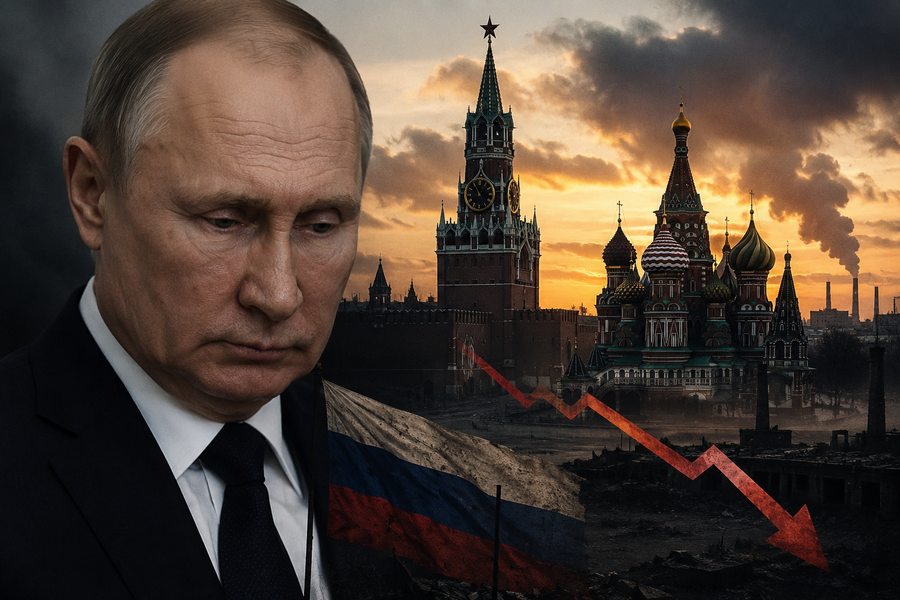
The war in Ukraine is consuming not only the military front, but also Russia itself, calling into question its status as a great power...
At Moscow's Kazansky railway station, in a July that usually marks the start of holidays to the Black Sea, the southbound train lines are almost empty. That's how a correspondent for The Economist magazine describes the situation, according to which the scene has changed radically from previous years.
No more families with suitcases traveling to Crimea. Instead, there are military uniforms and an air of anxiety that, according to the British magazine, reflects the way the war has begun to directly affect the daily lives of Russians.
The Economist correspondents, spread from Rostov to Nizhny Novgorod, describe a war-weary country. There are reports of two- to three-hour queues at petrol stations due to supply restrictions, internet outages, rising prices for basic goods - potatoes alone have risen by 4.5% in a month - and farmers are worried they may not be able to harvest their wheat due to a fuel shortage.
A survey by the Fund for Public Opinion (FOM), a Kremlin-affiliated think tank, shows that 55% of Russians perceive a general climate of anxiety among family members and colleagues, compared to 40% a year ago. According to the analysis, the unwritten contract on which Vladimir Putin built his power, citizens staying out of politics and the state not interfering in their lives, is starting to falter.
Is Russia losing its great power status?
Walter Russell Mead, an analyst for The Wall Street Journal, raises a question that, according to him, is increasingly being avoided in Moscow: is Russia losing the great power status it had regained after the Cold War?
In his analysis, Mead argues that the most visible symbol of this decline is the Black Sea. For more than two centuries, Russia has considered this region a pillar of its strategic influence. However, Ukrainian missile and drone attacks forced the Russian fleet to leave its base in Sevastopol.
According to Mead, a power that no longer controls the Black Sea is losing one of the main pillars of its historical and geopolitical narrative.
Allies are distancing themselves
The analysis highlights that the pressure is not limited to the military field. Journalist Edward Lucas, writing for EUobserver, argues that Russia is also facing increasing diplomatic and economic isolation.
Even China, often described by Moscow as a "borderless" partner, has refused to supply the Russians with important marine propulsion systems for the northern Arctic route.
Another blow is related to the giant Power of Siberia 2 gas pipeline project, with a capacity of 50 billion cubic meters of gas per year. According to Lucas, the project has stalled because Beijing wants to buy Russian gas at a price much lower than the one proposed by the Kremlin.
Meanwhile, due to damage to refineries from Ukrainian attacks, Russia has been forced to import refined petroleum products from China.
Other countries in the former Soviet space are also pursuing a more independent course. Kazakhstan has restricted imports of Russian grain, Azerbaijan has publicly expressed support for Ukraine's territorial integrity, while Armenia is restoring rail links with Turkey and Azerbaijan, bypassing traditional Russian influence.
The new front: the war for information
According to a report by The New York Times, Ukraine is increasingly investing in what it calls "cognitive warfare," shifting the battle from the military front to the realm of information and psychological influence.
Maria Berlinska, an activist and one of the figures who promoted the use of drones in the Ukrainian army since 2014, has founded the Victory Neurones organization, focused on strategic communication, cyber warfare, and psychological operations.
According to her, although drones have given Ukraine a significant advantage on the battlefield, in the event of a general Russian mobilization this would not be enough. For this reason, Kiev aims to weaken Russia's ability to sustain a long war through information warfare as well.
Ukrainian Defense Minister Mykhailo Fedorov has stated that Ukraine is catching up with Russia in the field of electronic warfare and drone technology, while acknowledging that Moscow still remains one of the greatest powers in influence and propaganda operations.
A change that could transform global balances
According to the analysis published by Il Giornale, the combination of Russia's internal consumption, gradual diplomatic isolation and new challenges in the information field supports the thesis that Moscow is entering a long-term phase of weakening.
The author emphasizes that the Kremlin continues to possess a nuclear arsenal and significant military and cyber capabilities, so it is still too early to talk about a final decline of Russia.
However, if this process continues, the analysis concludes, the question will no longer be whether Russia will win or lose the war in Ukraine, but what role it will have in the new international order: a regional power, a secondary partner of China or a state increasingly dependent on Beijing. /Adapted from " Corriere Della Sera"


Lini një Përgjigje