


 Shkruar nga Emilija Rozgic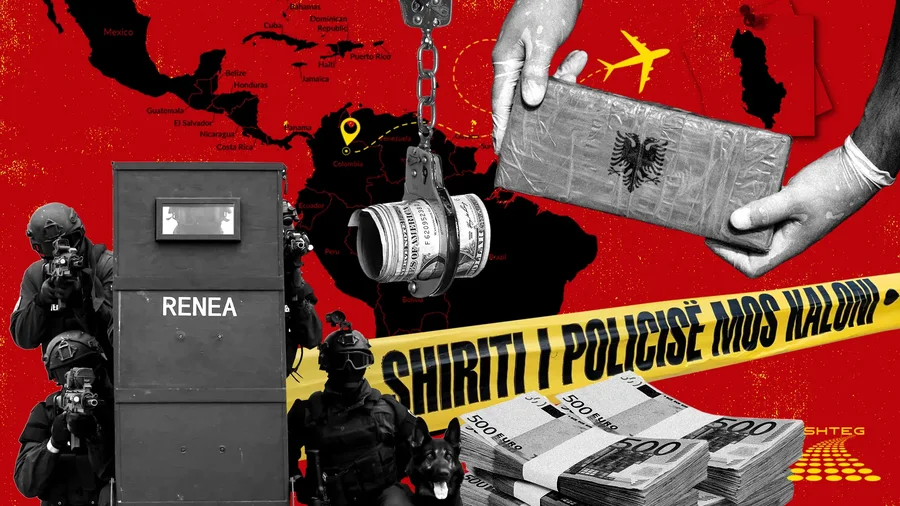
According to Frontex, the region will remain a major transit area for cocaine from Latin America, heroin from Afghanistan via Central Asia, and cannabis, while several Western Balkan countries remain among the main producers of cannabis in Europe.
Criminal organizations from the Western Balkans have established a direct operational presence in drug-producing countries, significantly increasing the quantities of cocaine, heroin and cannabis arriving in the European Union, the European Border and Coast Guard Agency Frontex reported in its annual risk assessment for 2026/27.
The analysis published on the Frontex website states that organized crime groups in the Western Balkans have expanded their influence and operational capacity in recent years by eliminating intermediaries and establishing a direct presence in drug-producing countries, thus significantly increasing the quantities of narcotics destined for Europe.
The region will remain a major transit area for cocaine from Latin America, heroin from Afghanistan via Central Asia, and cannabis, while several Western Balkan countries remain among the main producers of cannabis in Europe.
Criminal organizations are also abusing legal medical cannabis cultivation networks to supply illegal markets in the European Union, Frontex warns.
It also adds that organised crime networks active in the Western Balkans, the Western Mediterranean and along the Union's eastern borders are expanding their reach and improving their operational methods, posing a growing risk to border management staff and the integrity of the EU's external borders.
These networks, according to Frontex, are increasingly linked to migrant smuggling activities, further fuelling violence and developing tactics to evade controls. The analysis also highlights a growing illicit trade in modified firearms, particularly blank-firing weapons converted to live ammunition, often imported from Turkey and the Western Balkans, which are increasingly ending up in the hands of migrant smuggling networks.
“For this reason, these weapons are increasingly being used against migrants, rival criminal groups and law enforcement,” the report states. The growing use of firearms by migrant smuggling networks is cited as a key operational security challenge in the region.
"Incidents in which armed smugglers attack migrants, rival criminal organizations and law enforcement agencies have become more frequent and this trend is expected to continue."
Therefore, strengthening border security, improving inter-institutional coordination and developing rapid response capabilities are key priorities in border management,” Frontex states.
The Western Balkans route remains a key transit corridor
Migration movements in the Western Balkans are expected to continue to mirror developments along the Eastern Mediterranean route. “Some groups of foreign nationals will continue to abuse the visa-free regime to enter the Western Balkan countries, including citizens of Turkey, China and Russia, as well as Jordanian passport holders of Palestinian origin, driven by deteriorating conditions in their countries of origin or seeking economic opportunities.
The overall migratory pressure will be mitigated by police operations, seasonal factors and the deterrent effect of violence and kidnappings carried out by smuggling networks,' the analysis further states.
The Western Balkans route remains a key transit corridor through which migrants from Greece, as well as those arriving in the region by air, continue their journey towards Croatia, Slovenia and northern Italy.
Frontex concludes that over the next 12 months, the EU's south-eastern border region will be characterised by a complex and volatile security environment, marked by armed conflict, regional instability, the consolidation of new migratory corridors, the increase in cross-border crime and the activity of armed migrant smuggling networks in the Western Balkans, posing a medium-high risk for the European Integrated Border Management (EIBM).
The most important short-term factor that will affect the migration and security situation in the region is the war between the United States and Israel against Iran. This opens up a wide range of possible scenarios over the forecast period: from the survival of the current Iranian regime with a tense status quo, which is considered the most likely scenario in the short to medium term with a low to moderate impact on migration, to the collapse of the state or the outbreak of civil war.
The consequences of a possible state collapse or civil war remain uncertain in the short to medium term, but they would bring the risk of mass population displacement with extremely serious consequences for the external borders of the European Union, concludes the Frontex analysis./ Adapted from "Pamphlet", by "Serbian Monitor"







Lini një Përgjigje