


 Shkruar nga Pamfleti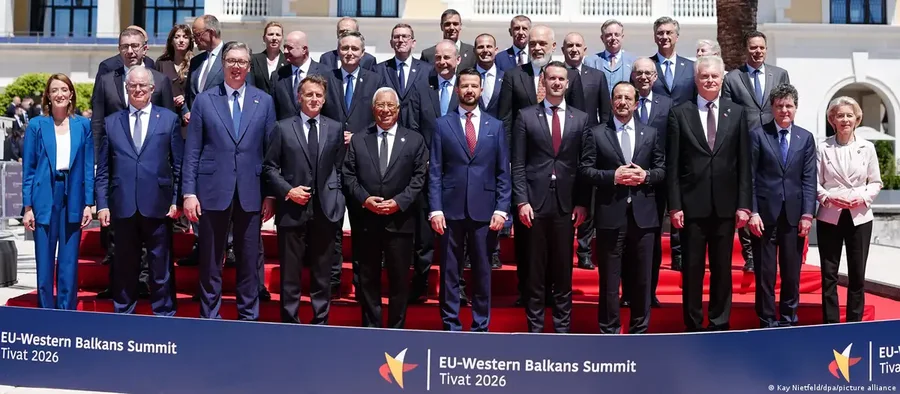
Germany and France are offering candidate countries from the Western Balkans access to the European single market if they meet the required conditions. However, this initiative also has its problematic side…
On the eve of the EU-Western Balkans Summit, held in early June in Tivat, Montenegro, Germany and France presented an informal document that could bring movement to the enlargement process, which has remained largely blocked for years. The document has been read with attention in the capitals of the region and is expected to spark serious debate in the coming weeks.
The German-French document, entitled “New impetus for enlargement”, is based on a proposal by Albanian Prime Minister Edi Rama and Serbian President Aleksandar Vučić from February this year. In a joint article for the Frankfurter Allgemeine Zeitung (FAZ) newspaper, the two politicians described “the accelerated integration of prepared candidate countries into the common market and the Schengen area” as a “strategic opportunity” for the EU.
They praised the European Union's enlargement policy, emphasizing that "no other political instrument has transformed Europe in a more profound and peaceful way."
Incentive for faster progress towards EU membership?
To counter the doubts often expressed in the Western Balkans that the offer of access to the common market could be used as a substitute for full EU membership, the document promoted by Berlin and Paris clearly emphasizes that the objective of full membership remains unchanged: “our aim is neither to replace full EU membership nor to extend the path towards it. On the contrary, we want to create incentives that promote faster progress on this path.”
Like the leadership of Montenegro, Ukrainian President Volodymyr Zelensky demands nothing less than his country's full membership in the EU, although Ukraine, not least because of the war, is still much further from meeting the criteria than Montenegro.
It is noteworthy that the German document mentions the Western Balkans and the Republic of Moldova, but not Ukraine. This raises the question of whether the offer of integration into the European single market is not also intended for Kiev.
Western Balkans threatened by new divisions
This is one of the concerns arising from the German-French document.
While Serbia, Albania and Montenegro have started membership negotiations, this does not apply to North Macedonia, Bosnia and Herzegovina and Kosovo.
North Macedonia has been blocked for years by Bulgaria on the argument, which many consider unfounded, that Skopje is not implementing a “compromise proposal.” In Bosnia and Herzegovina, internal disputes hinder progress. Meanwhile, Kosovo is not recognized as a state by five European Union member states.
In this context, the German-French proposal could increase the risk of internal disunity in the Western Balkans. In the worst-case scenario, new conflicts could even arise.
Paradoxically, this risk would be greater precisely if Albania, Montenegro, and Serbia were to take the initiative seriously and seize the opportunities it offers.
If these three countries were to implement substantial reforms within the framework of accession negotiations to achieve the intermediate objective of entering the common market, the completion of this process could be possible within just a few years.
But in such a case, new and strong dividing lines would be created in the Balkans: a group of three states within the common market and three others outside it.
Specifically, this would mean that Serbia's current borders with North Macedonia, Bosnia and Herzegovina, and Kosovo, as well as the borders between Albania and North Macedonia, Albania and Kosovo, and Albania and Montenegro, would be turned into "hard" borders, with strict controls.
Bosnian Serbs traveling to Serbia or citizens of Kosovo traveling to Albania would feel this change directly.
The borders over which the region has fought in many conflicts over the past decades would once again become more visible and potentially more conflictual. Furthermore, the progress of regional economic integration among the Balkan countries would be jeopardized.
Common market without membership negotiations?
Ideas on how to avoid this scenario are already being heard unofficially from several countries in the region.
One of them is that three countries that, for various reasons, have not yet started membership negotiations, be given the opportunity to fulfill the conditions for entry into the European common market.
If these countries manage to implement the necessary reforms and the European Commission certifies their success, then they too should have the opportunity to become part of the common market, even without the formal opening of EU membership negotiations.
Conversely, a success of the German-French proposal itself could bring new risks to stability and peace in the region.
However, it is still not certain whether the German-French idea will manage to impose itself at the European level and whether any affected government will publicly make its own request that this opportunity be offered to the six Western Balkan countries. / Pamphlet adapted from FAZ/


Tallin trapin keta me ballkanin! Nuk e duan dhe pik. Pasi jane kombe te perziera ne nivel fetar. Nuk e kuptoj cfare eshte kjo dashuri per BE, saqe falim cdo gje, vetem te futemi ne BE! Idealizma koti! Po u futem ne BE, do jetojme si Hollanda, Gjermania etj. Nje mut. Keta do jemi nuk do ndryshojme! Ah po, e vetmja gje eshte. qe do zbrazet Shqiperia akoma me shume. Kjo eshte e vertete. Fuck Europe!
Keta muterit e Europes qe i kane grate me nga dy tre dashnore, e kane kunj qe nuk e moren Ballkanin pas renies se ottomaneve. Sidomos me ne Shqiptaret kokekrisur kur pasi shporrem ottomanet nga Greqia e morem pamvaresine vajtem ne ndohme te Mustafa Qemalit e i zbythem me Galipol. Churchilli ka thene, ne Galipol nuk luftuar me luftetare por me Zotat e Luftes per Shqiptaret. Diplomacia eshte vertet kurve por nuk ta le tryezen bosh. e Ne nuk e njohim fare. Nuk ditem t'ibajme trojet e nuk dijme akoma.