


 Shkruar nga Pamfleti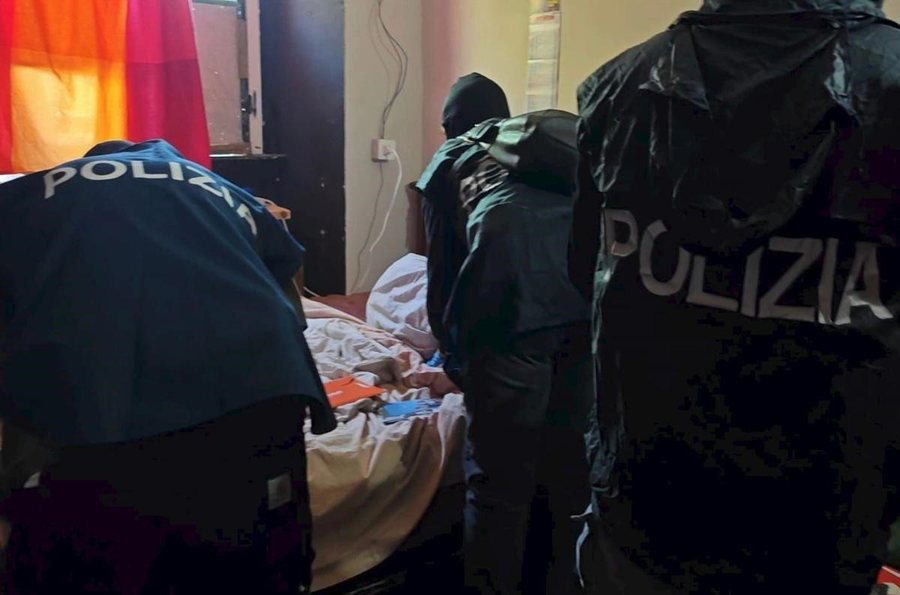
At the center of the investigation is the sabotage of the Rome-Florence high-speed rail line, carried out on February 14, 2026.
A large-scale anti-terrorism operation conducted by Italian authorities has led to the destruction of a terrorist cell and the arrest of seven people, who are accused of organizing a criminal group against the democratic order.
The operation was carried out by the DIGOS Special Operations Unit of Rome, in collaboration with the Central Directorate of the Prevention Police and under the coordination of the Rome Prosecutor's Office. According to investigators, the group operated according to the traditional structures of the Italian anarchist movement and had created an organized network based in the capital, but with branches and collaborators in several other cities of the country, including Bologna, Milan, Naples and Forlì-Cezena.
The investigation focuses on the sabotage of the Rome-Florence high-speed rail line, carried out on February 14, 2026. According to the authorities, two of those arrested are suspected of being the direct perpetrators of the attack, which used homemade explosive devices, but with a high destructive effect. The attack caused significant damage to the railway infrastructure, with a repair cost of 455 thousand euros.
Investigators say the Rome-Florence line sabotage was not an isolated incident. A similar attack was also carried out on the Rome-Naples line, and both attacks were claimed via a website specifically created to publish the group's statements. The statements published online mentioned the actions' connection to the Milan-Cortina Winter Olympics and opposed what the group described as the militarization of territory and infrastructure.
According to investigative documents, the organization aimed to strike objects and structures considered strategic for the Italian state, with the aim of creating insecurity and exerting pressure on institutions. The evidence collected by DIGOS has led to the seven suspects being charged with conspiracy with terrorist purposes or the overthrow of the democratic order.
A key element of the investigation is related to the figure of Alfredo Cospito, the well-known Italian anarchist held under the high-security regime 41-bis. According to the authorities, support for Cospito was one of the main motives for the group's activity.
In one of the wiretaps included in the 94-page investigative file, one of the suspects states that “something must be done to force the state to face the fact that keeping an anarchist under the 41-bis regime is a real nuisance.” In another wiretapped conversation, members of the group speak of the need to continue “direct action” and conflict as the only way to achieve political results.
According to investigators, these statements prove the existence of a well-organized strategy that aimed not only at ideological propaganda, but also at carrying out concrete violent actions against the state and public infrastructure.
During the operation, checks and raids were carried out in several regions of Italy with the support of the DIGOS units of Milan, Bologna, Naples, Turin, Terni and Rieti. Among the facilities searched was the anarchist center "Bencivenga Occupato" in Rome, considered by investigators as one of the reference points for the group's activities.
Italian authorities emphasize that the investigation has revealed the existence of extensive links between radical anarchist circles in Italy and their contacts abroad. For this reason, the operation was carried out in close coordination with the National Anti-Mafia and Anti-Terrorism Directorate.
After the operation, the Italian Interior Minister, Matteo Piantedosi, also reacted, congratulating the law enforcement and justice bodies for what he described as an important blow against domestic terrorism.
"Even today, I applaud the women and men of the State Police and all the investigators who, through a complex and highly qualified activity, have destroyed a subversive network of anarchist origin that operated throughout the national territory and had targeted the country's strategic infrastructure, including the high-speed train network," declared Piantedosi.
The minister added that investigations show that the extremist mobilization developed in recent years around the Alfredo Cospito case has continued to fuel forms of radicalization and violent actions against democratic institutions.
According to him, the operation confirms the high capacity of Italian security structures to prevent and counter terrorist threats, as well as the authorities' continued attention to extremist circles that aim to destabilize public order and democratic institutions in the country.







Lini një Përgjigje