


 Shkruar nga Pamfleti
Iran has cited battles from history in response to US President Donald Trump's recent comments on a looming deal between the two countries.
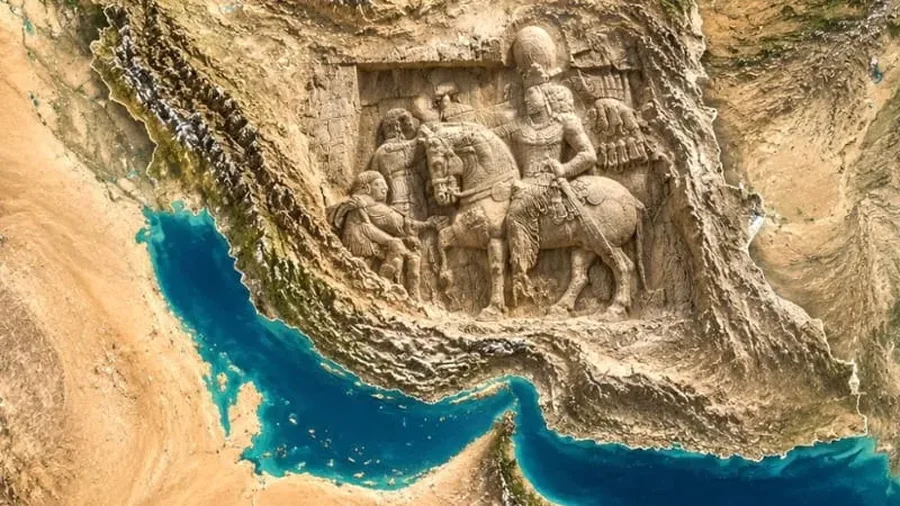
Iran and the United States have intensified political and symbolic messages regarding the history and geography of the Middle East, while the announcement of a possible agreement to end the conflict between the two countries is expected.
Iranian officials have brought back important historical episodes to reinforce the narrative of a "David versus Goliath" confrontation, where Iran is presented as the weaker side, but manages to resist and triumph.
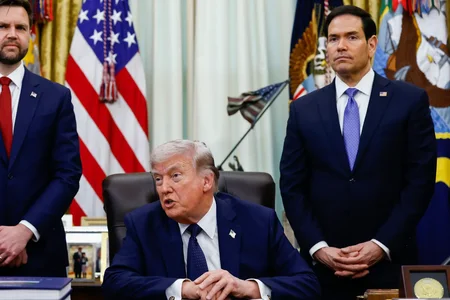
This comes after US President Donald Trump declared that a deal with Iran was “largely negotiated,” while Tehran also signaled that an agreement could be reached soon. Both sides are trying to present any agreement as the result of strength rather than compromise.
Historical references and nationalist messages
Iran's Foreign Ministry spokesperson Esmaeil Baghaei has invoked ancient Persia's victory in the face of a failed invasion by the Roman Empire.
— Al Jazeera English (@AJEnglish) May 24, 2026
The post suggests the US has been forced to make concessions in a deal to end its war on Iran on Tehran's terms. pic.twitter.com/kuMLfmMStk
Iranian Foreign Ministry spokesman Esmaeil Baghaei compared the current situation to the Roman Empire's march against Persia in the third century, noting that the invaders were ultimately forced to "accept the conditions" of the Persians.
Baghaei also published an illustration of the Roman emperor Valerian after his capture by the Persian king Shapur I in 260. This image has been frequently used by Iranian authorities in recent months to stir up nationalist sentiments and convey the idea that Iran is once again facing a foreign power.
At the same time, Iran commemorated another key historical moment, the eight-year war with Iraq from 1980 to 1988.
The Islamic Republic annually marks the recapture of the city of Khorramshahr in 1982, a city in the western province of Khuzestan, with an Arabic-speaking majority.
The Battle of Khorramshahr is considered a turning point in the Iran-Iraq War and one of the bloodiest clashes of the conflict, where hundreds of thousands of people on both sides lost their lives.
Iranian authorities are using this symbolism even in the current context of tensions with the US and Israel, presenting it as evidence of resistance and protection of national sovereignty.
The commander of the Islamic Revolutionary Guard Corps (IRGC), Ahmad Vahidi, declared that "the liberation of Khorramshahr is a permanent model for future victories," also mentioning Jerusalem and what he called "the destruction of the Zionist regime."
Iranian President Masoud Pezeshkian linked the historical symbolism to current developments in the Persian Gulf.
“Today’s Khorramshahr of Iran is the Persian Gulf and the Strait of Hormuz,” he wrote on the X network. “Resistance, sacrifice, and confronting aggression are part of the culture of this country.”
Messages of strength and negotiation
Mohammad Mokhber, an advisor to Supreme Leader Ali Khamenei, stated that both former Iraqi President Saddam Hussein and Donald Trump did not fully appreciate Iran's power when they began confrontations with Tehran.
“The first ended up in the trenches of Khorramshahr, while the second is embroiled in a political crisis created by the Zionist regime,” he wrote in X.
Kazem Gharibabadi, part of the Iranian negotiating team and deputy foreign minister for international affairs, said that any state facing aggression has the legitimate right to defend its territory and integrity.
According to him, Tehran is pursuing an approach based on "the pursuit of peace accompanied by strength, diplomacy with integrity, and decisive defense."
Vice President Mohammad Reza Aref also stated that the recapture of Khorramshahr in 1982 showed that Iran could face aggression on its own terms.
Symbolic clash with the USA
The political rhetoric intensified after Donald Trump published on the Truth Social platform a map of Iran covered with the American flag, accompanied by the question: "The United States of the Middle East?"
In response, several Iranian embassies published on X a map of the US covered with the Iranian flag and the question: "United States of Iran?"
The Trump administration has emphasized that it demands a long-term suspension of uranium enrichment in Iran and the removal of enriched nuclear materials from Iranian territory.
Washington also demands the full reopening of the Strait of Hormuz, through which about a fifth of global oil supplies pass without tariffs or blockades from Iran.
Meanwhile, Israeli officials have maintained a largely reserved stance toward the possibility of a US-Iran deal, although reports suggest Tel Aviv is pressing for a resumption of military operations./ Al Jazeera


Heee Telaviviii… Rezistence ndaj NAZI-SIONISTEVE PUSHTUES!!! Benjamut Netanazisti ne BURG,megithe Donald Trapbolen.