


 Shkruar nga Pamfleti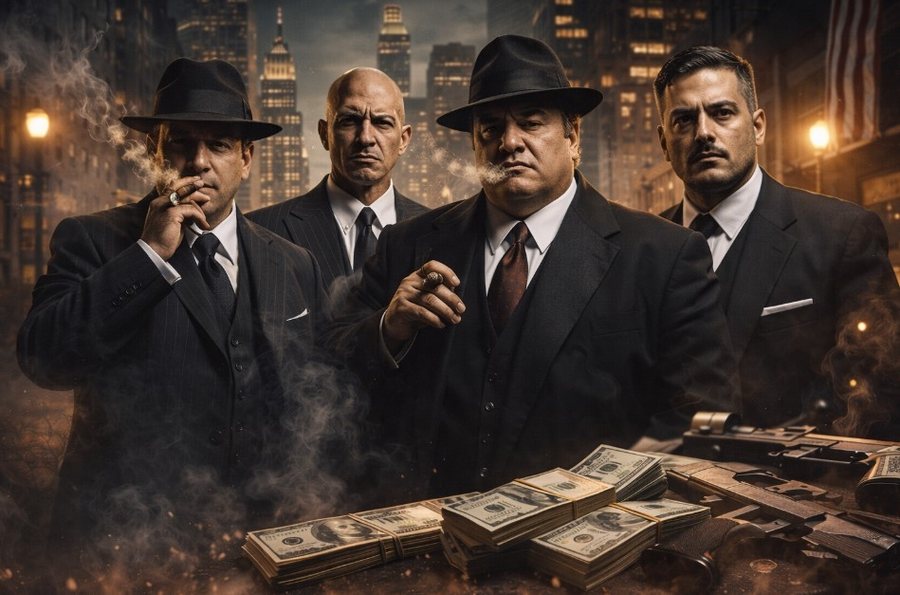
The five mafia families of New York, less visible but stronger than ever
Whenever the Mafia is discussed in New York, the same illusion returns: the idea that it is a museum relic, a yellowed photograph with hats and cigars, good only for movies and anniversaries. In reality, the historic families have not retreated. They have done what any rational organization does when the state increases pressure: they have reduced visibility, reduced noise, transformed violence into an expensive and, therefore, sparingly usable tool.
The problem is not that the mafia no longer exists. The problem is that today it is less convenient for them to be seen.
And when it comes to "family", in New York we are not talking about abstractions. We are talking about the old skeleton of the Commission: Gambino, Genovese, Lucchese, Bonanno and Colombo. Five names that are no longer brands to be displayed on the street, but structures that know how to adapt, integrate into the real economy and survive precisely because they have learned not to repeat the mistakes of the past.
Fraud as a production line
The last signal comes from a seemingly secondary terrain, but which is in fact ideal for understanding criminal evolution: rigged bets and rigged gambling. Here the new rule clearly appears: the mafia no longer aims to rule the neighborhood, but to control the flow. It does not only supervise roads and construction sites; it controls information, access, transactions.
The qualitative difference lies in the method. Gambling in the past required people, physical control and intimidation. Today, operations built on technological tools and fast communications reduce risk and multiply efficiency. It is a mafia that thinks like a small industry: it invests in tools, organizes the value chain, selects a specialized workforce. And above all, it separates the levels: the one who designs is not the one who collects, the one who collects is not the one who stands out.
Criminal rents in a high-friction economy
Rigged gambling is not just a crime, it is a model of rent. It targets a sector where money moves quickly, where traceability is difficult, and where demand never goes away. Add to this the ability to launder money, and you have a perfect circle: profit, reinvestment, cover.
In an urban context where the cost of living pushes many activities towards informality and where legal finance is increasingly regulated, the criminal economy is offered as “parallel credit” and as a service: quick loans, protection, access. The mafia, when it is intelligent, is not enough to steal; it appears as a middleman. And the middleman thrives when society is filled with fears, obstacles and needs.
Less blood, more control
From a security perspective, this is the gist: reducing violence does not show weakness, but discipline. Violence attracts police, courts, prisons, and informants. The memory of the civil wars of the 1980s has taught families that showing force is a dangerous luxury. The modern strategy is the opposite: staying within the real economy without looking like an army.
Moreover, when public priorities change, criminal organizations take advantage of the gaps. Not because the police stop working, but because resources and emergencies are redirected. It's the classic game of adaptation: the state follows emergencies, the mafia takes over.
Local networks learning to move globally
New York remains a global capital and, like any global capital, is a hub of money, people, goods and data. Organized crime does not need to “conquer” the world: it is enough to penetrate its infrastructures. Traditional mafia networks, born on a family and territorial basis, today dialogue with much wider circles: money laundering, fraud, triangulation, disguised investments. Territory remains important, but as a platform, not as a border.
The result is paradoxical: less public visibility, more capacity for influence. The mafia is not a folkloric remnant. It is a form of power that survives because it knows how to adapt to its time. And today's time is not that of guns on the street, but that of technical fraud, of fast-moving money, and of a city where the legal and illegal economies interact every day without making a sound. /Adapted from "Pamphlet" by "Inside Over"





Nuk ka me te forte se shteti.Mafia e ka frike shtetin,tmerrohet,ndaj edhe gjene fo5rma per te ju shmangur dhe per te komprementuar shtetare te dobet,pa moral. Punonjesit e policise edhe udheheqesit ushtarake do ti zgjidhja nga familje te ndershme te pakten tre breza,dhe paga e tyre duhet te jete te pakten tre here me shume se nje nenpunes