


 Shkruar nga Pamfleti
Out-of-pocket payments account for 48.3% of current health spending in Albania, the highest level in the regional table. This means that almost half of health costs are covered directly by citizens, rather than being covered by public schemes, insurance or other protective mechanisms.
Albania remains one of the countries in the region where citizens bear the highest financial burden for healthcare, despite total spending on this sector being close to the South East Europe average. According to the report “South East Europe 2030 Strategy – State of Play in 2025”, the country spends 7.0% of GDP on healthcare, slightly below the regional average of 7.5%, but out-of-pocket payments amount to 48.3% of healthcare spending, the highest level among the economies compared.
In 2023, Albania's current health spending was estimated at 7.0% of Gross Domestic Product, according to the report, which cites WHO figures. This is slightly below the Southeast European average of 7.5%, but above several other economies in the region, such as Moldova at 6.7%, Romania at 5.7% and Turkey at 4.3%.
Compared to neighboring and regional countries, Albania lags behind Bosnia and Herzegovina, where healthcare spending amounts to 8.9% of GDP, Montenegro with 9.7%, Slovenia with 9.3%, Greece with 8.4%, Serbia with 8.0%, Bulgaria with 7.9%, North Macedonia with 7.4% and Croatia with 7.2%. This shows that Albania is not among the countries that spend the least on healthcare, but remains below the regional average and far from the countries with the highest public and total financing of the system.
However, the report emphasizes that the main problem in Southeast Europe is not only the level of spending, but the way this money is translated into accessible, quality and affordable services for citizens. On this point, Albania shows a significant weakness.
Out-of-pocket payments account for 48.3% of current health spending in Albania, the highest level in the regional table. This means that almost half of health costs are covered directly by citizens, rather than being covered by public schemes, insurance or other protective mechanisms.
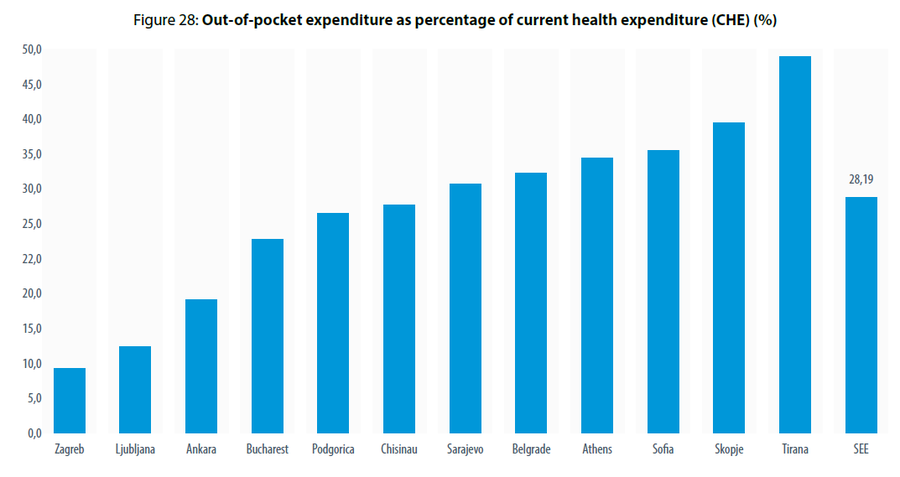
The difference with other countries is large. The average for Southeastern Europe is 28.2%, while in Croatia out-of-pocket payments are only 9.4% and in Slovenia 12.4%. Turkey, with 19.1%, Romania with 23.0%, Montenegro with 26.3% and Moldova with 27.5% are also below the regional average and much lower than Albania.
In the group with the highest burden on families are also North Macedonia with 39.6%, Bulgaria with 35.5%, Greece with 34.3%, Serbia with 32.1% and Bosnia and Herzegovina with 31.0%. But even compared to these countries, Albania has the highest level of direct payments from citizens.
This indicator is important because out-of-pocket payments are not simply a matter of financing. When citizens have to pay directly for visits, tests, medications, or treatments, the risk increases that they will delay healthcare, forgo treatment, or face difficulties in covering other basic needs.
The report also refers to WHO analyses, according to which financial protection in health is strongest in countries where out-of-pocket payments are below 15% of current health expenditures. In this comparison, Albania is far from this threshold, while countries like Croatia and Slovenia are close to the most protective model for families. / ekofin.al







Lini një Përgjigje