


 Shkruar nga Pamfleti
Albania has lost almost a quarter of its population since the early 2000s, marking the strongest contraction among European countries.
According to Eurostat data, on January 1, 2026, Albania had about 2.34 million inhabitants, down from 3.06 million in 2000 (Eurostat reports figures published by INSTAT).
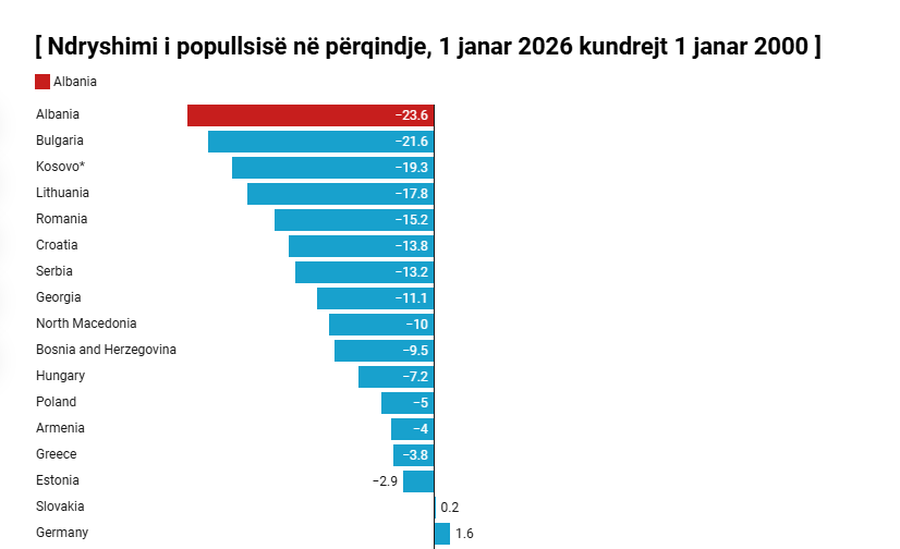
In 25 years, the country's population has decreased by about 721 thousand people, or 23.6%. The data shows that Albania has lost almost one in every four inhabitants it had at the beginning of the millennium.
This decline, according to data compiled by "Monitor", is the highest in Europe. The second country with the highest contraction is Bulgaria, which saw a reduction of 21.6% in the same period.
In third place is Kosovo, for which the shrinkage is calculated from 2003, when the earliest data is reported. Since that period, Kosovo's population has shrunk by 19.3%.
Lithuania also recorded a strong decline, with 17.8%, followed by Romania with 15.2%, Croatia with 13.8%, Serbia with 13.2% and Georgia with 11.1%.
In North Macedonia, the population has decreased by 10%, while in Bosnia and Herzegovina by 9.5%. Hungary has lost 7.2% of its population, Poland 5%, Armenia 4%, Greece 3.8% and Estonia 2.9%.
Data shows that almost the entire Western Balkans has lost population, but Albania remains at the top of the ranking in terms of the pace of contraction.
Serbia has lost about an eighth of its population compared to 2000, Croatia approximately 14%, while Bosnia and Herzegovina and North Macedonia about a tenth.
The only exception in the region is Montenegro, where the population is 3.3% higher than in 2000.
Population decline, due to high emigration and gradual population aging
Albania is facing three demographic shocks simultaneously: high emigration, declining birth rates, and rapid aging.
Emigration is the main factor influencing this trend. The constant departure of young people has reduced not only the number of residents, but also the population base of reproductive age. As a result, the number of births has fallen rapidly, while the ratio between young and old is worsening.
Since the early 1990s, the country has been experiencing successive cycles of emigration, which do not seem to be stopping, despite economic growth and improving incomes. According to the latest INSTAT data on net migration, more than 166.4 thousand Albanians appear to have left the country during the post-pandemic years from January 1, 2021 to 2026.
Shqipëria, që për dekada konsiderohej si një nga vendet me popullsinë më të re në Europë, ka arritur tashmë moshën mediane të Bashkimit Europian. Sipas të dhënave të INSTAT, mosha mediane arriti në 45 vjeç më 1 janar 2026, nga 34.2 vjeç në vitin 2014. Në vetëm 12 vjet, treguesi u rrit me 10.8 vjet, rreth 4.5 herë më shpejt se në BE.
Kjo do të thotë se gjysma e popullsisë shqiptare është tashmë mbi moshën 45 vjeç. Rënia e lindshmërisë dhe emigrimi i moshave të reja po e zhvendosin me shpejtësi strukturën demografike drejt grupmoshave më të mëdha.
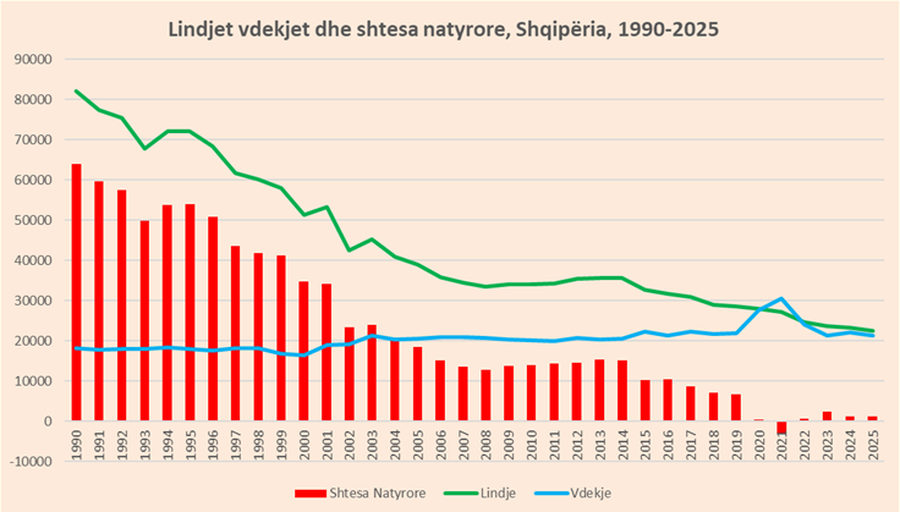
Në vitin 2025, lindjet arritën nivelin më të ulët historik të pas tranzicionit, në 22.5 mijë, nga 82 mijë në vitin 1990, teksa shtesa natyrore po shkon drejt zeros. (shik grafikun e shtesës natyrore)
Pasojat nuk kufizohen vetëm te numri i banorëve. Tkurrja e popullsisë ul bazën e konsumit, ngushton ofertën e fuqisë punëtore dhe shton presionin mbi sistemin e pensioneve dhe shërbimet shëndetësore.
Me më pak të rinj që hyjnë në tregun e punës dhe më shumë të moshuar që dalin në pension, raporti mes kontribuuesve dhe përfituesve përkeqësohet. Në të njëjtën kohë, prej disa vitesh bizneset po përballen gjithnjë e më shumë me mungesë punonjësish, sidomos në sektorët që kërkojnë fuqi punëtore të kualifikuar dhe po tentojnë ti zëvendojnë ato me punonjës të huaj.
Europa rritet, pavarësisht se ka më shumë vdekje se lindje
Ndërsa Shqipëria dhe shumica e vendeve të Europës Lindore po humbin popullsi, Bashkimi Europian vijon ta rrisë numrin e banorëve.
Më 1 janar 2026, popullsia e BE-së arriti në 452 milionë banorë, rreth 706 mijë më shumë se një vit më parë. Ky ishte viti i pestë radhazi me rritje, pas rënies së regjistruar gjatë pandemisë në vitin 2021, raportoi Eurostat.
Në krahasim me vitin 2016, Bashkimi Europian kishte 8 milionë banorë më shumë, ndërsa ndaj vitit 2006 rritja ishte 16 milionë.
Por shtesa e popullsisë nuk po vjen nga lindjet. Që prej vitit 2012, BE-ja ka regjistruar më shumë vdekje se lindje. Bilanci negativ natyror është kompensuar nga emigracioni neto pozitiv.
Kjo do të thotë se pa hyrjen e emigrantëve, popullsia e Bashkimit Europian do të ishte në rënie.
Gjatë vitit 2025, popullsia u rrit në 16 vende të BE-së. Normat më të larta të shtimit u regjistruan në Maltë, me 24.1 persona për 1,000 banorë, Qipro me 13.7 dhe Luksemburg me 13.1. Rëniet më të forta u shënuan në Letoni, Estoni dhe Hungari.
Malta dhe Irlanda, rritja më e fortë që nga viti 2000
Në krahasimin afatgjatë, Malta e ka rritur popullsinë me 51.3% nga viti 2000, norma më e lartë në Europë.
Pas saj renditen Irlanda me 45.9%, Qipro me 44.3% dhe Islanda me 41.3%. Andorra ka shënuar rritje prej 35%, Azerbajxhani 28%, Zvicra 27.4%, Lihtenshtajni 27.1% dhe Norvegjia 25.7%.
Spanja e ka rritur popullsinë me 22.5%, Suedia me 19.7% dhe Mbretëria e Bashkuar me 19.3%. Rritje të konsiderueshme kanë regjistruar edhe Belgjika me 16.8%, Austria me 15.2%, Holanda me 14.3% dhe Franca me 14.2%.
These countries also face low fertility and aging, but have managed to mitigate natural loss by attracting immigrants.
More developed economies offer higher wages, jobs, public services, and institutional stability. This has made them destinations for labor from the Balkans, Eastern Europe, and elsewhere.
Immigration is creating two different demographic realities in Europe. Receiving countries are growing their populations and meeting labor market needs, while countries of origin are losing young people, professionals, and working-age families./ Monitor








Lini një Përgjigje